Recommended Reading: Thich Nhat Hanh, Love Letter to the Earth

TNH LLtoE

The wisdom of compassion allows us to see that we are part of a great cycle, that there is no separation. The earth is us, and we are the earth.

In this book, Love Letter to the Earth, Vietnemese Buddhist monk, Thich Nhat Hanh, talks about the stress we humans are putting upon the planet, and what we can do to live more harmoniously with the rest of the natural world.

I read this with the eyes of a human, the mind of a Zen Buddhist and the heart of a Druid.  In my opinion, this book needs to be on every Pagan’s bookshelf, let alone read by everyone regardless of faith, spiritual path, economic circumstance, political party, etc.

It is animism, and how to live it.

Letting Go

Taking inspiration from nature, many Pagans see this season as a time of letting go. Even as leaves fall from the tree, we let go of things in our lives that no longer nourish us. In the letting go, we allow new manifestations to feed our creativity and inspire us in our journey, even as the fallen leaves feed the soil around the tree.

There are many different kinds of things we let go – ideas, relationships, emotions, material possessions. They key here is that if they are no longer nourishing, then we can softly let them go into the lengthening nights, thinking deeply about our lives and carrying within us new seeds for the coming year. They might be the vegetable garden that didn’t work, the friendship that no longer feels right, grief or anger that we have experienced or even just clutter in our houses.

We can also learn from the letting go – we can try and plant a vegetable garden in a different spot, grow different vegetables. We can focus on the relationships that we have that make our souls sing, and open ourselves to new possibilities. We remember those who have passed away, or who are struggling in the shared human journey. We learn to cherish and make space in our homes and in our lives for things that bring us joy.

The tree does not mourn the falling leaf, nor does the leaf mourn the tree. In the letting go, we simply allow for new manifestations to occur.

Blessings of Samhain.

Yoga, Animism and the Nature of Evil

During yoga last night, halfway through the class and moving to another pose, a loud “wham!” sounded in the room. In the middle of the class, a woman had squashed some spider or insect with her shoe on the wooden floor. “Did you get him?” the yoga teacher asked.

“Yep,” the lady replied, pleased with herself.

My heart fell. I was saddened, not only by the loss of life, but more by the wanton destruction of said life, as if it had no right to existence. For one such as myself, intentional killing of another animal is tantamount to murder, when it is completely unnecessary. The class carried on as if nothing happened.

I’m still thinking about it. I know that I personally could not squash a spider or bug, snail or slug, no matter how yucky they might appear to my preconceived human perception of what is beautiful and what is not. Driven since a very young age, we are told that wasps are evil, spiders are scary and snails are gross and destructive in our gardens. They all deserve to die because of these things. It is utterly absurd.

I have sat down to a meal at a pub, outside in their beer garden, where customers could request a can of insecticide to kill the wasps that came looking for food, tantalised by the sweet smell of beer. Horrified, not only by the wanton killing but by the thought of such chemicals near food, I have not been back since. The way the human mind works both disgusts and challenges me sometimes.

I’m not overly fond of worms or slugs, slimy things or creatures that live in the ocean that I cannot see beneath me when I am swimming. Big spiders are slightly frightening, only because I know that they can bite (I’ve yet to be bitten). That doesn’t mean that I seek to eradicate spiders, or all slimy things from my garden, or cull sharks when I want to swim in their waters. We really have to get over our ideas of what is good, what is beautiful and what has a right to existence, and what doesn’t. Who the hell are we to say?

I’ve been an Animist all my life. I have known on a very deep level that all things have a right to existence. This was not instilled in me by my parents, per se – it just seems an inherent part of my personal nature. I know that all things are connected on both a spiritual level and also on a scientific level. We live in ecosystems, where one part relies on another part to function. We often forget that we are part of such complex systems, or we believe we are above them. I recently wrote to my local newsletter in response to a letter to the editor asking for the eradication of ragweed near his home. He saw the dangers of the toxic plant, however he also failed to recognise the many lives are dependent on this one species of plant. For himself, he saw no benefit in this plant. He saw himself as above and more valuable to the ecosystem in which this plant existed. This is the nature of evil, in my opinion – belief that we are separate and therefore we can do as we please.

Philip Carr-Gomm has recently shared his queries and thoughts on the nature of evil in a recent social media status update. He states:

“Humans can be so unspeakably destructive – either to their fellow humans or the Earth, perhaps the ‘unthinkable’ needs to be thought – that human nature is not naturally beneficent, and evil acts therefore the result of aberration, but that it is in its essence a mixture of beneficent and maleficent, and that only some sort of training, discipline, spiritual practice, psychotherapy or education that can help us ensure our beneficence rules our head, heart and actions, rather than the reverse.

What do you think? Have you sometimes thought ‘perhaps they got it right when they came up with the idea of Original Sin’?”

The idea of Original Sin to me is abhorrent as killing things without thought. It is used to guilt people into behaving in the way that those in power think they should, to keep those in power in the status quo. This is not a criticism of Christianity as a whole, but of those who use it to further their own purposes. There is much within Christianity that is beautiful and inspiring. This abuse of power is not limited to Christianity, but can found in religions and communities all over the world.

I personally do not think that people are born evil. When I look at human beings, I see monkeys with car keys. Sadly, these monkeys have forgotten their roots, forgotten that they are just monkeys, forgotten that they are a part of the world and a part of an intricate web of existence. This is where the nature of evil occurs, the sin that divides and separates. This is where the destruction occurs, because we believe we are separate, that we are in control, that we have power over other beings.

I would argue that nothing in nature is beneficent – everything simply is what it is, neither good nor bad. The sun is not being beneficent in providing us with light and life – it is just being what it is. The clouds are not being beneficent by providing us with rain – they are just being clouds. Beneficent seems to imply a focused and intentional act of giving. While nature has its own consciousness, how intentional is it? This leads us to the ultimate question – what is the meaning of life?

For me, life has no inherent meaning – it just is. Things are alive because the appropriate conditions were available for life to be. This includes humans and all other beings. There is no master plan. It is a wonderful, beautiful, freestyle weaving of a web of life.

We are not born evil, or with evil intent. We are not born good, or with good intent. We are simply born, and the lives that we live, the circumstances of those lives and the environment that we live in all provide us with a path that we take. We have a choice to cut ourselves off from our inherent nature, of living in harmony with the rest of the world. We choose to do this for the most part out of desire for personal gain, whatever the cost to other lives and the planet as a whole. When we believe in the lie that we are separate, we can commit the worst atrocities.

We don’t even need a religion or spirituality, psychotherapy or other means to find some sort of return to harmony. We just need to wake up and shake off the lie, the belief that we are separate. We need to see things how they are, not how we think they should be. We need to see our place in the warp and weft of the tapestry of life. We need to sing in tune with all the other songs of existence. We need to remember what it is to be truly alive.

When we awaken, we also find the proverbial return to the garden. We understand life in all its forms. By living with eyes open, we walk the earth with compassion for all things.

When we return to our place in the web, the end result is deep and lasting peace.

Self-Governance

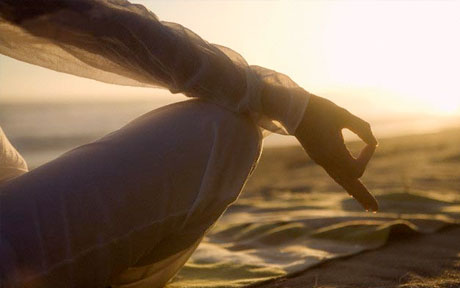
mudraFar too often we allow our emotions to control us, dictating how we react and respond to situations and perhaps not in the best way. Some would argue that our emotions are what gets things done, however, something done with anger, for instance, may not always be the best way forward.

Discipline has become a bad word in our society. What we need to do is to reclaim this word, along with duty (which I will elaborate more on in another blog). We need to sit down with ourselves and take a good, long, hard look at our emotions and the roots of these emotions, finding out why we react to situations the way we do, discover underlying patterns and unravel the threads that are loose, or about to snap, reworking them into something more harmonious.

If we work on a situation based on an emotion of anger, hate or jealousy, then the outcome will most likely not be conducive to creating compassion and harmony with the world. Exploring the roots of these “negative” emotions, we will realise that the underlying thread is one of fear. Anger is another expression of fear. We become angry at our partner for not behaving in a manner that we think he should. In reality, we may be fearful of losing our partner, or of changing feelings for him, of not having enough control in our own lives, etc. Hate is based in fear, as we fear that which is the Other, separate from ourselves, the unknown. Jealousy is based on fear of change, our own insecurities and fears created out of past experiences.

What we need to do it to sit down with our feelings, to better understand them and in doing so, better understand our selves. In creating a safe space to sit with our feelings, we can engage with them openly and honestly. Creating a haven, a sanctuary in which to perform this task, we can explore the deepest corners of our minds. For me, the goddess Nemetona helps in this exercise.

She is a goddess of sanctuary and sacred space. She is present in my home and in my heart. Human beings have such a craving for safety and security, and within this goddess we can find that wherever we are. Not only does it help with emotional discipline and self-governance, but the two are intricately woven together, with self-governance creating that safety. Let me explain.

If we are ruled by the tides of our emotions, we will never settle, never find a place that we can call a sanctuary. We are subject to the peaks and valleys of an emotional long hard slog, and never really find a good breathing space in which to find some respite. If we do not have that sanctuary, we have no place to breathe and to truly connect with our emotions. And so an endless cycle of repetition is created.

Finding time every day to simply sit and breathe is a great way to begin. In a safe, comfortable place, whether indoors or out, we focus on our breath, in and out, breathing in the air that our ancestors breathed, that all living things breathe. We breathe out into the world, exhaling even as the trees exhale in the deepening twilight. Sharing this beautiful moment, this sacred breath, we come to an awareness of ourselves, of our self and how we currently feel in the world at this particular moment. We can call upon Nemetona to hold this space while we simply sit and breathe, honouring Her for all that She is with a return to the stillness at our core.

It’s not easy, taking the time to simply breathe, to meditate on our breath. Our minds will try every trick in the book to distract us from this present moment and this one little act. It is with discipline that we return to our breath again and again, each time we find ourselves wandering off mentally, or shifting our bums restlessly. You have to really want to find stillness – it doesn’t just happen. You have to be disciplined enough to achieve it. It won’t simply suddenly appear out of nowhere, nor can it be spoon-fed. Discipline will not allow any passivity. We must take full responsibility for our selves and for our world.

After breathing, we can take some time looking at our feelings and emotions without attaching to them. Again, we can ask Nemetona to help us, to hold the space and to guide us to explore our feelings without getting too involved, wrapped up once again the in the emotion. She won’t do it for us, however. We can look at our fear, at our anger, our impatience, our joy and our happiness. We can find the roots of these if we don’t let them take control over our minds, and therefore live in better awareness.

For not only do we have to be careful of the negative emotions ruling our behaviour, but we must also become aware of the more pleasant emotions. Far too often we experience a beautiful emotion, and crave that emotion for the rest of our lives. We will never be able to recreate that experience, for it has happened and exists only in the past. All we have is this present moment, which is always changing, moving forwards. If we try to regain the feeling of joy that we had on our wedding day every time we look at our loved one, we disregard other emotions and feelings that will eventually come and bite us on our backside. We may not notice the present moment. Focusing only on positive emotions doesn’t work – we are human and we have negative emotions too. Those who deny them, who suppress them, will face some pretty hard demons at some point in their life.

So we sit, and we meditate day after day, breathing and coming to an awareness of the present moment. We are able to take the time to look at our feelings and get to know them better, thereby allowing ourselves the opportunity to break from negative patterns of behaviour into more purposefully led lives. Discipline and self-governance are not things to be afraid of, nor are they something to shun as not in keeping with our freedom of expression. We are better able to express ourselves when we are not ruled by our emotions, allowing us to see what lies at the root of our souls, and thereby what lies in others’ souls as well.

This is the heart of compassion. When we understand ourselves we can better understand others, and see their fears, their patterns being created. We can work with them to help create new patterns, or we can simply walk away with respect and not have their patterns reflected in our own. We can only help those who want to be helped, and this includes our own self.

So please do take the time to sit, every day, and be in the present moment. Become aware of your breathing. Call upon Nemetona or any other god to help you find that peace, that space to explore your feelings, should you so desire. Look at your feelings and better understand them for what they are. In doing so, you will no longer be ruled by them, but instead be able to respond in the world with an awareness and mindfulness that can only create harmony. We come to understand each other in a very deep and meaningful way when we take what we learn of ourselves and relate that to others. In this, we can see that we are all related.

We are not restricting ourselves with self-governance, but allowing ourselves to open to the world with the eyes of compassion and hearts that are true.


For more about the goddess, Nemetona, please see my book, Dancing With Nemetona: A Druid’s Exploration of Sanctuary and Sacred Space

Solitude and Serenity

I spent a wonderful couple of days by myself, “glamping” in a yurt for my 40th birthday. It was heaven.

I love spending time by myself. I always have. Don’t get me wrong, I love my friends and family, but I am entirely comfortable in my own company for long periods of time. Growing up as a teenager, I didn’t have any close friends nearby – my boyfriend was about 20 miles away, and so I only saw him about every other weekend when not at school. My other school friends were over 60 miles away. After school and weekends then were spent by myself, alone in the woods or wandering the village, immersed in the songs of the place.

Turning 40 gave me the perfect excuse to hole up away from everybody for a couple of days. It was time to be entirely selfish – time to spend solely on me, on thinking about my past, present and future. Looking over the last 40 years, and thinking about where I am now, I am very hopeful and content about the future, whatever it will bring. Looking at myself from a different viewpoint as well helped to confirm my sense of self; I thought about how my family see me, my friends, my colleagues, my peers, my cats, etc. Fully grounding in my sense of self, of knowing who I was, I was then able to let that go.

Sitting vigil at night in front of the campfire, with the stars shining brightly overhead and the fire burning merrily, I was able to let go of the past, be in the present and not worry about the future. I knew who I was, and I was able to let that go as well, to simply be in the moment with the darkness, the owls, the crickets and the night air. It was wholly freeing.

We do not spend enough time alone, in my opinion. Four days without phones, television, radio or internet was lush, with time spreading out before me in a lazy spiral. I ate when hungry and slept when tired, not matter what the time of day was. I was able to allow my thoughts to slowly dissipate in the wind, and I found myself becoming more and more a part of the landscape. I no longer thought about Facebook or the emails that awaited me. I was free.

Of course now I am back, and there are business emails to deal with, blogs to be written and thoughts to be shared with friends and family. But these moments of stillness, when utterly alone I was able to let go into the world has carried with me to an even greater extent than I thought possible.

The thought of going on social media gave me a slightly sinking feeling. I had emails and deadlines to meet. I did not want the television on. But I share my life with others, with my husband and my friends, and I cannot retreat entirely from the world. What I can do, however, is to re-prioritise how my time is spent, both with others and by myself.

The monastic life is all about retreating from the world in order to better engage with it. Time spent alone is finding solace for the soul, slowing down thoughts and finding out what really matters. Put away your phone. Get off the computer. Turn off the television and the radio and simply sit, wherever you are. Be in that space. Let that space get to know you. Go outside, alone, for hours at a time and feel yourself slowing down, thoughts receding until you are simply in the present moment, awake and aware to the world around you.

It was the greatest gift I could ever have received on my birthday.

10 more things you probably didn’t know about the Zen Druidry Lady

  1. I have blurry vision – I cannot see vertical lines very well. If I know you, and walk past you at an event or gathering, I’m not snubbing you – I can’t see you! (I forget my glasses all the time…)
  2. I went back to university in my early 30’s to get my degree.
  3. I have an innate good sense of direction.
  4. I have an overactive inner barometer – I am very susceptible to air pressure changes and often get headaches from a vast change in the weather.
  5. Since 1998, in the UK, I have lived in Cambridge, Norwich, Loddon, Northampton, Mumbles, Ipswich and now a rural village on the Suffolk Coast.
  6. I have sacrificed three rings to the North River in Quebec in my lifetime.
  7. Teaching runs in my family – my mother and aunt were teachers, and my brother and sister are also teachers.
  8. The taste of brussel sprouts makes me gag.
  9. I have been in love with David Bowie for 27 years and counting.
  10. Autumn is my favourite season.

Thich Nhat Hanh on No Self

Meditating upon this for a couple of years now, I was absolutely delighted to come across this little question and answer session with Thay back in 2010.  His thoughts on ancestors, on no self and awareness were exactly the same as my own, and resonate deeply within my soul.

Whoever I am.

Midsummer

Ah – midsummer. I remember when I first moved to these isles over 16 years ago from Canada – it was a cold and wet summer, and I wondered just what on earth I had done. And yet, the light fascinated me at that time of year, and later at the winter solstice, the darkness. It was so much more than where I grew up – the twilight of midsummer and the barest space of total darkness, the unrelenting darkness that forces you to face it head on in winter. The difference in latitude was a great teacher – (Montreal, 45.5N, London 51.5N).

 
The current is running strong in the British Isles right now. As I go to my outdoor altar every evening, laying my hands upon the soft, mossy earth I feel the white dragon that has risen to the surface and is dancing in the ethereal currents of energy crisscrossing the land. It is a time of great joy, of celebration.

 
This is a time of year to be proud of what you have done so far in the year’s cycle. But beware – the carpet can be pulled from underneath you, and the harvest may not quite be as expected. For this brief moment, however, we can perform this wonderful balancing act, in a liminal time before the tide tips over and we tumble headlong with it. It is important to be proud of what you have achieved – it is too easily done to become prideful.

 
Stand and feel the earth beneath your feet. Feel the serpent energy rising, the dragons of these lands, filling your soul with this time of year. Reflect on your achievements, and state them aloud under the eye of the sun. Confirm for yourself the good that you have done for the world, for your family, your community, for yourself. Let the sun’s rays witness this confirmation.

 
On Saturday I will be reflecting on the good investment of my solar panels – this time of year it is especially rewarding to know that the longer daylight hours are helping others in the village, ie. local businesses. I will take a bow for the two books published (and doing well), and the third and fourth on their way. I will applaud the money that has been raised for various charities through a lot of hard work in fundraising, events and suchlike over the course of the year. For this brief moment, I will take pleasure in my achievements, and remind myself that this is why I do the work I do, and live the life that I live. I will remember this moment in the darker times, to guide me through them and out the other side.

 
And then I will immerse myself once again, into the landscape, losing that sense of self and becoming a part of it, letting it guide me, teach me, blend with my blood and my bones with the whispers of the ancestors blessing it all.

Offense taken, Mr Fry

*Warning – this blog post contains strong language*

 
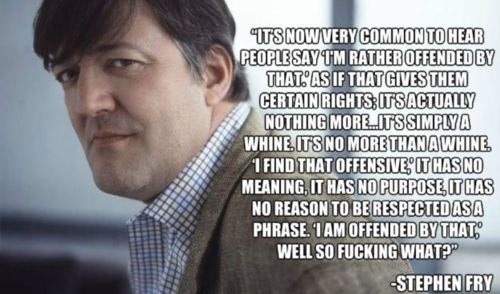
stephen-fry-on-offenceI’ve been thinking about Stephen Fry’s little rant that made the rounds of social media a year or so back. It’s something I’ve been meaning to comment on for a while, mulling it over thoroughly, discussing it with other people and trying to understand the mindset that would provide such an opinion.

 
In short, I just can’t understand why he would say such a thing.

 
The blog Tea Leaves and Dog Ears has provided a good reply to his statement. However, there are still a lot of people who agree with Fry’s sentiment, including Ricky Gervais, who stated on his Facebook page in August 2013:

 
“We have to stop this recent culture of people telling us they’re offended and expecting us to give a fuck.”

 
Fry and Gervais’ comments are nothing short of belligerent. When someone does not care regarding the effect their words and actions have on society in general, they are also not acting in any way with compassion. Fry’s comments about taking offense are well and good if he is the one being offensive, however, as in Tea Leaves and Dog Ears’ blog, when it is his own person that is being offended, the tables turn and a double standard occurs.

 
I’ve been studying the Celtic worldview for some while now, diving in to the history and research, and have come across one perspective time and again: that of personal responsibility. In a culture, in a society, we all have a personal responsibility to behave in accordance with that society and the laws that it contains. If we don’t like them, we should be able to speak out against them in a peaceful manner, protesting using our freedom of speech. Yet every action, every word that comes out of our mouths we are responsible for, whether spoken with mindfulness or mindlessness.

 
I believe that Fry’s and Gervais’ comments were spoken out of mindlessness. In Mr Fry’s case, also taken out of context. I also believe that they would, and probably have, taken offense at something since they made those comments. It is human nature to have an opinion. We have a voice and we use it. Sometimes we do so with full intention, sometimes we do not think before we speak.

 
I simply cannot fathom walking around, saying things without thinking of the repercussions my words and actions would have on the world. My sense of personal responsibility lies too thickly ingrained in my soul. It is confirmed by my Druidry, by my spiritual path. Stating that those who are taking offense are merely having a “whine” is to diminish their point of view, their opinion as worthless. It goes against the very freedom of speech that the original rant seems to hold up.

 
Sometimes it can be hard to find the words at the exact moment the offense is being taken. We’re not all eloquent beyond belief, able to put thoughts and emotions into carefully constructed arguments on the spot. It is a talent that some people have, some do not. We should not dismiss those who cannot find the words to express their true feelings, who can only say at that moment that they’ve taken offense. We have hurt someone’s feelings. We hate it when our feelings get hurt. Why do we forget that when we are the ones that are creating the offense?

 
Acting with compassion in all things is central to Buddhism. Right Speech is part of the Eightfold Path. I personally do not believe that Fry or Gervais’ comments are made with this in mind. Speech, words and stories were very important to the Celtic ancestors. The Druid teachings up until the modern day were never written down, for various reasons – to keep it within a political and spiritual elite in Classical times, for example. Going back further than this brief point in history, the written word did not exist for our Bronze Age or Neolithic ancestors. What was said, expressed in a language either now lost or evolved into our current tongue mattered. Even before verbal language, body language meant so much. Just watch two strange cats meeting each other, eyeing each other up for the first time…

 
So, we shouldn’t dismiss someone for taking offense simply because they cannot express in words at that time what it is that is hurting them. It’s difficult for a lot of people. And what of those non-human beings that we hurt? We must act with compassion, yes – but we must also be allowed to stand up for our rights, to be able to express it in our own time without being told that we are simply “whining”.

 
Supporting Fry and Gervais’ statements can lead to all sorts of messy encounters. Sexual harassment, jokes of a sexist, racist or religious nature can lead to a culture sliding down the slippery slope of intolerance, misogyny and bigotry. The words “rape culture” are hot right now, filled with debate about what it is and what is isn’t, who is contributing to it and who isn’t. Again, here I think that personal responsibility is key to working in honourable relationship with the world at large. Not giving a f*ck isn’t.

 
There is also the argument that letting go without taking offense is the best way forward. However, this only applies to a comfortable Western point of view, where one isn’t being shot at, forced to marry their rapist, or being subjected to all manner of discrimination due to the colour of their skin, their gender or their religious beliefs.
We are a vocal tribe now, and as such we should discuss things with compassion. Simply stating that someone is whining is not taking a look at the broader picture. In doing so, one is dismissing another human being. In time, someone may find the words to express their offense – it is a matter of eloquence and language, not one of who is right and who is wrong. Dismissing the other for taking offense is, in my opinion, repulsive and incorrigible. It is bad behaviour and bad form.

 
Stand up for what you believe in. Express yourself as eloquently and as honourably as you can. Consider the impact that your words will have on the world at large. Use the tenets of Right Speech and personal responsibility to the best of your ability. It is all that we can do. We may fail, we may be brought up on it, and it is up to us to make amends. Do not let pride get in the way. No one is infallible.


20 Things You May Not Know About the “Zen Druidry Lady”

Some things you may not know about the “Zen Druidry Lady” 🙂


  • I spent my spare time in my youth figure skating at the ice rink at the end of my street all winter long
  • When I wasn’t figure skating, I was cross-country skiing or downhill skiing
  • I know all the lyrics to pretty much every Taylor Swift song
  • I know the entire script of Jim Henson’s movie, Labyrinth, by heart
  • I played the head of a pirate nation in a Live Action Role-Playing system
  • I was also an elf in another LARP system
  • I began writing my first book when I was fourteen
  • I only have an automatic, not manual driver’s license (but I can drive/operate a tractor with bucket)
  • I used to ride a Yamaha Xmax before I got my driver’s license
  • I was a volunteer and member of the Valley Farm Mounted Troop, part of the Suffolk Division of the Legion of the Horse for the Volunteer Corps of Frontiersmen
  • I also competed in Western horse-riding competitions
  • I rode down the aisle, side-saddle, next to my husband (who was on his own horse) at our wedding
  • I sing silly, improvised songs to my cats. A lot.
  • My cats LOVE my songs.
  • I play golf (at eco-friendly sites)
  • I never measure the quantities of anything when I bake – I always wing it
  • I am a very good swimmer
  • I do a very good screaming chimpanzee impersonation
  • I work for one of the largest classical music festivals in the world
  • I can play the guitar, strumstick, drums, flute, recorder, harmonica, and piano (none of them particularly well)