Swift, Celebrity, Stories and Sovereignty

Yes, I am a Swiftie. Unabashedly a Swiftie. Always have been, most likely always will. I’m loving the new song (total earworm!) and the video is a little bit of genius. It’s also gotten me thinking, which is what all art/social commentary should do, no?

Musician and singer/songwriter Loreena McKennitt has spoken about the cult of celebrity for a few years now, how it has changed music makers from being artists to being commodities.  The face of music has changed so drastically in the last ten years that it’s becoming more and more difficult to express yourself musically, as an artist, rather than going for the superficial jugular of celebrity status. While I’m not saying that Taylor Swift has never sought celebrity, this clever woman has criticised it and examined it from many angles over the span of her career.

Taylor Swift’s most recent song and video, “Look What You Made Me Do“, is another critique of how people see her, based on assumptions made from the media, other artists, the haters and the Swifties alike. (She previously covered one assumption a few years back in her video, “Blank Space“, poking fun at the  media image of her being an over-emotional, co-dependent serial relationship junkie.) It’s a very good tongue-in-cheek look at the many personas that others have created for her, such as the leader of “The Squad” (a media reference to her circle of famous friends), her so-called “surprise face” when she wins awards, her “love” of playing the victim and more. Before the song was released, Taylor had wiped all social media, deleted all Facebook, Twitter and Instagram posts, as well as having her website simply showing a black screen. It’s a very shrewd move, personally deleting everything that the media could interpret about her, which she knows as well as we do that it’s only a part of who she is, a representation of a facet of a person. No one is their Facebook or Twitter account.

Taylor Swift ReputationThe song and video also points out that we need to take responsibility in our lives, which includes personal and emotional responsibility. The title, “Look What You Made Me Do” is referencing that fact that we often blame others for so many things, which engenders a lack of personal responsibility when it comes to the art of basic living. We need to take responsibility back for ourselves, for our actions, our words, our thoughts and emotions. When we do so, we pull of the mask that allows us to stay in our wounded selves, and to fly free with the wings of freedom and sovereignty. The reaction of others to this, well, what can I say? Some may praise you for it, some may criticise, some may hate and some may love you for it. The title is also a comment on how the media have created and fabricated all these stories about her, making her as a media-created character do and say things that are completely false. Taylor Swift’s new album (available beginning of November) is called Reputation, is yet another examination of the power of story, and who is telling it, and to whom.
This year, on a pilgrimage to Glastonbury, I met with the goddess Bloedewedd at the White Spring. She cautioned me to choose the mask that I wish to present to the world, otherwise others would do it for me. As I was watching Taylor’s video, these words came back to me, reflecting that everyone needs to choose, otherwise the choices will be made for them. Some would argue that we should simply take off all masks, and I would agree with this statement up to a point. We need boundaries, and certain barriers in place for different situations.

When I am working in a professional capacity, I can’t be the silly goof that I am in my dance troupe, twerking in the middle of a choreography just to make the others laugh. When I am teaching, I can’t be the child running to the bottom of the garden in search of faeries, or seeing how much of the alphabet I can burp after several glasses of Prosecco. We have different masks, different hats that we wear in different situations, because I am a daughter, a wife, a Druid, an author, a dancer, a woman, a teacher, a friend, a sister, a lover. To some, I am even a challenge, an enemy, a fraud, a hypocrite, a liar, and more. While this may not be true, other people’s interpretation of me is something that I have very little control over. They may have their reasons for believing in the story that they hold of me, they may not. But we have to remember: it’s just a story.

What is important is that our story is something that we can be proud of. Not in order to impress others, but for ourselves, so that we can move forward and add to our story with honour and integrity. We can shake off other people’s perceptions of us, because we have very little control over that anyway. We can choose to not be commodified inasmuch as we are able, and to take the reins in our journey and guide ourselves towards the sovereignty and the story that we wish to fulfill. Only we know the truth of our story, the terrible lows and the glorious highs. Only we can choose to move forward with honesty and good self-examination, in order to achieve our goals and to live a life that’s more integrated, with deep and sustainable relationships.

I’m proud of my story.

And so is Taylor Swift.


Please consider contributing/subscribing to this blog! Click HERE for more details.

Working with Anger, Working with Community

An article by Sophie Dòbhran and Joanna van der Hoeven

As Druids, as Pagans, and also in the role of priestess it can sometimes become really hard to stay connected with people who are cultivating rage and anger towards an event that creates a painful gap between what they wish and what is happening. One reason might be that they seem so shocked towards the event, as if they had just realized that such things are possible in our world. The first surge of anger is necessary, in order to provide a little release from the pain and suffering of the first wounding, but then we keep wounding ourselves again and again by cultivating the anger. And in doing so through our connection with others, we cultivate misery and pain together and nurture our being entitled to it.

Is it in how we resist a situation, and in doing so how we are ourselves nurturing the rage and anger and blind suffering that we so loudly condemn?

Even more troubling, is that it seems that the journey stops there: misery seeks misery, people suffer together then turn the page and go back to watching violent forms of entertainment on television and in the movie theatres but all that’s acceptable in our society. Until the next shocking thing happens. It’s like awakening sporadically is so painful and shocking that it doesn’t stick.

It is so difficult to feel the anger properly, and then to let it go. Anger perpetuates more anger, more suffering, and more pain.

Sometimes we need anger to begin a new motivation, a new revolution. However, a revolt that is perpetually based in anger turns into the riots in the streets of London a few years back, where innocent people were hurt, shops destroyed and more. That sort of anger doesn’t produce any results other than more suffering. Yet the anger that the women of the suffragette movement felt turned into courageous and defiant acts against the establishment that won women the vote, and more rights to come.

We could look at it as differentiating between holding the anger as motivation, or holding the anger as instigation. The preferable way would be the former, and then with a level-head find the solution after gone through the initial suffering. But there is a boiling anger in society that’s continuously being repressed, both here in the UK and in the USA, which will eventually explode if nothing is done about it, if there isn’t an outlet for it. Peaceful demonstrations seem to have little effect anymore on the establishment, and the media can just block it out as if it never happened. So, there’s the anger there, and it’s not going away soon…

Perhaps it has to do with the general isolation that has taken place, people being so disconnected from each other, and from Nature. We are no longer used to being mindful, to listen to silence. We are addicted to all kinds of fake relationships, superficial activities, superficial foods, and so on.

We need to remember that it’s all energy; sometimes the energy of anger isn’t appropriate. And when it’s no longer appropriate, when it becomes harmful instead of leading us out of apathy, for instance, then we need to repurpose that energy into something useful.

“Useful” is something each person must define for themselves, for each situation is unique. In order to do that, we need to step back from the situation and get perspective in order to discern just action. Anger, like a barking dog, can alert us that our boundaries have been crossed. But are we going to let the dog address this situation for us? How about when we cultivate anger together and become a pack of barking dogs?

Perspective needs distance and silence to produce clarity. No one can understand just why we are so angry better than we do. What follows is compassion. Compassion is not always soft and gentle. Sometimes, compassion means strengthening boundaries or raising one’s voice to be heard. Compassion means observing the situation with distance and clarity in order to discern the best path of action inherent to it.

It’s easy to be angry and feel desperate, lost and confused. Or to think that a public demonstration will change things, because we are now used to getting immediate satisfaction all the time. And yet if we truly pay attention, we realize that we can truly cultivate the change we want to see in the world. On a much smaller scale, maybe, but it is real and it is tangible, and it is satisfying.

Given that we are already what we condemn, we never have to look very far to create mindful actions that reverse that negative flow. It doesn’t change the world or impact politicians, but it changes our world, from our nemeton to another’s nemeton. Aren’t our nemetons microcosms?

Druidry is a religion based on locality first and foremost, and so, when we are upset or angry, it’s our immediate locality that bears the brunt of it. Our immediate locality is also the thing that we can affect most in our lives. When we’re angry at the government or our employers, we can do what we can to be heard: writing letters, signing petitions, talking and organizing unions, etc. But we have no control over what happens after that.

However, in our own environment, in our own bodies and for the most part, in our own houses and land we do have some control, and these are the areas that we can affect to effect change. Only we can change ourselves. We can think and act locally first and foremost, instead of the usual “think globally, act locally” because our range of influence is not all-encompassing. We can think all we want (and post all we want on social media), but that does not effect change. If we bring it down into bitesize chunks that we can handle, then we’re able to really do the work that needs doing.

So, we work in our area, to clear litter, to do ritual work, to contact the Fair Folk, to work with the ancestors and the spirits of place because that is where we live, because that is where we get our nourishment and sustenance. It is also useful to become members of their parish council, or join other committees in the community. That way, we have a real vote on planning applications and housing developments, environmental and health issues and more. In doing so, our environment affects us and we affect it. Then, like little ripples from a pond, that changed and charged energy can spread out. We create an effect in the world.

Think of your locality, think of your tribe. When your tribe is strong, let that energy permeate the rest of the world. This is not to say that we must become insular, separatist and isolated, but more as a ways and means of really affecting change in our own worlds. Become aware of the energy of anger, and how it is being used. Take care of your community, of your locality, and be conscious of the choices you are making and the reasons behind those choices. When we are conscious of our behaviour, we work with right action, and our work will benefit in a holistic pattern that emanates from a strong and true core of personal sovereignty.

Sophie Dòbhran was born in Quebec and lives in a farmhouse on a small island near Quebec city with her husband, her son, two cats and a dog. She studied under Swami Premananda Saraswati for a certification in Hatha yoga and also studied with the Order of Bards, Ovates and Druids. She joined the Sisterhood of Avalon in 2014 and has been actively cultivating an avalonian spiritual practice since. She facilitates Red Tents once a month, as well as druidic rituals and an SOA learning circle in her community. To find out more, visit her website at http://www.ileauxpommes.wordpress.com.  

Joanna van der Hoeven is a Druid, Witch and a best-selling author. She has been working in Pagan traditions for over 20 years and is also a member of the Sisterhood of Avalon. She is the Director of Druid College UK, helping to re-weave the connection to the land and teaching a modern interpretation of the ancient Celtic religion. To find out more, please visit http://www.joannavanderhoeven.com

Blessings of the First Harvest

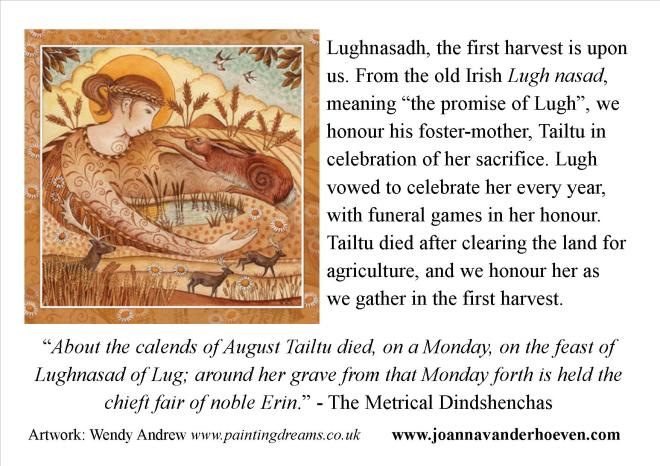
As Lugh pledged to honour his foster-mother, Tailtu with games in her honour every year, what pledge will you make to the land? Let this vow strengthen your resolve through the cycles of the seasons. Lammas/Lughnasadh blessings to you all. x

Lughnasadh

Make the Journey Count

As I near the end of my trip “back home” to Canada, I’m left with mixed feelings. I’m proud to be Canadian, but also cannot ignore the terrible things that have happened, not only in my lifetime, but for many previous generations in this land, “The True North Strong and Free”.

Canada recently celebrated its 150th birthday. This is the anniversary of the signing of the confederacy of the four colonial provinces, to be added to later, with the most recent province, Nunavut, having been “created” in 1999. (It was separated officially from the Northwest Territories on April 1, 1999, via the Nunavut Act and the Nunavut Land Claims Agreement Act, though the boundaries had been contemplatively drawn in 1993. The creation of Nunavut resulted in the first major change to Canada’s political map since the incorporation of the province of Newfoundland and Labrador in 1949.)

Though there are a great many stories from those pioneers who colonised this land, there are also many sad and devastating stories from the First Nations Peoples who suffered under their rule. Chief Crowfoot of the Blackfoot tribe (1830 – 1890) on his deathbed asked that his children be taken care of, that they should not starve under colonial rule (only four of the twelve didn’t starve, and all of those four later died of tuberculosis). His most memorable words speak of being utterly in the moment, and taking care and notice of the important things in life.

What is life? It is the flash of a firefly in the night.
It is the breath of a buffalo in the winter time.
It is as the little shadow that runs across the grass and loses itself in the sunset
.”

He was outlived by his mother, who lived to be over 100 years old.

More recently, there are still tragic stories to be heard in the history of this nation. I remember the Oka Crisis of 1990, a year before I graduated from high school. The Mohawk from the Kahnawake Mohawk Territory near Montreal stood their ground, literally, over a dispute where a landowner wanted to build a golf course on sacred ground, including burial ground. For nine holes in the ground, people died on both sides. Waneek Horn Miller, a First Nations woman was stabbed by a Canadian soldier’s bayonnet behind the lines. Though she survived and became co-captain of Canada’s Olympic women’s water polo team among many other accomplishments, the fact still stands that this should never have happened in the first place.

Canada has always heralded its mission as a cultural mosaic, rather than a melting pot. But this mosaic needs to be agreed and respected first and foremost, and not imposed. So far, the track record has not been all that great, and hopefully we are making strides towards a future that is better for all. Roseanne Supernault, a First Nations woman from the Metis Settlement in North Alberta speaks of this cultural mosaic, and also of the cognitive dissonance that results from trying to answer a call to consciousness.

As an Indigenous person who partakes in the nation-to-nation relations that happen in Canada, I demand of myself that I strengthen my tolerance – that I allow my brain to hurt from confusion that’s a by-product of education (not necessarily in an institution) or for my body to feel discomfort from hearing things that differ from whatever understanding I think I’ve had prior to new knowledge being received. At the end of the day, tolerance is learning to accept that you can be wrong; the ego cannot possibly know everything in this world.” – Our Canada, Issue Feb/March 2017

I think that Roseanne’s words should be deeply considered, meditated upon, and acted upon all across Canada. For our Prime Minister Justin Trudeau’s message has always been one of tolerance, of acceptance; that it is our differences and diversity that makes us a strong nation. But the uncomfortable aspects that are involved in this diversity need to be felt, and not ignored. We need to meet these head on, sit with them, talk them through, and find a strong and true reconciliation that isn’t just pretty words and hopeful thoughts.

I’m still proud to be Canadian, but I am also uncomfortable. And in that discomfort I find the heart of acceptance, tolerance, and compassion. We still have a very long way to go in being what we say we are or wish to be, but let’s make the journey count, for all it’s worth.

Be healthy.

A89A0650BMI (body/mass index) is only one thread in the tapestry that is your overall health. I had my NHS health check today, and scored a BMI of 29. This puts me in the “overweight” category. Obese is anything over 30. The NHS Health Check is a health check-up for adults in England aged 40-74. It’s designed to spot early signs of stroke, kidney disease, heart disease, type 2 diabetes or dementia. It looks at a range of possible health issues, with weight simply being one of them. They enter all the criteria into a form which calculates your overall risk for the above. Anything less than 10% means that you are at low risk. I scored 0.82%.

We can focus far too much on weight, as opposed to overall health. I will never be as thin as I was in my 20’s, and that’s fine. Overall, despite the arthritis, my body is in pretty good condition, and for that I am so very thankful. Being healthy is what matters most, not a number on a scale. Besides, most BMI testing does not factor in muscle/fat ratio. I was told by the nurse (who was stunned, as she rarely sees anything less than 1%) to keep doing what I was doing, because it was very good.

Yes, I have a rounded belly, bum and hips. Yes, I am classed as “overweight” according to the weight equivalent of standardised testing. But I’m still damn fine, fierce and healthy. THAT’s what matters most!

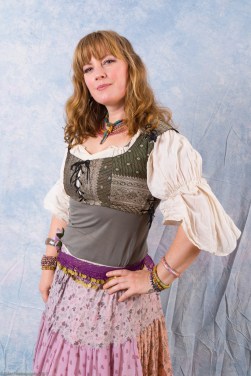
Photos of me by Graham Haynes, from “Beauty and the Belly” workshop June 2017 hosted by Mystic Belly Dance

Our land, if not our country

In year two of Druid College UK, we cover the topic of leadership: what it means, how you can achieve ethical leadership, and what makes a good leader. Today, our country is voting on who it wants to have as a leader for the next five years; basically it’s a two-person contest between the current Prime Minister Theresa May and the leader of the opposition, Jeremy Corbyn.

It’s very telling simply in the language that they are using as to what they think leadership is about. Theresa May want us to vote for her in order to “strengthen her hand”. Jeremy Corbyn wants us to vote for him in order to give power “for the many, not the few”.

Leadership is about empowering others. Leadership is about using your wit, intelligence and resources to make something better, not just for yourself, but for everyone. Yes, you can certainly benefit from your own leadership, but that shouldn’t be the goal of leading; that is simply the ego talking. We lead from a place where we want to help others, to bring harmony to the majority involved. Yes, there might be a revolution in the meantime, and peace might certainly not be on the cards, however sometimes this is necessary in order for things to change.

Here in the UK, things are very tense as we await the election results. We have a real chance to turn from the brink of something destructive and harmful to many, to turn away from a Prime Minister who wants to repeal human rights for goodness sake. In a reflection of the turbulent world around us, this tiny little island nation has a chance to say “no” to tax breaks for the wealthy (and their businesses), to taking away fuel allowance for the elderly, to zero contract working hours, to selling off assets of our National Health Service, to dementia tax (other conditions, such as cancer, as funded by our healthcare service, whereas dementia falls under social care, not healthcare). We have a chance to make a statement to the world as to what we want our future to be. And we’re terribly worried about what is at stake, and the misinformation that people have been fed by a right-wing Conservative-led media (most newspapers, for example).

We have a chance to change politics, to make it fairer. We have a chance to elect a leader who doesn’t do personal attacks, and who focuses on the policies, not the power. We have a chance to really change the way we do things. I had hoped that our last election would be influenced by what happened in Canada, with the Conservatives being thrown out of power by the Liberal Justin Trudeau. But no, that wasn’t the case at all. There is a slim chance that this might happen today. That’s the very best that we can hope for. The more practical are hoping for a Conservative minority.

Today, as I walk the land, the bell heather coming into bloom, the oak trees in their full glory, the adders basking in the sun and the deer dreaming in the shade I hope for the best for this country. Like many others today, we are holding our breath, for there is so much at stake.

And even if things turn out for the worst, we know that this is still our land, even if it is no longer our country.


Compassion on a Tuesday Morning

22 people died last night in a bombing of a pop concert in Manchester. The first thing I saw on my Facebook newsfeed this morning was a post from a friend, who had said that they had reached compassion capacity, and that they simply shrugged and got on with getting ready for work, as there was nothing they could do anyway.

I hope never, ever to become this way.

It is my firm belief that we only allow ourselves to be de-sensitised. No one can de-sensitise us in today’s easy, modern world (I’m talking about people who have decent jobs, put food on the table, have a place to live and also have money left over for some nice things, like socialising). It is a choice that we make to turn ourselves off to the world.

My thoughts and prayers are with the families of those who are seriously hurting right now. They can’t shrug it off and go to work. They have lost children, parents, brothers and sisters. Those who survived are in pain, undergoing or awaiting surgery at one of the six hospitals in the area that took these emergencies. If these people can’t turn off, then I certainly can’t.

There is no limit to compassion. Let me repeat that: there is absolutely no limit to compassion. We can have compassion for anyone. That doesn’t mean we tolerate bad behaviour or condone violence in any way. It means that we do not turn off that very essence of what makes us human, that ability to feel, to empathise, to look deeper into an issue and to offer healing, support, prayers and love where and when we can. There is no limit to that.

Yes, there are some cases in our lives when we have to walk away from a bad situation. But we don’t have to turn ourselves off in the process. People have been horrendous to me, and I have needed to walk away. In doing so, I have not turned myself off, but sought compassion for myself, and gotten out of a bad situation so that my compassion for others would not be compromised. And the people who were horrendous to me, well, I only hope that they truly find the healing that they need, so that they stop doing it to others, and themselves.

It is all about the choices that we make. I was going to write a blog post today about choices, but that will follow in a consecutive post later this week or next week. This morning, I needed to focus on the events of last night, and my friend’s reaction to them. It saddened me greatly, and also angered me that people could make the choice to turn themselves off. We live in such a narcissistic society, that we only focus on ourselves. We often use the excuse that the only thing that we can change is ourselves, however, for me in that context it is just that: an excuse. When we see suffering in the world, if we only focus on ourselves, then how do we stop the suffering of others? Yes, we need to heal ourselves, but we also need healing for the world at large. If we are always looking inwards, then we are ignoring the outer world that is very much a part of our reality and existence. Just because we choose to ignore it, doesn’t mean it doesn’t exist.

If everyone ignored the suffering in the world, then there wouldn’t be organisations dedicated to helping others, when human or non-human. Greenpeace, The Red Cross, Amnesty International; these would not exist. We have to look beyond the scope of our little world and realise that we are very much part of the whole. We co-create the world that we live in. We co-create our reality.

What do I mean by that? Well, I often hear the saying that “we create our own reality.” This isn’t true, because there are many factors in life that aren’t under our control. The child in Aleppo did not create the reality of a war-torn city. We are responsible for what we bring into the world, and we also have to realise that we share this world with others who are bringing their own stuff into the mix, and therefore into our reality. Ignoring this does not make it go away. If I ignored what happened last night and simply got on with my day, then this blog post would not be written. I would not be sharing my words and thoughts with you. I would not be exploring the themes of suffering and compassion, and how to make this world a better place for everyone.

I will not turn myself off to the suffering in the world. Sometimes, there may not be much I can do about it, but if I turn myself off then I will bring that into my own little world, my local environment, which leads to a de-sensitivity to that area. It will trickle down into my everyday life, from my relationship to my husband, to my friends, to the lady at the post office. When we de-sensitise ourselves at a national or global level, we are fooling ourselves if we think that doesn’t seep into our everyday life, our everyday interactions with people, with the world.

My thoughts and prayers for the families of last night’s tragedy may not have an immediate or direct affect upon them personally. The children who are orphaned in Syria, with no place to go, are again not immediately affected by my thoughts and prayers. Neither are the badgers being culled, or the battered woman seeking a place to sleep for the night in a non-government funded women’s shelter. But I am affected by this, and so is everyone around me. I will not lose my compassion, and open my heart to everyone who I do come into contact with. I will try to make this world a better place, to live in harmony and to promote peace. If I turn myself off to the suffering, how can I promote peace?

We are making a choice, when we ignore the suffering. Sometimes there is a line, where we have to walk away from a bad situation because we ourselves are at risk. That is usually because we are suffering to a large extent, due to myriad factors, most of them beyond our control. We all need to retreat every now and then, to lick our wounds and to heal. On my darkest days, when the suffering in the world overwhelms me, when the aching in my bones and joints moves from the dull to the sharp, I need to take a step away. But that doesn’t mean I shut myself off completely. I still have compassion for others. I need to take care of myself, certainly, but I do not forget others. I do not forget that the world is more than just me.

Compassion is all about choice.

On the turning away
From the pale and downtrodden
And the words they say
Which we won’t understand
“Don’t accept that what’s happening
Is just a case of others’ suffering
Or you’ll find that you’re joining in
The turning away”
It’s a sin that somehow
Light is changing to shadow
And casting it’s shroud
Over all we have known
Unaware how the ranks have grown
Driven on by a heart of stone
We could find that we’re all alone
In the dream of the proud
On the wings of the night
As the daytime is stirring
Where the speechless unite
In a silent accord
Using words you will find are strange
Mesmerised as they light the flame
Feel the new wind of change
On the wings of the night
No more turning away
From the weak and the weary
No more turning away
From the coldness inside
Just a world that we all must share
It’s not enough just to stand and stare
Is it only a dream that there’ll be
No more turning away   – Pink Floyd

Druid College and Earth Day

Well, another brilliant weekend of Druid College has come and gone. We’re nearing the end of our Year 2 programme, and getting ready for the apprentices to declare their Chair, their work for Year 3. It’s an exciting time for me, to see what direction each person will take in their path to being a priest of nature, and to help guide them on their personal journey.

Some of the elements that we covered this weekend really stand out for me: crafting sacred ritual and exploring the ecstatic in ritual. As the Saturday of our weekend also coincided with Earth Day, we decided to create a ritual using the energy of the day, alongside the millions of other intentions the world over for peace, harmony and respect for this planet we call home. As Druidry is all about crafting sacred relationship, we used the time and tide as an opportunity to ride the waves of energy and, hopefully, the winds of change.

In the morning we got together and discussed the intention of the ritual, and how we could go about manifesting that intention. We hadn’t used ritual drama before, and so I suggested that Robin (our other course leader and a brilliant storyteller and actor) take on the role of someone who has lost their connection with nature, with the earth, with the fact that we are all related. In sacred space, we invited the personification of this energy, and Robin played the part to the hilt. It was difficult to hear the words he spoke (rather, yelled) in the peaceful setting of the woodland where we stood, the scent of bluebells surrounding us, the mallard ducks flying in and out of the pond next to us. Word of racism, environmental destruction, classism and more were flung into our space from the voice of a wounded individual who had lost that sense of connection, who represented everything that we work in our daily lives to heal. We had heard these words in the media, from people on the street, perhaps even from family members, words of the uselessness of nature except as a resource, words of nationalism and “foreigners”, words of the necessity of cheap manufactured goods despite the cost to human and non-human lives and more.

Then we created a container for that energy. Like an oil spill, we contained the negativity by creating a circle around the energy, holding it and stating that we will not allow it to infiltrate into our lives, and do everything we can to change and transform that energy. Circling Robin, we held hands and took in that energy.

We then needed to transform it, and so in a cauldron filled with water from the Red Spring in Glasbontury (Chalice Well) we spoke words of how we will transform that energy in our own lives.  Aware of what we can and cannot control, we decided how best we can transform and create a counter-balance to the destruction of the sacred and the values of sustainable relationship that we hold so dearly. We can change ourselves, first and foremost, and that energy will ripple outwards. And so, bringing our lips close to the cauldron we spoke, of loving friends and family despite their flaws, of working on how to heal ourselves, of how we can affect our local environment, community and more. Changing ourselves, we change the world.

We then used an elixir of vervain, created by the waters of the Red Spring and White Spring, blessed by the light of the full moon, and added three drops to the cauldron filled with holy water and our intention. Through the magic of herbs and intention, the water was blessed and transformed to heal and nourish all.

We then created a circle once more, holding hands and feeling the energy of community strong. We then opened our circle and allowed a space for Robin to join us, should he so wish. In his character, he was unsure of whether he wanted to join us or remain as he was, and so we simply stated that the circle was open to him when and if he was every ready to join. There was always room at the table.

A healing sound bath followed, where we each took up an instrument with beautiful vibrational energy, and the air was cleared with the soft sounds we created, mingling with the songs of the robins and blackbirds, the wind through the new leaves in the trees, the glow of the bluebells bright in their basking in the warm spring sunshine.

All in all, it was a wonderful ritual, created by the group and one in which everyone had a part to play, both in the ritual circle and afterwards in their own lives. A very transformational ritual, to say the least.

I want to take this opportunity to thank all involved in Druid College over the last two years, who have shared in this wonderful journey. I look forward to many more years to come.

Reblog: Bullies and Re-membering

This is a reblog from my channel at PaganSquare… to see the original, click HERE.

bf fully

“Bully Bogey” by Brian Froud, from the book Good Faeries, Bad Faeries

I was bullied really badly as a teenager. I went from being an utterly confident 12-year old, full of promise and with a “sky’s the limit” attitude to one of sheer terror and depression. For three long years I suffered physically and mentally at the hands of a few girls who were two grades above me. Those feelings never go away.

The problem with bullies is that they too never go away. You may never see those childhood bullies again in your life, but they’ll always be there, living in your head, little demons that run out and snarl at you when you least expect it. You have forgiven the childhood bullies, and done cleansing ceremonies. You’ve accepted and moved on. You’ve lived the best life you can. But they’re still there. They are a part of you, and they wait to pounce on you, grasping into your flesh with their sharp little fingers, whispering in your ear. Through acts of kindness, through living a life of compassion for others, you can keep them at bay, but they never, ever go away. A tiny crack in the fortress of love can allow these slippery little demons through. There merest tear in the fabric of your being allows them to shred their way straight through to your soul. Yet you continue, you go on, putting one foot in front of the other. Demons of the past may have been dealt with, but they re-emerge with demons of the present, a lingering army in your mind, combining forces in an assault against your very being. So how to win through?

As with any abuse, we can only take things one day at a time. Things will happen in our lives that will allow these demons a chance to take hold once again. New bullies may appear in your life, and dog you for years, trying to bring you down. You struggle and fight against the abuse with all the resources you have to hand: love, empathy, compassion, intelligence, determination. You may win a battle, but the war is a long one, and you are tired. So we carry on, one day at a time, one battle at a time, keeping those demons and bullies at bay, from both the past and present. It’s not easy. But you know that giving in to them is not an option, for then they would tear you apart, turn you into one of them. You struggle on, seeing the good in people, despite everything aimed at you, despite the unkindness in the world today. Is it sheer determination or just plain stubbornness? You don’t know, but you carry on regardless.

People can be wonderful. They can also be utterly awful. Though my life is filled with mostly beautiful folk, there are one or two that try to negate all that loveliness, with sour words and tongues, whispering into the ears of others, for whatever reason. These broken souls wend their way into your life every now and then, and there is no option but to deal with them as best you can. And when you have past abuse to contend with, the assault on the psyche is even worse, as issues from the past rise once again to the surface, and you realise that you have to deal with them all over again. I’m 42, going on 14.

But then again, aren’t we all? We are all stories, stories of our past trying to live in the present moment, without worrying too much about the future. We work and walk with nature, seeing the beauty in the sunset, the mystery in the moonrise. We know the different gods, we talk to the ancestors, we dance with the spirits of place. We find inspiration everywhere, and so do we use our spiritual path as well to help us along on our journey, no matter what demons rear their ugly heads.

We need to remember. We need to re-member. We need to take our inspiration from nature, to bring ourselves back into being. We need to recreate ourselves each and every day. By remembering who we are, we can re-member our very being, bringing together those disparate elements that we have lost at the hands of abuse, allowing the past to have happened, but not allowing it to live in the present moment. If we remember, we acknowledge the past. If we re-member, we forge ourselves anew in the light of a brand new day. By bringing the two together, we can find wisdom.

I spoke with Rhiannon, Bloedeuwedd and Cerridwen recently about the bullies in my life, past and present. They helped me to acknowledge the past suffering, as well as the present. I am unable to do anything about the behaviour of other people, foul as it may be. But I can remain open and honest, compassionate and kind. These were their words to me, along with words of caution: they also reminded me that I have nothing to prove.

Often when we are bullied, either from the past or in the present moment, we feel that “living well is the best revenge”. However, if revenge is anywhere in your thoughts, you most certainly are not living well. We can pour inordinate amounts of time and energy into trying to prove ourselves against those who would badmouth us, who would threaten us, who would try to bring us down for their own troubled reasons. But as we realise that we have nothing to prove to these people, we release them from our lives, allowing them to be blown away on the evening breeze. We can face the darkness without fear of them lurking in the shadows.

There will always be people who are antagonistic towards you in your life, for whatever reason. My advice, for myself and for all who have suffered similarly, is to not overcompensate, for in doing so those bullies still have a hold over you. We need to take a stand sometimes in our life, and we need to speak out against injustice. But when we feel that we have something to prove, then little cracks being to appear in our being. It’s the ego talking, and it’s not coming from a place of compassion or empathy. It’s almost a form of punishment, which is perfectly understandable given the amount of suffering one may have undergone. It’s a purely human response, and we can acknowledge it as such. How we act upon that feeling is what defines us.

The bullies in our life, past, present and future, may never go away. We may have to content with them again and again, privately, publicly, professionally. My advice to all who have similarly suffered would be to not fall into the trap of overcompensation. We all have little coping mechanisms to help us get through. Look deeply into the amount of time and energy that you give to a situation, and see where that time and energy might be better spent: with family and loved ones, for example. Look for the good in the world. Look for the beauty.

I remember those long bus rides home, over an hour, with name-calling, food/garbage throwing, physical abuse, etc. I remember the more recent times of bullying in my professional life. And I re-member myself. I see the beauty of the clear blue sky, and I re-member. I see my cat’s sleepy face, and I re-member. I make love to my husband, and I re-member. I laugh with my friends, and I re-member. These are the important things that require focus and attention. This is where I can find the core of my being. This is what I re-member.

And when I do, I can let it all go, slipping into the gentle stream that burbles in the sunlight, that nourishes with its very being everything it touches.

An Inconvenient Sequel

Al Gore has created the sequel to his film, An Inconvenient Truth. It will be out this summer. May our future ancestors forgive, and may we do right by them before it’s too late.