
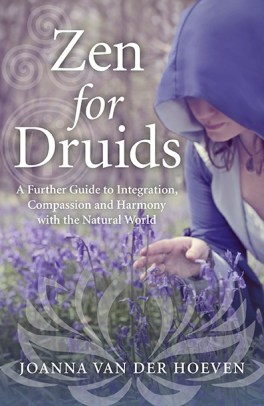
 Reviews are coming in for my new book, Zen for Druids: A Further Guide to Integration, Compassion and Harmony with Nature. This new book expands upon my first work, the introductory Pagan Portals Zen Druidry, and looks deeper into combining elements of Zen Buddhism and Druidry. Here are a few of the reviews!
I am a massive fan of Joanna van der Hoeven’s books. They are wonderfully accessible whilst still conveying a depth and clarity that helps the reader to really connect with the wisdom of the subject. Her latest offering does just that. ‘Zen For Druids’ is a companion to her earlier work ‘Zen Druidry’, exploring Zen Buddhism and Druidry by illustrating how these spiritual paths can complement one another in practice. The book is written in five parts. The first explores Druidry and the Dharma giving an excellent overview of Buddhism’s Three Treasures; The Four Noble Truths; The Five Precepts; The Eightfold Path and The Sixteen Bodhisattva Precepts and how these relate to Druid philosophy. The second part takes us through the Pagan Wheel of the Year and how Zen Buddhism can enrich the understanding and honouring of these festivals. Joanna includes some really useful tips at the end of each festival section, with ideas to deepen your experience of each. Part three focuses on Meditation; part four on Mindfulness and part five on Integration, each section helping to both explain the underlying spiritual meaning of these practices whilst giving practical advice, exercises and encouragement. I particularly enjoyed the section on Integration where the author writes beautifully about Awen and Relationship as a connecting, compassionate force that reveals the interconnectedness of life. In her chapter on Ego, Self and Identity the author tackles the thorny issue of the Ego. In many spiritual texts, the Ego can so easily be labelled the ‘bad guy’ but Joanna skilfully explores the difference between Representational Ego and Functional Ego, redeeming the Ego’s useful functions whilst suggesting a compassionate approach to its more challenging aspects. The concepts in this book take some thoughtful pondering but the beauty of Joanna’s writing is that it cracks open what initially appear to be very complex ideas and gets straight to the heart of each. Obviously the real work is in the dedicated practice of a spiritual path but Zen For Druids offers a wonderful foundation to build upon. In every page you can sense that the author has learned these insights through experience, that she really understands and lives these principles from a place of deep heart-knowing. We move from a purely intellectual grasping of a subject to this heart-led living of a spiritual path through the constant connection and exploration of that path; Joanna van der Hoeven’s fabulous book is both an inspiring and deeply practical aid to help you on that journey. I highly recommend this book. It is proof of how seemingly different spiritualities can enrich each other, and for those of us who are drawn to both western and eastern paths, it’s a real gem! ~ Maria Ede-Weaving, from the office of the Order of Bards, Ovates and Druids
Zen for Druids: A Further Guide to Integration, Harmony, and Compassion with Nature by Joanna Van Der Hoeven is a look at integrating aspects of Zen Buddhism and Druidry into ones personal practices. We take a look at some of the basic principles of Buddhism such as the Four Noble Truths and the Eightfold Path and how they can be integrated with aspects of Druidry such as the sacredness for all things. There are questions which help us contemplate these concepts within the aspects of both Druidry and Buddhism. We take a look at meditation and mindfulness in both areas of practice. We are shown how to incorporate the eightfold path of Buddhism into the Wheel of the Year and Druid festivals. I liked how this book brought together both Buddhist and Druid practices to create a practice that is one with nature and enhances our spiritual practice. I learned a lot about both Druidry and Buddhism and how they can work seamlessly together to create a spiritual practice. ~ Rose Pettit, Insights into the Wonderful World of Books
In this user-friendly book, Joanna van der Hoeven further develops ideas already present in her earlier ones, especially Zen Druidry. On my reading, this book will work best for Druids committed to a modern eco-spirituality. I imagine readers already re-enchanted by their experience of the natural world, who want a harmonious relationship with that world, and to honour, protect and preserve it. Zen for Druids confirms this stance and adds something else: the interwoven ethical and attentional training of the Buddhist tradition. The author draws specifically on Thich Nhat Hanh, the Vietnamese Zen Master who founded the Community of Interbeing and is a leading model and exponent of ‘engaged Buddhism’. This cultivates personal, social and ecological levels of awareness. It recognizes the radical interdependence of all beings and a need to make ethical/political choices in line with this interdependence. Such Buddhism is not in any way world denying, in the way that Buddhist tradition has at times been in the past. I see Thich Nhat Hanh as a perfect source of influence for this book, and several of his own works are cited in the bibliography. Zen for Druids is divided into five parts. The first is a clear exposition of Buddhist basics, helped by that tradition’s own style of clear exposition and list making. It includes chapters on the three treasures, the four noble truths, the five basic precepts for lay Buddhists, the eightfold path and the sixteen Bodhisattva precepts. By age-old Buddhist design, there is a certain amount of repetition in these lists, with the same issues coming up again in slightly different contexts. Each individual chapter ends with a set of questions designed to engage the reader in their own reflections. The second part moves through the eightfold wheel of the year, frequently found as a festival year in Druid and Pagan communities. Each festival is given its own chapter, and each chapter combines traditional Druid and Pagan themes with a principle from the Buddhist eightfold path. The author starts at Samhain (right effort), moves on to the Winter Solstice (right mindfulness), Imbolc (right concentration), Spring Equinox (right intention), Beltane (right view), Summer Solstice (right action), Lughnasadh (right speech) and the Autumn Equinox (right livelihood). Each section is followed by a list of suggestions for practice. The book’s remaining three parts are shorter. They concern, respectively, meditation, mindfulness and integration. In two chapters on meditation, the first explores ‘mind traps’ – “those little prisons of our own making. We are constantly hijacked by our thoughts and feelings, attachments to them and our egos, such that we spin endlessly in circles until we fall down”. The second shows us to how do a brief meditation session in the Zen manner. The following section, concerning mindfulness in the world, suggests a practice of ‘mindful Mondays’ and explores the relationship between present time awareness and an animist world view. The final section, on integration, focuses on our integration with nature, looking at the issue of ‘ego, self and identity’ before reflecting on ‘awen and relationship’. For Joanna van der Hoeven, indeed, “awen is relationship and integration, the connecting threads that bind us soul to soul”. In Zen for Druids, one Druid shows how she has taken an iteration of Zen Buddhism into her life and practice, combining them into one path. She sets out her stall very clearly and offers the reader specific opportunities and resources for practice and reflection. This book does a valuable job well. ~ James Nichol, Contemplative Inquiry
I read Joanna’s “Zen Druidry” and it really helped add an extra layer of depth to my own Druidry. This book continues down that same path, with a lot more emphasis on how to incorporate aspects of both Zen and Druidry into one’s life. Not only does Joanna write in a way that is easily accessible, her approach to topics provides the reader with enough information to work with the topic or concept. The questions she asks throughout the book are definitely good moments of “food for thought” – and for me provide even more desire to dig even deeper into what she is presenting here. Is her book a be-all, end-all of Zen, Druidry, or the combination of the two? Not even, nor is it meant to be. Finding that kind of depth, in my opinion, is up to the individual bringing these concepts into their Spiritual practices. This book; however, is a definite strong start for those who are looking for ways to incorporate these two particular Spiritual disciplines into their lives at the same time. For me, this book is a timely follow on to the “Zen Druidry” title, providing more depth and clarity to the combination of these two Paths. Going further down that Path, will be up to the individual adherent and their own unique application of these disciplines to their own lives. If you are picking this book up first, set it down and get “Zen Druidry” and read that first. Then follow on with this one. The two flow together very nicely. ~ Tommy van Hook, Life with Trickster Gods
 As we prepare to take our Year 2 students through their first weekend of the second year, we are also looking forward to opening up for applications on 31 October for our next Year 1, which begins in October 2017. We are opening for applications earlier this year, a full year in advance, to allow for payment in installments before commencement of the course so that everyone will have an opportunity to apply and if accepted, reserve their place for Year 1.
 I had a lovely solo ritual last evening, to celebrate the autumn equinox. As the sun set, I meditated on the changing colours in the sky, on the harvest that has taken place, the wheat and corn crops taken in, the onions and turnips. The fields are still being tended, ploughed for winter veg, seeding with potatoes and other root crops. The sounds of work in the fields is still going on, even as the evening dog walkers pick blackberries and apples from the hedgerows. It’s a strange time of both noise and stillness, when the swifts and house martins have mostly left, the skies seeming emptier for it. The dawn chorus is softer, the evening calls less urgent.
 Down the Forest Path