Pagan books sales have gone down radically in the last year and a half, despite the increasing number of books being made available. It seems to reflect what many of us authors have been worried about for several years now. The sales aren’t even made up with e-books, as those have dropped significantly as well. Audiobooks for non-fiction still aren’t that popular either, and the revenue from them has always been minimal. So why is there this sudden and sharp decline in books sales?
When I first started learning about and practicing various forms of Paganism in the early 1990’s, books and events were the go-to places to gather the information that I sought out. The choice of books available in the bookstores was only a handful stuffed somewhere in the “New Age” section. The internet didn’t exist, but you could order books from glossy catalogues that companies such as Llewellyn provided, which wasn’t too bad if you lived in the US but if you lived anywhere else, the shipping fees were astronomical. And so you just had to make do with what your local bookstore provided. If you were lucky to have a witchy type shop near you, the selection was a little better, but shelf space was always at a premium. And we didn’t even bother much with libraries back then, because they would never stock those sorts of books in the first place. Finding books to read was a real struggle, but such a joy when you did find one that resonated with you.
The coming of the internet was a huge blessing for the Pagan community who wanted to connect with others, talk about authors and books and find solace with others when the community was so small and so widespread. Books began to be marketed online, which was a real boon to the publishing industry. And yet, with more people online than ever before, what has happened to book sales lately? Surely they should still be increasing?
Nope. I’ve talked to my publishers, I’ve talked to other authors and everyone is seeing a real downturn in books sales. We’ve been scratching our heads, trying to figure out why. As book lovers ourselves, it’s difficult to fathom how this downturn has come about so suddenly. So here is my take on what’s going on, and how it could very well spell the end of non-fiction books in the coming future.
People can get information for free online. As people are online more and more and there are so many different channels to get information from, why buy a book? You could watch a video, read a blog and receive a ton of information anywhere for free. I know that if I was a youngster just starting out, the majority of my information would be garnered from this form of transmission simply because it is free.
People don’t have spare cash to buy books right now. Everyone I know is hurting more and more financially, and if it comes down to buying your groceries for the week or buying a book, you will buy the food. I hope.
You can find pirated copies of pretty much anything online. Need I say more?
Attention spans are waning. It’s a fact. “In the early 2000s, she and her team tracked people while they used an electronic device and noted each time their focus shifted to something new—roughly every 2.5 minutes, on average. In recent repeats of that experiment, she says, the average has gone down to about 47 seconds.” https://time.com/6302294/why-you-cant-focus-anymore-and-what-to-do-about-it/ (I actually had trouble reading this article, not because of attention span but because four different pop-ups kept interrupting my reading. Oh, the irony.)
When a book is released, it is competing will millions of other books these days. With so much choice, it’s wonderful for the reader out there. But for the author? It seriously dilutes the sales. Unless you have a slick marketing team that works for you.
Authors can’t afford slick marketing teams. The shift in lots of publishing has been to place the onus of marketing up on the author, as the publishers have to make cuts somewhere just to stay competitive. Most authors aren’t marketers. I spent nearly a decade in marketing for a world-famous music venue here in England. That has seen me in good stead for the last ten years, but even now I’m struggling against a tide of everything that I’ve mentioned above.
The struggle is real, folks. I hope one day that books will have a resurgence, that cosying up with a book on a rainy day will replace hiding under your duvet with your smartphone. There is just something about a book, something that feels like an old friend you can turn to, something that you can hold in your hands, that ages even as you age, the feel of something material rather than something immaterial.
Go analogue for a while. Slow down. Smell the books along the way. Because who knows how long they’ll be here?
Well, I have just returned home from another Glastonbury pilgrimage. This time I seven lady friends and I from here in Suffolk went to experience the sacred sites around Glastonbury. We had a lovely time stopping at Avebury on the way, to walk among the stones and to get a feel for this ancient site, as well as having a lunch break at the Red Lion pub. We were surprised to see that their prices are still incredibly reasonable, even after everything that has happened in the last few years. In fact, we noticed that wherever we ate, we were spending around £5 to sometimes nearly £10 less than we would in Suffolk, for some reason. Since Covid hit, every pub and restaurant in Suffolk has increased their prices dramatically. It made eating out on our roadtrip/pilgrimage even that much more enjoyable.
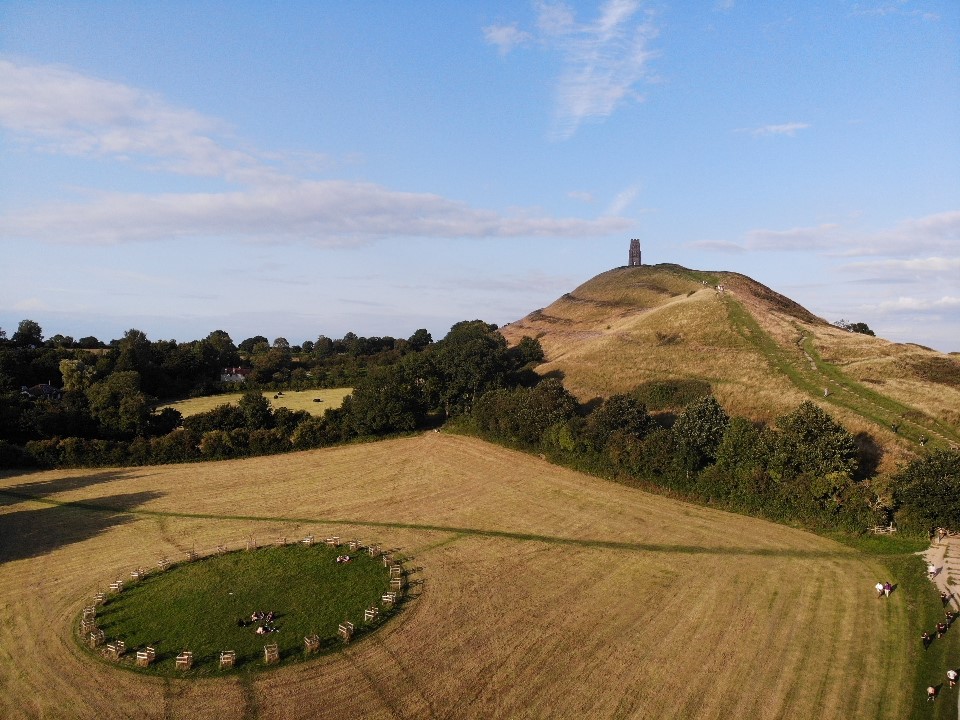
When we arrived in Glastonbury, a few of us immediately climbed the Tor. It was quite still, with very little breeze, which is rare on the Tor! Standing up there on top of than ancient hill felt like being on top of the world, as it always does. A few people were quietly sitting and watching the sunset, or meditating, and it was incredibly peaceful up there. The mists were beginning to gather in the Somerset levels below, and the setting sun peeped out through the clouds just before disappearing below the horizon.
The next day we began our visit to the sacred places all together. We began with the Red Spring (Chalice Well). It is a beautiful sanctuary of peace and love, with the waters of the Red Spring flowing through various gardens and areas before culminating in a gorgeous vesical pisces pool at the bottom. I always begin at the bottom, crossing the little stream and stepping through into the Otherworld before I continue my journey up through the gardens, and all the ladies did it with me together. It was wonderful.
We meditated at the pool and gazed at the flow forms, before heading up to the yew trees and walking through their gateway. We then passed beneath the archway with the wrought iron, archangel Michael’s sword over our heads, which we saw as the sword of sovereignty, rather than the archangel’s fiery blade. Once in Arthur’s Court, we took off our shoes and walked through the paddling pool, bathing our feet and beginning our spiritual pilgrimage in earnest. Afterwards we sat beneath the yews and just soaked in the atmosphere of that very healing spot in the Chalice Well gardens.
Next we moved up to the Lion’s Head, a tap where you can collect water from the Red Spring within the sanctuary of the gardens. After having bathed your feet, now you can take in the healing waters into your body and soul, having been purified and readied for the experience. We filled our bottles and, for many of the women, tasted the iron-rich water for the very first time. I love the taste, but it’s not for everyone!
From there we moved up to the holiest of holies, the wellhead. Here in this silent sanctuary we meditated on the waters with other pilgrims who gathered round in quiet companionship. Well, we tried to anyway. The pot smoke and noise across the street at the White Spring was growing, until someone blew a horn and the White Spring opened in earnest. Sigh. More on that later.
We ate a picnic lunch on the slopes of Chalice Hill, just beneath the apple orchards. The sun was shining, and it was an absolutely gorgeous day. We then headed down to the gift shop to pick up a few things, and then made our way to the Tor once again.
The climb up the Tor this time was different, with more people and the wind whipping around us. Thankfully the wind was at our backs, which felt like it was giving us a helping hand on the climb to the summit. Once there we came across a large group of people occupying the sheltered, sunny side of the tower, singing and chanting, and so we moved into the tower itself. It is a relic of the old monastery complex that used to be situated on the Tor, and is the second tower to be built there, the first having fallen after an earthquake.
We stood in the tower, looking out the doors and through the roofless structure to watch the few clouds scudding quickly across the azure blue sky. We spoke of the legends that surrounded this magical hill, and of who was said to dwell within it. We then sat in silence, taking it all in, when a lady and a man came in. She stood in the doorway and laughed, while he stood in the centre of the tower (and us) and began gyrating and shaking as if he was being electrocuted, followed by noises as if he was sexually climaxing. I rolled my eyes and left, resisting the temptation to give in to violence, and was followed by the rest of my ladies, bar one. She remained, giving him the stink eye while he continued, not allowing him to vibe her out of that space. Rock on, grrlfriend.
I then spent some time sitting on the hilltop facing west, and meditated, connecting to the energy of the Tor and the surrounding landscape, the elements and the myths and legends that abound in this magical place. I was interrupted five minutes later by some young teenagers nearby who, after smoking a joint, proceeded to record themselves making what they thought were sexual noises. Sigh again.
Eventually we headed back down the Tor and went to see if the White Spring was still open. It was, and so after a health and safety briefing we all went into the dim chamber of the Victorian wellhouse. Before this structure was built, the White Spring flowed from a fissure in the rock, coating all the plant life around it with a calcified deposit, created faery forms and shapes all around it. When cholera hit the town the decision makers decided to use the water from this spring, ignoring the calcium deposits evident all around. In a short time the pipes that connected the spring to the town were filled with calcium, and water had to be found elsewhere. It is so infuriating to think that with just a little common sense, a beautiful and sacred landmark could have been preserved.
All that being said, the wellhouse has now been transformed into a water temple. Ten years ago it was a fairly quiet place to come, reflect on the mirror pool in the centre and listen to the sound of water running all around you, down the floor and through little rivulets. In the last seven or so years however, you are lucky if you can hear the water at all, with all the other noise that visitors to the spring make in that echoing, high-ceiling chamber. Such was the case with our visit this time, as it was the last two times I have visited. There just seemed to be no regard for others visiting the site; it was all about doing your own thing and to hell with everyone around you.
The water in the big, round mirror pool was filthy. I’m not sure if it has been cleaned in recent years, but it sure didn’t look like it. It had a brown cast to it, with an oily film on the top from people jumping into it and putting all sorts of chemicals from their bodies into the water. The dipping pool is off to the left-hand side of the chamber, but people ignore it and go into the main pool anyway, regardless of whether people are trying to scry, meditate, pray or do anything near it. At any rate, I was deeply saddened to see the state of the water in the main pool. I myself have been in the water, many, many years ago now when the dipping pool didn’t exist, and the main pool was the only way to get in the water. I had booked the space for a private ritual, an hour of quiet reflecting and soft chanting, prayers and verbal offerings of thanks to the water before the doors opened to the public. We had showered before coming, and gave the space the reverence it deserved. It was a beautiful time, when everything was kept clean and the waters ran clear. It is a completely different experience now.
We had a look at the dipping pool, which was crowded all along one side by four naked men watching a naked woman bend over in front of them to get her clothes so that she could dress after going in the waters. We walked between them, appearing to be tourists having a look around as we tried to give the woman some space from these blokes. They just hung around and watched anyway.
A couple of us then moved to the Brighid shrine, and spent a few of minutes there before a large group of people took up the whole space, and we moved on again, to the shrine of Gwyn ap Nudd. The drumming had already started again, by a chap who moved from section to section providing the visitors with what he probably thought was a bitchin’, trippy experience. All he did was give me a headache from his loud, continuous hard drumming which reverberated off the stone walls and from which there was no escape. Singing began loudly from the group in Brighid’s shrine, competing with the drumming. I could take no more and had to leave. I sorely miss the simple sound of the water, and the sanctity that once occupied this space.
We left the White Spring annoyed, and all the ladies commented to me that they felt the space had been taken over by men and unthinking, male energies. I had to agree. The White Spring has definitely changed in these last 7 – 8 years, and not for the better. I feel a deep grief for the beautiful, quiet, sacred space that it used to be, and which is now a free-for-all with people climbing everywhere, doing anything they like without any regard for anyone else.
The day was getting on, and so we decided to head back to our apartments and take some time to ourselves before supper. We ate at the Who’d A Thought It inn near the market cross, and the food was pretty good apart from one meal which had to be sent back, as it was not what it purported to be. Tired from the day, we had an early night.
The next day the rain came. When it rains in Somerset, it doesn’t kid around. It rained all day, a soaking rain that is what makes this landscape so lush and green compared to the arid climate of our home county of Suffolk. But it was actually nice to be in the rain, as we have had so little in the last three years that we’ve nearly forgotten what it feels like! We spent the day shopping, and there are so many lovely shops to visit on the high street, down the alleyways and arcades. One shop that I feel I MUST mention, and which I hadn’t been in as it wasn’t there since my last visit, was Sons of Asgard. This is a witchcraft supply shop, and an amazing one at that. Well lit, with tons of homemade kits for everything you could possibly want, even a magical housecleaning kit with everything you might need to magical cleanse the home, all components made by the staff themselves! The room sprays and aura sprays I delighted in, as with my asthma I can’t burn incense indoors. These homemade sprays were divine, with essential oils, flower essences, crystal infusions and more. The choice! There were also witch ball kits, spell kits of all different kinds, and a good old-fashioned herbal apothecary corner where you could order quantities of however much you fancy, much like StarChild just a couple of doors down. I really, really loved this shop, and highly recommend it for your witchy needs.
We then had lunch at the Blue Note Café, which is still awesome. The food is just so good there. I had a wrap with a bunch of salads – you can get five little salads on the plate or chips instead, but I always go for the salads as they are delicious: potato, cous cous, coleslaw, bean and greek salad complimented my wrap. And all at pre-Covid prices too!
We visisted the Goddess Temple next, which opens from 12 noon to 4pm. I love the Goddess Temple. It’s just a room in the top of a building in a courtyard, but it’s so filled with love and energy and devotion that it has taken up a spirit of its own. You truly feel like you are entering sacred space because, well, you are! In their own Wheel of the Year, they are in the element of water for the summer months, and so the temple was decorated accordingly, with super soft music to reflect that energy. Both times I visited they were playing Jennifer Berezan’s “Returing” song, which is one of my favourites for meditating on the divine feminine, and which is also a firm favourite with the temple. I spent a large chunk of time alone within the circle of nine morgens, feeling their energy and blessings whirl around me in a clockwise circle as The Lady of Avalon gazed down at me from the large painting on the altar. Pure heaven.
We then did some more shopping before our feet and legs gave out, and we retreated back to our housing for a cuppa and some R&R before supper. We ate that night at Gigi’s, an Italian restaurant again near the market cross, and it was superb. I highly recommend their pizzas, and the risotto had rave reviews from the ladies too.
Another early night, followed by an early start awaited us. We filled up bottles of water at the taps outside the Red and White Springs before beginning our long journey across the widest expanse of England, back to Suffolk and our homes on the east coast. From east to west and back again we made our pilgrimage over four days, and we came away with some special memories. Glastonbury, thank you for your beautiful, sacred places, and I hope that they all maintain or redeem their respected status, now and forever more.
There are now lots of Pagan books out there, on a huge variety of subjects. Some are new, some are old, some are out of print but still available through second-hand shops and websites. I’ve recently been perusing some older and out of print books on Wicca and Witchcraft, as well as Paganism in general and it’s really hit home just how much one page of a book can make all the difference. In fact, it’s the most important page of any book. And what is that page?
The page at the beginning of a book that has the publishing details on it.
So why is this important? Well, information changes, history changes as new facts come to light. Knowing just when a book was written will allow for some leniency with regards to what was known at the time, versus what we now know after decades of research. I can forgive a book that is 20+ years old for not having a good history of witchcraft, for example. With even older books I can be more forgiving. The use of terms such as “shaman” and “shamanic”, as another example, can be forgiven because that was the term being used at the time. If the book hasn’t undergone a reprint recently, or has been out of print for a while, then this information just can’t be changed. And this is, at least to this author, a source of anxiety. I don’t know about other authors, but often when you put stuff out there, it’s out there for good and people can forget the context in which it was written.
People change. Facts change. Views of history change. What is politically and socially correct, changes. But old books can’t change. Not unless a new publishing company picks it up, the author is still alive to consult about making the changes, and everyone is happy to go along with it. But so often I will see criticism and horrendous reviews of old books regarding the information contained within. If you look at the book within context, you will know that it is out of date regarding historical accuracy, and then you might be a little more lenient. But instead people slam the old authors, those who many of us from Gen X and previous grew up with. We know that some of the information is wrong, or outdated, if we have the privilege of being able to keep up to date with the latest books and information (and in today’s growing economic crisis here in the UK, and around the world, we know that people have less and less money to spend). Think about it for a minute. If you haven’t been able to buy a new book on an aspect of Paganism in the last decade or so for whatever reason (no money, no time to read it because you’re working two jobs and trying to raise kids, etc.) you won’t have the most up to date information. But people will still criticise you and the books that you have for it, when it is beyond anyone’s control.
(There is a caveat here – some books do just contain information that was made-up at the time, and the author knew it. Or it was just poorly researched when information was quite readily available at the time. I’m thinking of a certain book written in 1990 that states the ancient Irish peoples carved pumpkins. Yeah. We knew better even at that time.)
Books are a luxury. For sure. Not everyone has the ability to do the in-depth research, to keep up to date with the latest information and the world of academia. For some people it just bores the crap out of them. Some people are doers, not readers. We have to take a look at the bigger picture, and stop cancelling authors whose books are out of print, as well as over-criticising people for not keeping up to date with the latest academia. It’s just not possible for some people to do. It’s utterly beyond their control.
I am so lucky that I am able to search around to find these old books, to add to my collection. I am so fortunate that I am able to buy new books with the latest academic research. I understand my white, middle-aged woman privilege here. Which is why I’m not ranting at others online or in person about the material they present, the authors they like, the books that they’ve read or not read (apart from my small caveat above). Because there’s a whole world of circumstances that I cannot possibly understand.
People are throwing out, or at least recycling old books because some of the information in them is out of date, contains bad history or what not. But as I’m re-reading these old books, every time I pick one up I look at the publishing details, to remind myself of the context. I can then be more forgiving. It doesn’t mean that all the material is worthless – it means that we have learned a lot more since this book was written. Now, if it was a brand new book written in the last few years, I might have a different attitude, but again there are variables: is the book self-published? If so, then there aren’t any external editors to say to the author “Look, this claim that you make has been shown to be false, here’s some research for you to look up” or some such. Circumstances matter.
Acknowledging circumstances help us to live more compassionately.
One last thing to think about is that authors, if they have the good fortune to have kept going throughout the decades, will contradict themselves sometimes. This is a good thing, because it is showing growth (sometimes in the wrong direction, it may seem, but it shows that they are still seeking). I released my first Pagan book in 2012, written in 2011. I am most definitely not the same person I was 10+ years ago. I have said things in my older books that I cannot say today, because my life has changed. I mention in one of my old books that I’m vegan, but I haven’t been vegan for a long time now, for various reasons. But someone reading that book will still think I am, or may even criticise me later on when they read a subsequent book and find my position has changed. The history that my older books contain may not stand up to the test of time. But the message, the exercises, the feeling and the passion hopefully will, as long as people understand the context in which it was written.
Words are funny things. They’re like stones, and if you put too much stock in them, hold too many too close to your heart, they will weigh you down. We have to let some of them go, in order to fly. We have to change and adapt with the times, realise that there are circumstances beyond our control, or that we aren’t even aware of while holding a compassionate regard for the past, and an understanding of just how far we have all come.
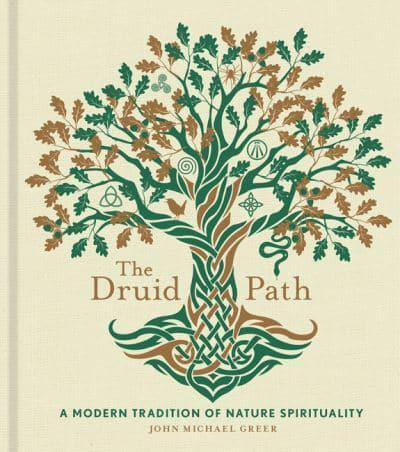
The Druid Path: A Modern Tradition of Nature Spirituality by John Michael Greer
Published by Sterling Ethos, 2021
This book is a great introduction to Druidry. I love a hardcover book, and this little gem published by Sterling Ethos is a really nice production. The corded cover with embossed title, the interior illustrations and the overall print quality is superb. We need more Pagan books that pay attention not only to the content, but also to the print quality and aesthetic! This book will last a long time, for sure. It’s in a nice almost square format too, which is different. It is an introductory book, so it doesn’t go into great length on any given subject, but it does cover all the essentials necessary to begin your path of Druidry.
It is divided into four sections: Part One looks at the sources of Druidry, including the ancient Druids, the Druid Revival and Modern Druidry. This brief history of Druidry covers all the essentials, as well as some new things that I have never come across, including William Stukeley’s elephants (you’ll just have to read the book for more on that one). I am also pleased to see a section on Women in Druidry.
Part Two looks at the Druid teachings, the different strands of Druidry and exercises to help one not just read about it, but also turn it into personal wisdom through experience. The section on “The Two Currents” I had not come across before in my own Druid learning. This chapter discusses the solar current and the earth’s telluric current and how to incorporate that into your practice.
Part Three is the practice of Druidry, an essential section that really shows how Druidry is a living practice, something that must be done, not just read about. I especially like Greer’s words on Druidry as a craft:
“Druidry is not an ideology. Like basketry, forestry, and many other words that end with –ry, it can be best understood as a craft. You don’t become a basket maker or a forester by believing some set of opinions. You become a basket maker by learning and practising basketry, and you become a forester by learning and practising forestry. In the same way, you become a Druid by learning and practicing the craft of Druidry. One of the things this means is that becoming a Druid isn’t an all-or-nothing matter. You start becoming a Druid as soon as you begin learning some elements of the Druid craft, and you keep on becoming a Druid as long as you keep studying and practicing that craft.”
In this section, Greer also introduces us to divination through the Coelbren alphabet, which is not used as much as the Irish ogham taught by many other Druid authors, teachers and organisations. This chapter also gives you some more daily practices and a couple of rituals to get you started.
Part four is about initiation into Druidry. The word initiation means “to begin” and so the ritual set out in this section provides the reader with a definitive point in time where they can say that they started out on the Druid path with directed intention to practice this craft to the best of their abilities. The self-initiation ritual is simple but poignant. Greer ends the book with the following words:
“A more important source of guidance than books and organizations, however, is the time you spend working with the basic practices of Druidry, listening to the One Life, and learning from nature. No one can do that for you. The only thing that limits how much you can learn and grow on the adventure of Druidry is your own willingness to pursue it.”
There is also a helpful glossary, bibliography, recommended resources and index.
I was very pleased with this little book that holds much wisdom. I’d recommend it to anyone starting out on the Druid path who wants a concise introduction contained within a beautifully printed publication.
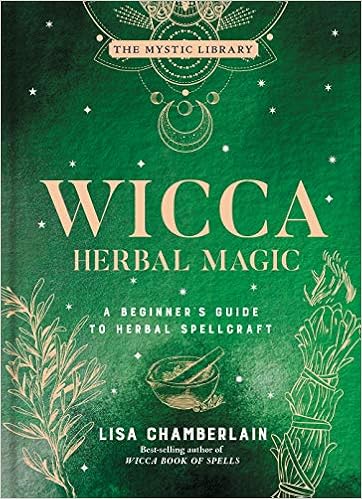
Wicca Herbal Magic: A Beginner’s Guide to Herbal Spellcraft is another fine installment from Lisa Chamberlain in her series of books on Wicca. This one, as several others, is published by Sterling in their “Mystic Library”, a series of lovely introductory hardcover pocket books. I’ve reviewed two others in this series, and this latest one does not disappoint. I adore hardcover books, and the little pocket sizes are excellent for those just starting on the path. They provide enough content to give a basic grounding in the subject, as well as a beautiful layout that really pleases the eye and captures and reflects the written contents of the book. I love these little books!
Lisa Chamberlain’s writing is excellent, as ever.* I liked the way that this book was laid out in three sections. The first is “The Ancient Art of Herbalism”, which contains a kind of short history of herbalism and its shamanic practices, as well as a look at the ancient system of correspondences and the aspects of Hermetics that relate to working with plants (and indeed many magical systems).
The second part of the book, the practical section, looks at thirteen herbs that can be used magically (as well as some of the better-known physical benefits that these provide). Most of these herbs many people already have in their cupboards or in their gardens, such as basil, bay laurel, cinnamon, dandelion, nutmeg, rosemary, sage and thyme. It shows us how we can work with herbs that have a long history in magical works, and without breaking the bank. On top of this, we have some wonderful tips on purchasing herbs, creating a magical garden, foraging, drying and storing herbs and how to use them magically (such as charging herbs before putting them to work).
Part three is an herbal grimoire, with recipes for magical teas which anyone can work with, magical baths, herb and candle spells, smudging, making oils and more. There are also rituals in this section such as blessings. At the end of this work, there is a brief overview of how to work with herbs in relation to astrology, which if you work with natal charts, the zodiac or planetary energy is perfect.
There are also handy tables of correspondences for quick reference at the end of the book.
All in all, this is a great little book to get you started working with our herbal allies. At just over 100 pages, it is not overwhelming and is easy to take in. Lisa’s writing style is informal but impeccable, and makes you want to learn more, try out the recipes and spells and get more involved with the work as a whole. It’s a great little gift for anyone interested in magical herbalism. I’ve been working with herbs for many years now, and I learned some new things in this book – with witchcraft, magic and herbalism, you never stop learning!
*For those in the Pagan community who still (wrongly) profess that Lisa Chamberlain is not a real person, (and the books are written by ghostwriters) it’s time to stop. She is real, she is lovely and I’ve spoken to her. It’s time this misinformation ends. She is a prolific writer, and good on her!
I thought I’d share with you some of my favourite eco-friendly products that I use on a regular basis. I have been buying these kinds of products for years now, and through lots of trial and error, have found which ones really do work, and which ones don’t (at least for me). So, here are my shining stars in the sustainable living category for your bathroom cabinet! Note: I have not been paid to endorse these products by any means, this is a genuine post in which I just want to share some little gems!)
My absolute favourite!
First off, I have got to mention Balmond’s Rosehip Scar Oil. I got this when I was ready to start treating my scar after the hysterectomy last summer. I was advised by the nurse who took out my clips after the surgery to use a specific oil on the scar to treat it, but when I looked up the ingredients it was a petroleum-based product, which is not something I wanted to put on my skin. So, I searched around and found Balmond’s scar oil, and wow – did it deliver! This oil contains rosehips, lavender and palmarosa, which gives it a lovely scent. It is all natural, gentle and works not only to treat scars, but as a facial moisturiser, for stretchmarks, uneven skin tone or fragile skin. It is rich in vitamin A, C, E and essential fatty acids. The main oils are grapeseed oil, rosehip oil, sunflower oil, calendula oil, chamomile oil, and lavender and palmarosa oil. Some, but not all of the ingredients, are organic.
I used this oil on my scar (and still do) and it has faded much quicker than if I hadn’t treated it. My brother-in-law had abdominal surgery last year as well, and we have compared scars. This oil has really helped in healing the skin, as well as keeping the rest of my tummy lovely and soft. I thought, this works so well on the skin for my belly, let’s try using it on my face. I have always avoided oils on my face, because it tends to clog my pores. Not this one. A few drops is enough to do your whole face at night (don’t use during the day, as the oils can increase your skin’s sensitivity to the sun) and when you wake up in the morning, your skin will look refreshed and lovely (at least, mine did). I can’t recommend this oil enough. I use it on my hands at night as well. It seems expensive, at around £18 a bottle, but the bottle lasts 4 – 6 months, depending on how much skin you want to treat with it. I thought it was extremely good value for money, and I’ll continue to use this oil long after my scar has been fully healed. It comes in a glass bottle, with a glass dropper. Sadly the top of the dropper is plastic, but I’m willing to make that concession.
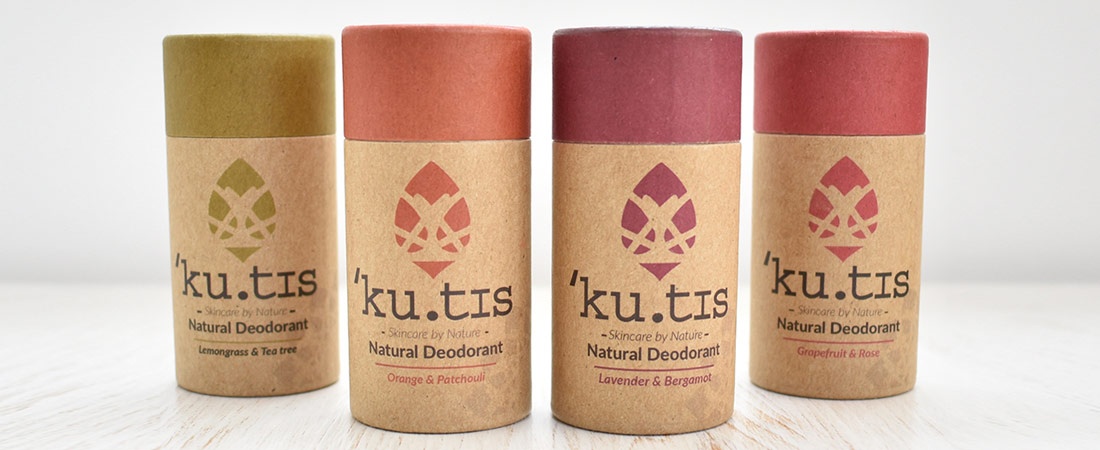
The next stellar product is Kutis natural deodorant. I have spent YEARS searching for a natural deodorant that actually works, and the best that I found for a long time was the solid deodorant from Lush. This still left me a bit swiffy on the hottest summer days, or after a workout, and so I still shopped around. I found Kutis two years ago, and I’ve never looked back. This deodorant really lasts, through two of the hottest summers I have ever known, through kickboxing workouts and belly dance performances – you name it, this product delivers. It has several lovely scent combinations, and my favourites are the citrus ones and the lavender and geranium. The main ingredient is arrowroot powder, coconut oil and sodium bicarbonate. This product contains lot of ingredients that are organic as well, but not all. It comes in a cardboard tube, which is fully home compostable.
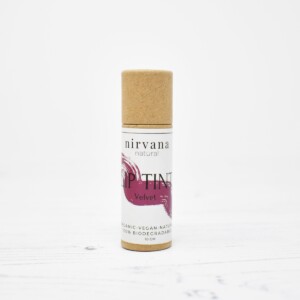
I love my lip balms, especially tinted lip balms. I found Nirvana last year. The lip tint, not the spiritual state. This is an organic, vegan lip tint in a home compostable cardboard tube. I’m not sure about the label being compostable however; I may have to write to them to ask. This lip tint comes in several different colours, but I used the Velvet one all last year. I also used it as a cheek tint too, and it was pretty good, though sometimes it can get a bit oily on very hot days.
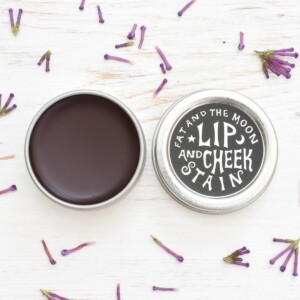
Another lip and cheek tint I found recently is Fat and the Moon. They call their product a lip and cheek stain, but it doesn’t stain at all – it is, in fact, a tint. I would have preferred a stain, for its lasting power, but this doesn’t have it, sadly. It is, however, a lovely tint, but you will have to keep re-applying it, not only to your lips but I also needed a refresher for the cheeks halfway through the day. It gives a lovely natural colour and contains all organic ingredients, though it is not vegan as its base is beeswax. I used to use Burt’s Bees All Aglow for a lip and cheek tint, but the plastic packaging put me off. As soon as Burt gets their act together on the packaging, I’ll be looking into them again.
Finally, let’s talk hair. I have spent YEARS looking for a natural, solid shampoo and conditioner that was SLS free. Everything that I tried (apart from Lush) left my hair a sticky awful mess. Lush works, but contains SLS. Then, at the beginning of this year, I found Ethique, who now distribute from the UK (they are an Australian company). I bought their hair sampler package and their facial sampler. Everything in them was lovely, but I highly recommend their St Clements shampoo for oily hair (mine’s not that oily, but it gives it a good clean) followed by Wonderbar conditioner (again for oily hair, but it works great on my “normal” hair. The full size bars last a long time, and the conditioner bar is a lot smaller than the shampoo bar. Don’t let that fool you. I’m almost finished the shampoo bar, but still have half of the conditioner left! The conditioner works best if you work it through the hair from root to tip, and then brush it all the way through. You also use less conditioner by doing so. The products from Ethique are not cheap – in fact, they’re a bit eye-watering in price, but they are the only ones that I have used that actually work, are eco-friendly, compostable packaging and really good quality.
Do you have a favourite beauty/bathroom product? Let us know in the comments, please!



 Down the Forest Path