Here in the final installment of my YouTube and podcast mini-series on the elements. I hope you enjoy it! To listen to all podcast episodes, please visit my Bandcamp Page.

Here in the final installment of my YouTube and podcast mini-series on the elements. I hope you enjoy it! To listen to all podcast episodes, please visit my Bandcamp Page.
Join me as I set up and perform my ritual for the Beltane full moon, 2020. 🙂
We’re so lucky to live where we do: walk out the door, turn left and we’re out in the beautiful countryside. Here are some photos from our walk today, with summer rolling in. If you would like any of these as prints, simply email me at vanderhoevenjoanna@gmail.com for prices.


This is an incredible short discussion on forgiveness, with wonderful insights. It’s given me a lot to meditate over, on the road to empowerment and responsibility.
I had fun filming this video 🙂 May the Beltane season bless you all!
She calls
And now you know you must answer
Softly at first
At Spring Equinox
She was all innocence
All light-voiced song
And you know She calls
The Queen of the May
The virgin voice now lusty and deep
Full in the belly and full in the throat
Her song caresses you
Like her fingertips caress the belly of Experience
And you answer her call
She calls
And you are faery-led
Into the wild haunts
To lay yourself down
As sacrifice
Upon the altar of ecstasy
To dance free around the faery tree
To let your heart be filled
With the songs of sparrows
And swifts
As they scream overhead
To touch the grace of the deer in the shadows
To feel the heartbeat of the earth
Pulsing beneath your feet
As you set you roots down
Even as you reach towards the skies
The Beltane time is nigh
You hear a cry
And it is your own soulsong
Escaping your cherry-red lips
Filled with laughter
And grief
Freedom
You dance the circle round
Whispering secrets to the trees
The eyes of the hidden folk following
You know who you are
You know who you were meant to be
And in your breathless dance
You sweat your prayers
And She hears them
And with crystalline clarity you know
In the blood that runs through your veins
And the thoughts that course through your mind
In the lives and loves of your ancestors
You know you are not the only one
And you revel in your witchdom
The music slows
The eyes of the does drop to the ground
As they lower their heads in reverence
For here She comes
Sovereignty
And you look into Her in the eyes
And you see the May Queen
You see all that you were
And all that has been
And you nod and you smile
She takes your hand
She knows every crack in your heart
She knows your inner land
And as the bright sun fades
And the stars begin to shine
You honour your past
Your future is bright
And the magic never ends
As day turns into night
She blesses you
With your own inner sight
There is starshine in your hair
There is elphame in your soul
And you remember
All you have been
All you have seen and been told
And you have come home
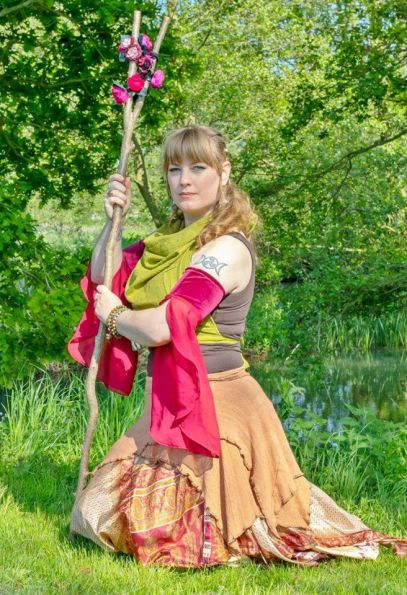
(Photo by Graham Haynes)
 I’ve just been introduced to Danielle Dulsky’s work, and I have to say, it’s been a pure joy to read Seasons of Moon and Flame: The Wild Dreamer’s Epic Journey of Becoming. Dulsky is the author of The Holy Wild, which I shall have to put on my list as well!
It’s been a long time since I’ve read a book that is so poetic. Her style of writing is just pure poetry – there is no other way to describe it. It took me a while to get into that headspace, but after the first chapter I was there, riding the currents of imagery and information, of inspiration and imagination. It’s encouraged me to be more poetic in my own work, for sure!
Seasons of Moon and Flame is a journey that takes you throughout the moons of the year, connecting with the energies of that enigmatic, wild and wisdom-filled Hag. The elder who tells us what we need to hear, but doesn’t couch her words. The one who teaches us without molly-coddling. The one whose lessons can be grasped as easily as plucking dandelion seeds floating on the breeze, or has hard won as climbing a steep and lonely mountain.
The key word is “wild”. Using the archetype of the Hag, the grandmother, the sacred Elder, this is a book for the mystic, the nature mystic whose heart beats alongside the earth’s heartbeat, whose soulsong is as enchanted and free as the hawk that soars on the thermals. Seasons of Moon and Flame teaches us to live in balance and harmony, with our selves and with the natural world around us, allowing the inspiration of nature to show us how to live our lives accordingly, in tune to the cycles of life. Our own stories are epic myths that must be lived. We hear the grandmothers calling, calling out their pain, their triumphs, and we know that we share in their stories. The Hag tells us to stop, to listen, to really be in the moment, to experience this for all it’s worth, because we are the living generation, now, today, that foretells the future of generations to come. We are Her children, and we will become Her in time, wiser and wrinkled, with a mischievous smile behind our eyes and the knowledge of the world in our bones.
This book is full of practical knowledge, rituals that you can perform, stories from our ancestral past and the poetry of today. Each moon we follow what is happening in the wild around us, exploring the nature of nature in our souls and in our environment. The final lesson of the Hag is as follows:
“Our Bones Want Belonging.
In the end, we all want to belong. We will go to all lengths to feel we belong to something, to some tradition or group. We will overidenifty with flawed organizations, let ourselves be hazed, shun the whole parts of ourselves, leaving them forgotten in shadow, while we put others in the spotlight in order to appear special or good. All the while, we do belong to great and immense collectives. We all have rich Earth-based ancestries if we go back far enough, We all have immense ancestral stores we can use to bolster our resilience and work for a broader, more just, more whole world. Our bones want belonging in a postcolonial world, and our grand story is not about questing and running, not about journeying so far from who we are or what we have become; it is a story of coming home to the house of the hag, returning to a place that part of us – the better part, maybe – never ever left.”
This book is a great guide post to walking in our own true nature. We walk with the hags of Spring, Summer, Autumn and Winter, and they teach us to come home to ourselves. Their lessons help us to remember our selves, to remember who we are in a world that tries to tell us differently. With this book, we definitely come home.


My Elements mini-series podcast now has its fourth installment. This mini-series is available for free on my YouTube channel. You can also listen to all the other podcasts, along with audiobooks, meditations and more with my Bandcamp subscription.
 Down the Forest Path