Of Chalk and Flint – A book review

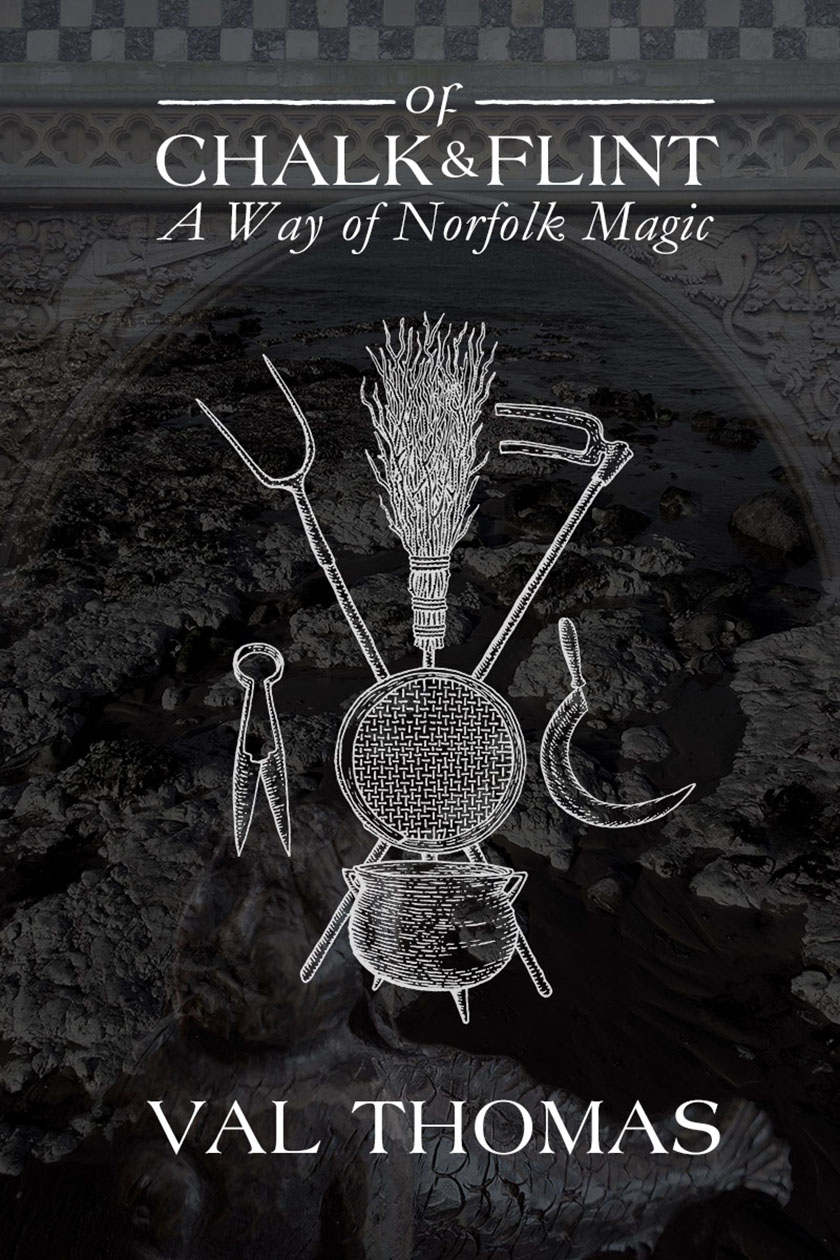
Of Chalk & Flint - Paperback Edition cover gallery imageVal Thomas’ Of Chalk and Flint: A Way of Norfolk Magic was the first book I bought this year. And I have a feeling that it will be the best book I’ve read all year, or for many years!

Of Chalk and Flint is a large tome of magical information rooted in the chalk and flint of Norfolk, in East Anglia, UK. Though it is a sizeable book, the material presented within is honest, without pretention and still hugely informative without being academically dry. We get an insight into how those of the Nameless Tradition within Norfolk work, their vision of deity, of the powers of nature that surround them, of the times and tides, the history and the lore of this eastern county. Though I’m a Suffolk girl now, I used to live in Norwich, and then in Loddon, and I can relate to many of the places and the history presented in this book. It’s a wonderful and inspiring book, to get you deeper into your own tradition, wherever you live.

It begins by looking at the Lord and Lady of Norfolk, the deities represented in local form, the goddess and the god. Here in my part of Suffolk, the Lord of Flint is all around, on the heath and in the fields, on the shoreline and in the forests. The Lady of Chalk resides on the other side of the A12 from where I live, and so The Lady for me here is the Birch Lady, whose trees are everywhere, or otherwise the Lady of Sand, as the arid soil where I live is abundant, both on the heath, in the forest and beneath the shingle of the beaches. Thomas’ view of deity inspired me to deepen my own connection to the land where I live, to open my heart to the deities even more, and to know them by naming them.

The second chapter looks at sacred places, and consists of local lore combined with accounts of energies and magical workings that the author and others have enjoyed at various sites around Norfolk. We then move to Spiritual Beings in chapter three, where we are given the lore of such creatures as the merfolk and the ferishers (fairies), again which sing to my heart as near to where I live we have the tale of the Merman of Orford, as well as a host of ferishers, frairies, pharisees, faeries and more.

We then move onto the Quest of the Year, where the author in great and exquisite detail gives us an account of the seasonal celebrations, the flora and fauna that abounds, rites and ritual ideas from the Nameless Tradition of witchcraft. It makes you want to take up spinning, or whip up some homemade marmalade, or visit certain places at midsummer. Following chapters include materia magica, items that can be used in the Nameless Tradition, such as holey stones and the like as well as magical tools, working magic effectively, information on coven working and public gatherings and moots, and famous practitioners from Norfolk.

The way that Thomas writes makes you feel at home. It’s as if you’re sitting down to have a cup of tea with your favourite aunt, while she spins stories or thread on a spinning wheel. You can almost smell the herbs drying from the rafters, and feel the sun beating down on your head out in the Brecklands as you traverse the landscape. This book takes you through the wonder of this county like a friend would, and this is a friend I would trust wholly, for it is clear that she walks her talk, without arrogance or humility, but with a sense of pride in the natural lore, and an honest presentation that comes from the true wisdom gleaned from marrying intelligence and experience.

I cannot recommend this book enough. It is available from Troy Books. I may save up my pennies to buy a hard-cover copy, to treasure for the rest of my life.
Video Update 12 February 2020

It’s been a difficult few weeks, but things are back on track again. Hot date with an MRI scanner tomorrow on Valentine’s day, and then hopefully surgery will swiftly follow. Police received confession yesterday from the man, and he has been given a caution and it’s on his record. Looking now towards getting creative again, painting and making videos, taking photographs and also working on the new book!

New Podcast Now Up!

Here is the latest in the Elements podcast mini-series, where we look at the element of fire. Hope you enjoy! You can download the entire podcast series, as well as everything else on my Bandcamp page, with a subscription.

Medical Issues and more…

Apologies for the gaps in posting these last few weeks! I’ve been to and fro from the doctor’s surgery, clinics and the hospital. I’ve got uterine fibroids and a big ovarian cyst (all benign) and am now awaiting and MRI and then an appointment to have the cyst removed. Looking forward to the surgery, it will be such a relief!

Trigger warning for the following…

I’ve also had to deal with the police, as a man indecently exposed himself (and worse) in my back garden last Monday (a local chap who’s been helping me with the garden these last three years, for crying out loud). Statements from the police have been taken, and we’ll see where we go from there. The garden’s energy has been cleansed, and it is well-warded now. It feels better than it has for months.

So, postings may be a bit “here and there” until everything has been sorted, but I am still here! And life just happens, and we get on with it as best we can.

Ancestors and gods at our backs, and the spirits of place all around us to inspire us with courage and beauty.  xoxo

Imbolc Protection Ritual

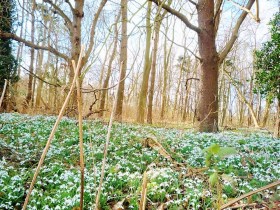
Snowdrops ButleyThis rite uses what is commonly known as “The Descent of Brighid” from the Carmina Gadelica. This rite specifically calls upon the powers of the goddess Brighid, and cannot be used interchangeably with another goddess. If you honour or work with other deities, you might consider using the poem as an example to write your own spell or charm of protection. Alternatively, you might just leave out all the references to deity. At the end of the poem, we find the term luatha-luis, whose meaning is not wholly clear, and which is open to interpretation. It may mean a fast-acting, possibly poisonous plant. Luis is the rowan or mountain ash, a powerful and magical tree, whose berries are poisonous when raw, but delicious and nutritious when cooked.
You can perform this ritual every Imbolc, especially if you are a follower or would like to honour Brighid. Or you can simply use it as a rite of protection. You can perform this rite after undergoing a purification such as smudging or saining yourself with smoke from mugwort or vervain.
For this ritual, I would strongly encourage the entire formality of designating sacred space. This will lend focus to your intention, as well as inviting the powers of the ancestors, the three realms, the spirits of place and more to your rite. Choose something that symbolises protection for you, a talisman if you will: something strong and durable, something that will “shield” you physically, spiritually and psychically. You can make a shield yourself, using whatever materials you prefer. This doesn’t have to be a full-body protecting hunk of steel, but again can be symbolic; you can make one out of papier maché to keep near your altar, should you so wish. You might wish to use something natural that you can carry with you, such as a stone or crystal, or even say the poem over a pendant bearing the triskele or triquetra symbol, reflecting the triple nature of Brighid. There are many ways you can use this; be creative!

Rite of Protection Using the Shield of Brighid

Set up and designate your sacred space. Once you have done so, sit or stand for a moment and breathe, focusing your intention on what is to come. Visualise a glowing light beginning to emanate from within, centred on your chest. This light reflects the light of the moon, or the light upon water, or the light of a flame. The energy from this light is not hot, but cool, flowing through you and filling you with strength and confidence, as well as compassion and love. Raise your arms to the sky, drawing down the power of the sky and the full moon. Then hold your hands out in front of you, and draw in the power of the sea, and the highest tide. Finally, hold your hands to the ground, and draw the power of the land into yourself, the serpent energy that courses and connects everything to each other. Stand fully upright once more, noting how the light emanating from within you is even brighter now. Take that light within your mind, and form it into a circle or sphere of light around you. Visualise that light encompassing you, shielding you. If you have a talisman to represent the shield, hold this aloft and still visualise the circle around you. Then say the following words, from “The Descent of Brighid” from the Carmina Gadelica, feeling free to adapt or leave out the Christian influence:

Brigit daughter of Dugall the Brown
Son of Aodh son of Art son of Conn
Son of Criara son of Cairbre son of Cas
Son of Cormac son of Cartach son of Conn.

Brigit of the mantles,
Brigit of the peat-heap,
Brigit of the twining hair,
Brigit of the augury.

Brigit of the white feet,

Brigit of calmness,
Brigit of the white palms,
Brigit of the kine.

Brigit, woman-comrade,
Brigit of the peat-heap,
Brigit, woman-helper,
Brigit, woman mild.

Brigit, own tress of Mary,
Brigit, Nurse of Christ, —
Each day and each night
That I say the Descent of Brigit,
I shall not be slain,
I shall not be wounded,
I shall not be put in cell,
I shall not be gashed,
I shall not be torn in sunder,
I shall not be despoiled,
I shall not be down-trodden,
I shall not be made naked,
I shall not be rent,
Nor will Christ
Leave me forgotten.

Nor sun shall burn me,
Nor fire shall burn me.
Nor beam shall burn me.
Nor moon shall burn me.

Nor river shall drown me.
Nor brine shall drown me.
Nor flood shall drown me.
Nor water shall drown me.

Nightmare shall not lie on me,
Black-sleep shall not lie on me.
Spell-sleep shall not lie on me,
‘ Luatha-luis ‘ shall not lie on me.

I am under the keeping
Of my Saint Mary;
My companion beloved
Is Brigit.

Let the words sink into the air around you. Let them suffuse the light that encircles you with their power. When you are ready, draw the circle of light that surrounds you back into yourself, centred on your chest. If you have a special talisman that you’d like to infuse with this energy instead, draw the circle of light that surrounds you into your talisman. When all the light has gone where it should, stand for a moment and see how this makes you feel. You can test the circle of light, by holding up your dominant hand (right if you are right-handed, left if you are left-handed) and immediately bring the circle of light back around your being. See it spring back up with ease, to surround you and protect you. If you are using a talisman, see it coming forth from the talisman. You can call and release this power as you wish, as you need. It is not something to be played with, but something real, an energy being focused around you. You are connecting with the power of Brighid.
When you are satisfied that you have the protection you need, it is time to reciprocate and leave an offering for what you have been given. As the lady of poetry, smithcraft and of healing, an offering related of one or all of these would be suitable.
Close down your ritual, and renew this rite of protection whenever you feel it necessary.

This ritual is an excerpt from my latest work, The Book of Hedge Druidry: A Complete Guide for the Solitary Seeker, published by Llewellyn Worldwide.

(c) Joanna van der Hoeven 2019

My second painting

Here’s my second attempt at painting yesterday, using all natural Earth Paints (I’m not sponsored, I just like them!). This time I used the Bob Ross technique, of wet on wet. This scene is inspired by childhood memories of cross-country skiing every Sunday in the winter, through the woods to the golf course. The mountain in the background is similar to the one you can see from the end of the trail. I wanted to try a very simple colour palette as well. It was fun, seeing it happen on the canvas, emerging with the awen!

New video about Imbolc is now up!

Learn about the festival of Imbolc, and how to incorporate it into your magical life 🙂  Subscribe to my Youtube channel to keep up to date with all my new videos! Blessings of the coming gentle time of Imbolc to you all. xoxo

Photo Prints now available!

Just a quick note to let you all know that I have a selection of photo prints now available to purchase from my website! More will be added in time 🙂

Living Lagom: 1

So, let’s start my little series on living a lagom life this year. First of all, perhaps we should define our terms: what is lagom?

P1020220 (5)Lagom is a Swedish word whose general meaning is about finding a personal balance that works for you and your lifestyle. This is often reflected in others who follow a lagom lifestyle, and you may see similarities in style, consumerism, eco-issues, work/life balance, relationships and a whole host of issues related to everyday living. It is often translated as “not too little, not too much, but just right” or “just enough”.

There are two schools of thought in the etymology of the word. The first, and the one that I like best, is that it stems from the Vikings, who when passing a horn of mead around the group ensured that no one was left out and that there was enough for everyone. You took a drink in the right amount, so that there was enough to go around. It was a way to ensure that the community stood strong, that no one took more than was their due, and that there was a sense of balance and equality to ensure the benefit of the whole. In this etymology, it is rooted in the words laget om, which means “around the team”. The second school of thought derives from the word lag, which means law. Following protocol and law allows everyone to live happily together, because everyone understands the boundaries.

There is a Swedish saying, lagom är bäst – lagom is best. Moderation and just the right amount is the best way forward for all.

Stones pile background. Scales balance. Balanced stones on the top of boulder. Decide problem. To weight pros and cons. Balance of stones on a blue sky stock imagesDo Swedes go to excess in anything? Of course. We’re all human. But it’s a philosophy, in a way, that is embedded in Swedish culture. I see it as akin to the values of moderation found within Buddhism. Finding that balance point where there is satisfaction, but not excess.

So I’ll be exploring lagom in this little blog series, talking about lagom in daily life. How can lagom be applied to your wardrobe, your house, your relationships, your work, your family, your exercise routine, your health, your diet? I’ll share my experiences with you, and also some of the resources that I find along the way. I hope you enjoy this little adventure with me, small but so satisfying, and totally lagom.

Recommended books:

Lagom: The Swedish Art of Living a Balanced, Happy Life by Niki Brantmark

(The best book on Lagom, in my opinion).

Lagom: The Swedish Art of Balanced Living by Linnea Dunne

(My second favourite, but some pages are hard to read because of the colours behind the lettering.)

The Lagom Life: A Swedish Way of Living by Elisabeth Carlsson

(Filled with beautiful images and a taste of the lagom life.)

NØRTH: How to Live Scandinavian by Brontë Aurell

(My favourite book on all things Scandinavian. Written with wit and humour, and jam-packed with info about most everything to do with Scandinavian life.)