The Runes: Rād

In this blog series , we will go through the runes as they are recorded in the Anglo-Saxon or Old English Rune Poem.

The fifth rune, Rād or Raidho  as it is commonly known, means “riding” and is mainly concerned with travel and roads, pathways and suchlike, but has lots of other lovely aspects to it such as partnership, co-operation, and sometimes even good luck. In the Old English Rune poem, Rād is defined thus:

“Riding is for every man in the hall

Easy, and strenuous for him who sits upon

A powerful horse along the long paths.”

As someone who has worked with horses for many years, I can see the truth is this kenning quite clearly from a literal viewpoint. When we have a powerful horse beneath us, we need to learn how to work in co-operation with its own power, instead of trying to overpower it ourselves. Horses work best with us if we use a “power-with” model, instead of a “power-over” model, especially when working with dominant or lead mares.  If you are fighting against the horse’s own power (and it’s way bigger and stronger than you) and are on a long road, then you will be exhausted by the end of it. Instead, learn to work with the horse’s energy, a blending with your own and form a true relationship, one of reciprocity, of give and take. You’ll get where you need to go in life a lot easier that way.

This rune also makes you consider your “seat”, or how you sit in the saddle. You have to work with the horse, and your seat is just as important as the reins. How you sit will greatly influence the horse, as it can feel the slightest movements in your weight, legs, hips, even the turning of your head. Many people think that riding is all about the reins, but first and foremost, it’s about your seat. If you weight is too far forward or too far backward, for instance, it will impair what you and the horse are trying to achieve. So Rād/Raidho is a good reminder to be mindful of how you are in the world, in order to move through it better.

Pollington suggests that this rune may have been used as a good luck charm for travel.[1] If you are planning a journey, or wish to go on one, using this rune could be very beneficial. The shape of the rune even suggests travel, as the rough outline looks like the head and neck of a horse. As stated above, it could also mean power, and even wealth, for horses have always been expensive to keep. Don’t forget that not all travels occur in this world – this rune could symbolise travelling between the worlds too.

Even the deities used horses – Odin has his eight-legged Sleipnir, and the wains of the Sun and Moon are drawn by horses. There is a beautiful Bronze Age solar chariot in Trundholm, Denmark, with a very lifelike representation of a horse (strangely, on wheels) which may symbolise the turning of the year.

Rād is to work with a powerful ally. Use it in your travels, both in this world and the Otherworld. Be mindful of your seat, and work in co-operation. Rād is not only the means of travel, but the road itself.

Sources:

Albertsson, A. Wyrdworking: the Path of a Saxon Sorcerer, Llewellyn (2011)

Gundarsson, K. Teutonic Magic: A Guide to Germanic Divination, Lore and Magic, Thoth Publications (2007)

Pollington, S. Rudiments of Runelore, Anglo-Saxon Books (2011)

Rance, S. The English Runes: Secrets of Magic, Spells and Divination, Dragon House (2017)

Waggoner, B. A Pocket Guide to Runes, The Troth (2019)


[1] Pollington, S. Rudiments of Runelore, Anglo-Saxon Books (2011)

Mist Drum Song

At the end of filming on the heath this week for my next video, I took some time out as the mist was settling in. I felt called to pull out my drum and sing to/for the mist, and this is the result 🙂

Surrendering

Since the release of his book, Surrender, I’ve been thinking about this concept that Bono talks about in so many different ways. In one tale, presented live on the “The Late Show” (see video below) it really struck a chord within me (pun totally intended).

He talked about how he had (and still has) to approach his wife of 40 years within such terms. He spoke of approaching her like this: “Only if you arrive at her fort defenceless, do you have half a chance in challenging her own, almost unbroachable defences”.

I thought that this was utterly beautiful. It could be applied to so much in life, not just your loved one. For me, it’s about being authentic, about being truly and utterly you, to whomever it is you are trying to connect with. It could be your life partner, your parents, your children, your gods, your ancestors, your community.

When approaching the gods, there is no point in putting up a mask, surrounding yourself with defences. They are gods. They see through all that crap. If you choose to open up your soul to a god, then there is no need for games, for duplicity or falsehoods of any kind. There is only you, and the deity.

It’s much the same with your life partner, family, ancestors, even those of your community. Those who think that they are fooling you with guises and masks are only fooling themselves. People are more perceptive than many think. We know when something or someone is “off”, it’s just that often we choose to ignore that instinct.

Authenticity is about surrender. It’s about being utterly human, being utterly you. It’s acknowledging the good and the bad and everything in between. It’s about working towards being the best person you can be, without masks, without disguises.

This doesn’t mean you have to let go of all boundaries. But if you truly want to connect on a soul-deep level, it is about being totally, utterly you. Letting down your defences also allows those to come to your aid. Keep them up, and they keep everything and everyone out.

The concept of surrender, and of defences, is one that I am going to chew over for quite some time this winter. In the stillness and silence of a winter’s day, in the overarching darkness of a long winter’s night, I am taking this to heart and really experiencing what it is to live in this manner. It will will, I think, open up new ways of living and being that before were only imagined.

This winter, I am surrendering.

New video now up for Samhain

After a couple weeks of filming on the heath and gathering footage, this new video is now up! A behind-the-scenes video will be available shortly on my Patreon community site 🙂

Interview on The Witching Hour with Patti Negri

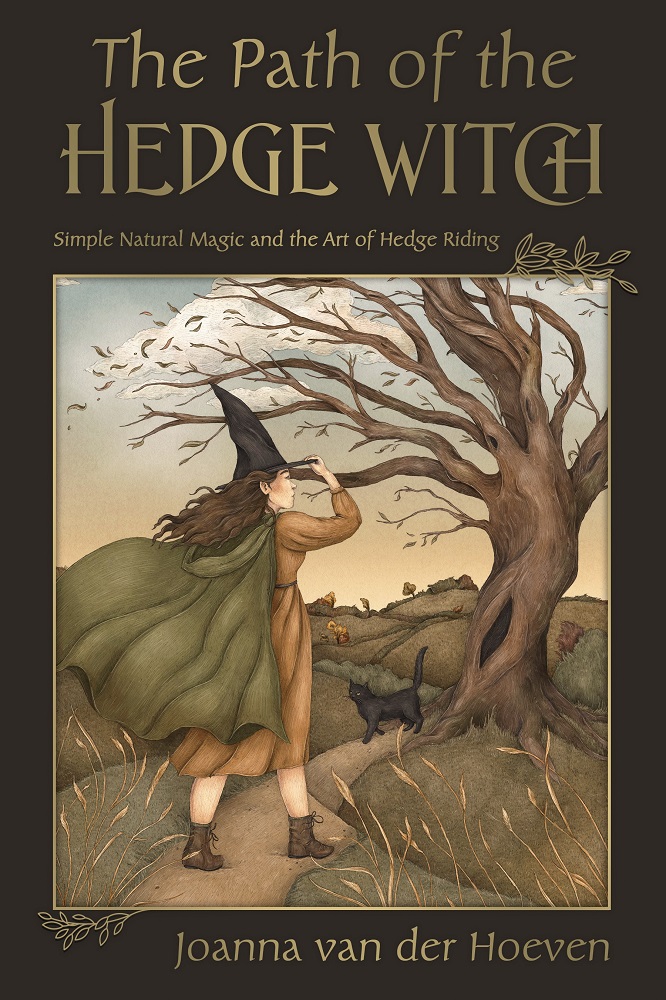
Last month I was interviewed by Patti Negri from The Witching Hour YouTube channel. We talked about my upcoming book, the Path of the Hedge Witch, which is out on 8 Oct for the Kindle version, and 8 November for the paperback. Audiobook to come later!

Paperback pushed back…

Release date for the paperback version of The Path of the Hedge Witch has been pushed back due to backlog at the printers. We’re now looking at November 8 release for the paperback. Kindle version still looks to be on track for and October 8 release though!

Interview with Eron Mazza!

Last week I had the most lovely interview with Eron Mazza on The Witching Hour podcast. You can listen to the whole thing HERE.

The Most Important Page of Any Book

The Most Important Page of Any Book

There are now lots of Pagan books out there, on a huge variety of subjects. Some are new, some are old, some are out of print but still available through second-hand shops and websites. I’ve recently been perusing some older and out of print books on Wicca and Witchcraft, as well as Paganism in general and it’s really hit home just how much one page of a book can make all the difference. In fact, it’s the most important page of any book. And what is that page?

The page at the beginning of a book that has the publishing details on it.

What? Yeup – that’s the bit that I find the most helpful from the start. Why? Because it gives you context. You can find out just when the book was written, so you will see © 2001 Witchy McWitch. These few words give you an idea into the time in which the words were penned, a snapshot in time as to what facts and truths were available, and what were not, and how they were presented. Under that you will see the publishing dates, such as “First published in 2012 by So & So Publishing”. There will be the initial publishing print date, as well as other information to let you know how many printings of this book there has been.  If you are buying the book brand new, this reprint information gives you an idea of how popular the book is, as well as the possible opportunities for correction during subsequent print runs by either the author (if they’re still alive) or the publisher (if at all possible).

So why is this important? Well, information changes, history changes as new facts come to light. Knowing just when a book was written will allow for some leniency with regards to what was known at the time, versus what we now know after decades of research. I can forgive a book that is 20+ years old for not having a good history of witchcraft, for example. With even older books I can be more forgiving. The use of terms such as “shaman” and “shamanic”, as another example, can be forgiven because that was the term being used at the time. If the book hasn’t undergone a reprint recently, or has been out of print for a while, then this information just can’t be changed. And this is, at least to this author, a source of anxiety. I don’t know about other authors, but often when you put stuff out there, it’s out there for good and people can forget the context in which it was written.

People change. Facts change. Views of history change. What is politically and socially correct, changes. But old books can’t change. Not unless a new publishing company picks it up, the author is still alive to consult about making the changes, and everyone is happy to go along with it. But so often I will see criticism and horrendous reviews of old books regarding the information contained within. If you look at the book within context, you will know that it is out of date regarding historical accuracy, and then you might be a little more lenient. But instead people slam the old authors, those who many of us from Gen X and previous grew up with. We know that some of the information is wrong, or outdated, if we have the privilege of being able to keep up to date with the latest books and information (and in today’s growing economic crisis here in the UK, and around the world, we know that people have less and less money to spend). Think about it for a minute. If you haven’t been able to buy a new book on an aspect of Paganism in the last decade or so for whatever reason (no money, no time to read it because you’re working two jobs and trying to raise kids, etc.) you won’t have the most up to date information. But people will still criticise you and the books that you have for it, when it is beyond anyone’s control.

(There is a caveat here – some books do just contain information that was made-up at the time, and the author knew it. Or it was just poorly researched when information was quite readily available at the time. I’m thinking of a certain book written in 1990 that states the ancient Irish peoples carved pumpkins. Yeah. We knew better even at that time.)

Books are a luxury. For sure. Not everyone has the ability to do the in-depth research, to keep up to date with the latest information and the world of academia. For some people it just bores the crap out of them. Some people are doers, not readers. We have to take a look at the bigger picture, and stop cancelling authors whose books are out of print, as well as over-criticising people for not keeping up to date with the latest academia. It’s just not possible for some people to do. It’s utterly beyond their control.

I am so lucky that I am able to search around to find these old books, to add to my collection. I am so fortunate that I am able to buy new books with the latest academic research. I understand my white, middle-aged woman privilege here. Which is why I’m not ranting at others online or in person about the material they present, the authors they like, the books that they’ve read or not read (apart from my small caveat above). Because there’s a whole world of circumstances that I cannot possibly understand.

People are throwing out, or at least recycling old books because some of the information in them is out of date, contains bad history or what not. But as I’m re-reading these old books, every time I pick one up I look at the publishing details, to remind myself of the context. I can then be more forgiving. It doesn’t mean that all the material is worthless – it means that we have learned a lot more since this book was written. Now, if it was a brand new book written in the last few years, I might have a different attitude, but again there are variables: is the book self-published? If so, then there aren’t any external editors to say to the author “Look, this claim that you make has been shown to be false, here’s some research for you to look up” or some such. Circumstances matter.

Acknowledging circumstances help us to live more compassionately.

One last thing to think about is that authors, if they have the good fortune to have kept going throughout the decades, will contradict themselves sometimes. This is a good thing, because it is showing growth (sometimes in the wrong direction, it may seem, but it shows that they are still seeking). I released my first Pagan book in 2012, written in 2011. I am most definitely not the same person I was 10+ years ago. I have said things in my older books that I cannot say today, because my life has changed. I mention in one of my old books that I’m vegan, but I haven’t been vegan for a long time now, for various reasons. But someone reading that book will still think I am, or may even criticise me later on when they read a subsequent book and find my position has changed. The history that my older books contain may not stand up to the test of time. But the message, the exercises, the feeling and the passion hopefully will, as long as people understand the context in which it was written.

Words are funny things. They’re like stones, and if you put too much stock in them, hold too many too close to your heart, they will weigh you down. We have to let some of them go, in order to fly. We have to change and adapt with the times, realise that there are circumstances beyond our control, or that we aren’t even aware of while holding a compassionate regard for the past, and an understanding of just how far we have all come.

In-Person Classes coming up this autumn

New classes this autumn in Woodbridge, Suffolk!

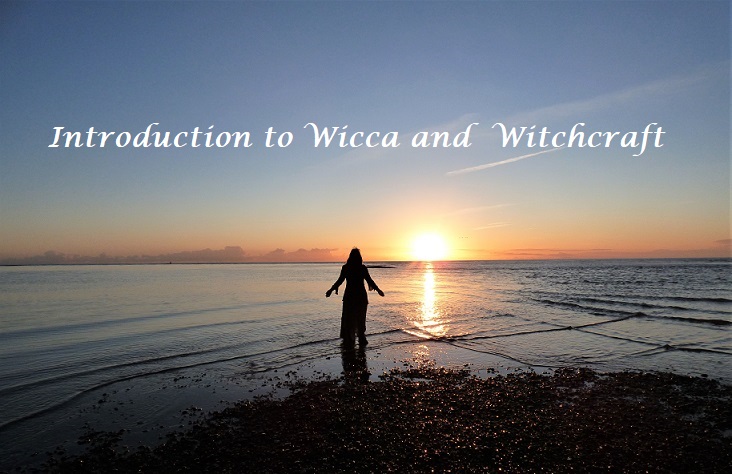
Introduction to Wicca and Witchcraft: A Nature Spirituality

Have you ever wondered why nature spirituality is on the rise? What is it that Wiccans and Witches do? Have you ever felt moved by the beauty of the full moon, the waves on the beach, the heart of the forest, and known that there is something more? If so, then this course may be for you.

Joanna is an author and a teacher and has been active in the Pagan community for over thirty years. In this introductory course, she shares her knowledge of the Craft and how important it is today. She emphasises being an integral, functioning member of your local ecosystem, and how we can work towards creating balance and harmony with the natural world. Through an understanding of Wiccan and Witchcraft theology and concepts, she demonstrates how we can bring peace, understanding, compassion, love and wisdom to the world, as well as find personal meaning and deep relationship with the earth and all her creatures.

In this course you will learn about:

• The natural cycles of the seasons, the sun and the moon

• The duality of deity as seen in a Goddess and a God

• The four elements and how to work with them

• How to create a personal daily practice

• Energy work and introduction to magical practices

This course is set out over four weeks, every Thursday night a week at a local public venue in Woodbridge, Suffolk. Each class will be 2 hours long, including breaks. Parking is free, and the venue is wheelchair friendly and also has an induction loop for the hearing impaired. This class is open to all who have an open mind and a willing heart. *Please wear a face mask, as the teacher (and possibly others in the class) have daily face to face contact with clinically vulnerable people.*

Payment for this course is on a sliding scale, and determined by the individual. Simply pay what you can afford at that moment. We aim to cover the costs of the venue hire and materials (there will be handouts, for example). If you are unable to pay, you may be able to help out by setting out tables and chairs, for instance, in a fair exchange of time and effort instead of a monetary contribution.

Please email Joanna at vanderhoevenjoanna@gmail.com for more information and to sign up. To find out more about Joanna, please visit her website at www.joannavanderhoeven.com