Samhain: The Origins of Hallowe’en

This article is in response to an article in my local village newsletter, declaring the so-called “evils” of Hallowe’en. Hallowe’en is not evil and is, in fact, a very ancient British tradition that spread to North America.

Hallowe’en stems from an ancient British tradition of the Celtic peoples. It was, and still is known as the festival of Calan Gaeaf (Welsh) or Samhain (Irish) which begins at sunset on the 31st October and runs to sunset on the1st November accordingly. The Celtic year was divided into two halves, the light half and the dark half. The light half began at the beginning of May, which marked the start of summer. The dark half began at Samhain (Irish) or Calan Gaeaf (Welsh) which marked the start of winter. The word Samhain is thought to be derived from “summer’s end”, being a linguistic inversion of sam-fuin.  Samhain is a time that lies between times, and is a time that is not a time. It is the end of summer, and marks the time just before we enter the dark half of the year, often referred to as the Celtic New Year. It is a liminal time, and begins at dusk on 31st October on the calendrical year. (All Celtic holidays begin at dusk, the day before the calendrical date.) Some Druids follow a more agricultural or seasonal calendar, and celebrate Samhain when the first frosts appear. 

Samhain is known popularly today as Hallowe’en. This stems from the Christian Hallowmass. What is interesting to note is that the Feast of All Saints, which follows the day after Hallowmass used to take place in May. It was moved in 834 to the 1st November, presumably to compete with the more Pagan traditions in an attempt to move the common folk away from such beliefs and practices.

Samhain is a time to remember the dead, and to welcome them. The dead are never far from us, and the Celtic worldview comprised a sort of ancestor veneration found the world over in Pagan traditions. Deceased relatives could come and visit the home, and so door were often left unlocked so that they could enter. Some use the tradition of a “Dumb Supper”, where food and places are laid out alongside the family’s fare for the dead, and the meal is eaten in silence. These plates were then taken outside as offerings to the spirits and the Fair Folk. Hollowing out turnips or sugar beets, and later pumpkins (which were/are much easier to carve) and placing a candle inside could provide a lantern by which the dead could find their way. Candles may have been left in windows as well, to help guide the way. Apples as well have a place at this festival, for one of the traditions was for a maiden to peel an apple and throw the peel over her shoulder: the letter that it formed was the initial of the name of the man she would marry. The custom of bobbing for apples is also thought to derive from Samhain traditions, with the lucky (and wet!) winners receiving fortune for the rest of the year. Brushing your hair and eating an apple while looking in a mirror at Samhain was said to reveal in the reflection the face of your true love. Modern-day trick or treating is said to come from the ancient buachaillí tui, disguised people who characterised the dead and lead a white mare (hobby horse) called Láir Bhán. This horse was symbolic of the goddess of the land.

At Samhain, when we arrive at summer’s end, is a liminal time. The veils between this world and the Otherworld are thin, and so we see the custom of dressing up or guising to protect the living from the “unhappy dead”. It could also be seen as an acknowledgement of the dead returning, and as a sort of celebration of the fact.

Samhain was celebrated by the Druids in Ireland high on the hilltops with fire, from an ancient ritual on Tlachtga or the Hill or Ward in Meath.  Tlachtga was sacred to the Druids, whereas Tara was the place of the High King. Tlachta could be viewed from Tara, and a fire on Tara may have been lit in response, allowing the Druid’s to light their fire first, in their role as advisors.  The Feast of Tara took place three days before and three days after Samhain. There is an alignment of the sun and moonrise from at Samhain from Tlachtga to a standing stone in Slieve na Caileach and also Lambay Island. Tara has an alignment from the Samhain sunrise to “Lugh’s Seat” at the “Pillars of Samhain” and a cairn dedicated to the goddess, Mór-Ríoghan above the Keash caves in County Sligo.  In Irish tradition many ancient hills and fairyforts were connected by paths which the Sidhe were said to travel. At Samhain, the Celts would be taking their cattle down from the high grounds to their winter lodgings, and so would the Fairy Folk. It was wise to avoid the fairy paths or alignments on this day/night for this very reason.

At Glastonbury in Somerset, England, the Wild Hunt is said to ride out of the hill of Glastonbury Tor, with Gwyn ap Nudd, the Lord of Annwn at its head. He collects the souls of those who have died over the past year, and acts in the role of psychopomp, leading the souls to their rightful place in the Otherworld or afterlife. Fire rituals may well have been a part of ancient ceremony on the Tor, being a hill that could be seen for many miles in the surrounding flat countryside. Recently, a Samhain fire festival honouring The Wild Hunt now takes place at Glastonbury Tor every year, and is hugely popular, with modern-day Druids officiating the ceremonies.

In County Derry in Ireland, they celebrate the Spirit of Samhain, or Spiorad na Samhna. It is a hugely popular event, with over 30,000 people coming to participate and enjoy the festivities today, with a parade and fireworks, acrobats, fire-breathers, stories, song and more. This is echoed in Edinburgh, Scotland, where the Beltane Fire Society also holds a Samhuinn event every year. This began in 1995 and has grown ever since, with street performance and theatre in the heart of the city. A large, dramatic ritual ceremony is created and re-enacted each year by different groups which include dancers, drummers, actors and more.

So as you can see, Hallowe’en is not evil. It is an ancient tradition which people across Britain are still practicing today. It is a celebration and veneration of our ancestors, much as others festivals across the world do at this time of year, such as Dios de los Meurtos, or the Day of the Dead in Mexico. Simply because something is not Christian, doesn’t make it evil.

Resources:

Baker, Des “Spiora na Samhna”, Underground Short Film Festival, 2015

Butler, Dr Jenny ” The Festival of Samhain & Halloween in Ireland “, Crypt Interview

Eastwood, Luke “Tlachtga and the Ancient Roots of Hallowe’en/Samhain”, Order of Bards, Ovates and Druids

Hutton, R. (2011) Blood and Mistletoe: The History of the Druids in Britain: Yale University Press

Restall Orr, (2016) E. This Ancient Heart 2016 Moon Books

Restall Orr, E. (2004) Living Druidry: Magical Spirituality for the Wild Soul: London: Piatkus Books Ltd

Talboys, G. (2002) Way of the Druid: Rebirth of an Ancient Religion: O Books

Telyndru, J. (2005) Avalon Within: A Sacred Journey of Myth, Mystery and Inner Wisdom

van der Hoeven, J. (2014) The Awen Alone: Walking the Path of the Solitary Druid: Moon Books

van der Hoeven, J. (2021) The Book of Hedge Druidry: A Complete Guide for the Solitary Seeker: Llewellyn Worldwide
What Is Hedge Druidry?

There seems to be some confusion over just what Hedge Druidry is, even in the Druid community. I should hope that my writing will clear up some of this confusion and misperception, and for a full account there is always the work that I am most proud of, which is The Book of Hedge Druidry: A Complete Guide for the Solitary Seeker. However, here in blog post I will address some of the misconceptions, and share my love, knowledge and experience of the tradition.

Let’s begin with one of the latest misconceptions that I have come across. I have read in a recently released book on Druidry that Hedge Druids are those “who believe that each Druid can make it up as they go along, collecting bits of lore and ways of worshipping from disparate sources, Druid or not, both ancient and recently invented.” The tone of this seems to be a bit condescending and condemning, and perhaps comes from an uninformed point of view regarding Hedge Druidry as a specific tradition.

Hedge Druidry is deeply connected to the culture, language and study of ancient and modern Druidry. Without that, it wouldn’t be Druidry. Only by understanding the history and context of Druidry, both ancient and modern, can we create an inspirational tradition today that is rooted in the past, but not chained to it. For Druidry does evolve, in order to be relevant to today’s world. But the above statement isn’t entirely untrue either, though probably not in the light that it was presented.

Do we make it up as we go along? Well I much prefer spontaneous ritual, that’s for certain. My words in ritual are never written down. I have an idea of what I am going to say, along with the ritual actions and intention based upon my decades of research into Druidry and the many, many rituals that I have performed over the years. I might write down my ritual beforehand, especially if I am sharing it with others, with a set ritual format to follow, but the words, the feelings and motions are totally spontaneous, deeply in the moment and connected to the spirits of time and place. My rituals are based on a knowledge and love of Celtic lore and my rituals, offerings, and prayers are all rooted in that soil. I have studied Druid ritual in many, many forms and, as no one single tradition of Druidry has survived since ancient times, we are all just trying to create rituals that are sound and which are inspiring, which connect us to the time, place, ancestors and deities based on what we know from history and what is meaningful today. Druidry has no liturgy, but many of my own rituals and those of other Hedge Druids follow a stylised format entrenched in Celtic lore and deeply connected to the land. It gives us an outline to follow, to which our spontaneous words spoken in the moment to those who are with us, both human and other-than-human, can witness.

Do we collect bits of lore and ways of worshipping from disparate sources, Druid or not, both ancient and recently invented? Of course we do. So do all Druids, whether they are Celtic Reconstructionist or from any other branch on the Druidic tree. We have ancient Classical Greek accounts, Roman accounts, and Irish and Welsh records written by Christian monks. We also pull from modern archaeology and, for some, the Romantic and other Revival periods in history, art and literature. We also look through the lens of comparative religion, in order to better understand and make links to the Druid tradition where there might be gaps in the knowledge, looking at shared proto-Indo European roots such as with Hinduism.

As well, there is the importance of the hedge in Hedge Druidry, which is often forgotten, not mentioned or not even known to some in the Druid community.

So just what is Hedge Druidry then? Well, here’s an excerpt from the beginning of my book, The Book of Hedge Druidry:

The Hedge Druid is a more recent term that applies to someone who walks the Druid path for the most part alone, using their wit and intelligence, the wisdom gained from long hours of research and practical experience in order to create their own tradition that is right for them and their environment. The term “hedge” when applied to Druidry stems from the 19th century term, “hedge priest”, which denoted a priest of the Christian faith who did not follow a particular or established tradition, had no church per se and who preached “from the hedgerow”. The term was first applied to Witchcraft in modern Paganism, and popularised by the author Rae Beth. The term then spread to Druidry, and became synonymous with solitary practitioners, who were not part of any Order or Grove or other established sect. Not all solitary practitioners of Druidry would call themselves Hedge Druids, however it is a term that is growing in popularity. However, in this work I shall show how Hedge Druidry goes beyond the notion of a solitary practitioner, into something that is deeper and more connected to the natural world.

The Hedge Druid is also one who rides the hedge, who travels between the worlds, who works with boundaries and the liminal places where the edges blend and meet. The term “hedge-riding” is a practice found in the Pagan community, mostly in Witchcraft traditions. It stems from the German word hagazissa which means “hedge sitter”. The Saxon term is “haegtessa” and both are where we get our word “hag”. Someone who rides the hedge can straddle the worlds, this world and the Otherworld, to bring back wisdom and information to use in our world, the Middleworld. We will learn more about the importance of the hedge and also hedge riding in later chapters. Suffice it to say that working with the boundaries of the civilised world and that which lies beyond the hedgerow is the world of the Hedge Druid, connecting and weaving together those threads to shape the world and find balance and harmony with the whole. It is the known world and the wilderness beyond that shapes and informs our earth-based tradition.

For me, Druidry is mostly a solitary path, though I do belong to some Druid Orders and networks, and celebrate the seasons with a few friends.  But the everyday Druidry, the currents of intention that flow through me and my home and through the landscape where I live is my main focus.  It is a mostly solitary pursuit. Like learning, I always preferred to do it on my own, rather than working with a group, for I found that my concentration was higher, and I could have a deeper level of experience than I could with the influence of others upon my work. The day to day living of my Druid path is what is most important, punctuated by the celebration of the seasons and festivals with others.

Of course, we are never truly solitary creatures, but in this sense I am using the word “solitary” with regards to other humans.  I am never truly solitary, for I am always surrounded by nature and all its creatures every single second of my life.  I am always a part of an inter-connected web of existence. Living this connection, weaving the threads of my life to that of my environment and all that exists within it, means that there is no separation, no isolation. Yet, when asked to describe my path, I use the word solitary or Hedge Druid in the sense that I prefer to find such connection on my own, without other humans around. Why this should be so is perhaps due to my nature: naturally shy, and sensitive to noise, light, barometric pressure and other phenomena, it is just easier to be “alone” most of the time.

It is similar to the path of the mystic, or a monastic. The path of the mystic is much the same; a solitary path where personal connection to the divine is the central focus.  Some would say that the mystic path is the search for the nature of reality. For me, Druidry is the search for reality within nature, and so the two can walk hand in hand down this forest path. There are many elements of mysticism in my everyday life, where the songs of the land and the power of the gods flow through me, the knowledge from the ancestors deep within my blood and deep within the land upon which I live, rooted in its soil and sharing its stories on the breeze. To hold that connection, day in and day out, to live life fully within the threads of that tapestry is what I aspire to do, each and every moment.  Sometimes a thread is dropped, and it requires a deep mindfulness to restore it, but practice helps when we search for those connecting threads, becoming easier with time and patience both with the world and with your own self.

The monastic retreats from the world to connect with the essence of the divine, however you may describe it.   There is a deliberate intention to be separate from the so-called “mundane” world, or secular culture. However, within Druidry we realise that there is no such thing as mundane, and the duality between the physical and the spiritual is something that is anathema to the tradition. Learning how to be in the world is of great value, even as great value is found in being alone. For some, I’m sure a monastic Druid tradition would be a most agreeable way to live, but for most they prefer to work in the world rather than separate themselves from it, because they understand that separation is merely an illusion.  Most non-gregarious Druids would prefer the path of the mystic, rather than the monastic, for that very reason. The mystic seeks integration, the monastic separation.

Yet both have many other similarities. Both seek to release the vice-like grip we have on our sense of self, the ego that we try to protect at all costs. The dissolution of the ego can be seen as at the heart of many Eastern traditions. Druidry teaches us integration, our ego perhaps not dissolving but blending in with that of our own environment. We don’t think less of ourselves, but rather think of ourselves less. The animism that is a large part of Druidry for many helps us to see the sacredness of all existence, and in doing so we are not seeking annihilation, but integration. We can perhaps dissolve the notions and out-dated perceptions that we have, both about the world and about ourselves, leaving the self to find its own edges and then blending in to the world around us, truly becoming part of an ecosystem where selflessness is not altruistic, but necessary for the survival of the system.

The flowing inspiration (otherwise known as the awen) where soul touches soul and the edges melt away into an integrated way of being has always been at the heart of Druidry.  The three drops of inspiration or wisdom from the goddess Ceridwen’s cauldron contain that connection; they contain the awen that, with enough practice, is accessible to all. We have to spend time brewing our own cauldron of inspiration, filling it with both knowledge and experience before we can taste the delicious awen upon our lips. Some prefer to do this with others; some prefer to do so alone.

It is easier to quiet the noise of humanity, and of our own minds, when we are alone without distraction. Notice I said “easier” and not “easy”, because again it takes practice. But time spent alone, daily connecting and reweaving the threads that we have dropped can help us create a wonderful, rich tapestry that inspires us to continue in our journey through life, whatever may happen along the way. Though the solitary path might not be for everyone, having these moments of solitude can be a great tool for deep learning, working on your own as well as working within a group, Grove or Order. Sometimes we need to remove ourselves from the world in order to better understand it, and then come back into the fold with a new awareness and integration filled with awen, filled with inspiration.

The Hedge Druid is not afraid to be alone, nor with others, but seeks deep and utter integration in the world. Being a Hedge Druid requires determination, in seeking out the ancient and modern lore, and finding what aspects resonate within our soul. Not everything ancient is valid today, and not all modern aspects have integrity. We need to take a step back from declaring authenticity when there is doubt, and instead search for validity in our spiritual path. The Hedge Druid learns to walk her path with integrity, with solid research and experiential wisdom. She does the work, in the physical as well as the academic. Our learning is our own personal responsibility.

I hope that this blog post clears up some of the confusion of just what Hedge Druidry is, compared to other traditions within the Druidic diaspora. It is a deeply transformational way of being in the world, that appeals to those who wish to be connected to the land, the ancestors and the ancient Celtic heritage, while also at the same time work with the allies and guides of the Otherworld, or the three realms of land, sea and sky through hedge riding experiences. A Hedge Druid is deeply connected to the concept of the World Tree, the importance and significance of the bilé, to inform their world and how they work within it. And, as are all Druids, we are questing the awen: that sense of connection, of deeply integrated relationship with the land and with each other.

May we be the awen.

The Goddess, Andraste

New video now up on my YouTube channel! A personal look at a local goddess I am working with deeply.

Whispers of the Moon

I’ve been a fan of Enya for over 30 years. I wrote this song for her, filled with the images of water which her music invokes in me whenever I hear it.
I had a 45 minute window to shoot this video, before I lost the light. It was cold, already at 0-C and falling quickly. The clouds cleared a half hour beforehand, and I was so delighted to see the full moon rising from the receding clouds on the eastern horizon over the North Sea. It was pure magic.
Blessings of the Moon to you all. xoxo

New Video Series!

I’ve now got a new Druidry video series started up on my YouTube channel. I hope that you like it! We start with Samhain…

Beltane video now up!

I had fun filming this video 🙂  May the Beltane season bless you all!

Blessings of Imbolc

Bright blessings of the returning light to you all! We’ve been filming this morning, for our Druid College Online Course which we hope will be available next year. Here’s one of my favourite spots…

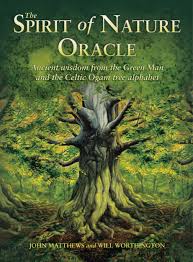
Review of The Spirit of Nature Oracle

spirit of natureThe Spirit of Nature Oracle cards by John Matthews and Will Worthington have been re-released by Eddison Books, much to my delight. This deck of 25 cards brings together the wisdom of the Druid Ogam, and the history and magical influence the Green Man has over humanity’s lives still, even in our modern day and age.

The Ogam is a Celtic “alphabet”, a series of lines drawn over a vertical axis that have many various meanings, depending upon the type of Ogam being used. There were over 250 types of Ogam, such as the famous Tree Ogam, Pool Ogam, King Ogam, Bird Ogam, Dog Ogam, even a Food Ogam! These provided the mnemonics necessary to retain and also express a vast wealth of information in as small a form as possible, not unlike poetry and its distillation of meaning to some carefully chosen words. The Green Man is a figure from out of the mists of time, one that has watched over humanity since its inception and throughout its evolution. Trees have been a very important part of humanity’s existence and success, for within their shaded boughs we found safety and security, as well as food and healing.

Bringing the Ogam and the Green Man together is a wonderful way to provide a holistic tree-based divination system. In our modern society, we are a very visual bunch, and so I believe the popularity of oracle cards has gained because of this in our lives. Our memories are filled with such an abundance of other “stuff” than our ancient ancestors held, and so the training to interpret the various meanings of each Ogam would take more time than most have in order to be successful. By bringing the format into something very visual, we can meditate upon the image and see the meanings held there, both historically and in our own personal gnosis, brought to life in an easy form and media that anyone can use.

We have the brilliant artwork by Will Worthington, who used ancient, traditional methods such as painting with egg tempura-based paints upon wooden panels. Matthews’ knowledge and wisdom shines through the text, providing historical background to the Ogam and the Green Man, both simply and eloquently, as anyone who is familiar with his works can attest to (and I’m a big fan). The divinatory meanings are clear and inspired, and yet personal gnosis is recommended first and foremost by Matthews when drawing a card, for to gaze upon the card before outside influence can reveal some truths about the self that others’ interpretations could not touch upon.

There are some suggestions for drawing the cards, based on one, three or five-card spreads. Using the Tree of Life spread, by placing three cards in reference to the Lower, Middle and Upperworld is truly inspired. It’s an approachable deck, for anyone to use, regardless of religious or spiritual background or preference. The cards can simply be used to meditate upon the season and the cycle that we are currently in, as well as being used for divinatory purposes. I would highly recommend using them both ways!

I am so very pleased that this deck has been re-released, and in such a beautiful format. It comes in a sturdy box, to protect both book and cards from being banged around and makes it useful when travelling. My only criticism would be that it would have been nice for the book to have been in colour as well, to match the cards, but being an author myself I am fully aware of the limitations both in print and in financial terms that this would be subject to, and so would say that the beauty of the cards themselves more than makes up for it. The book is great reference and resource material, and the cards are wonderful pieces of artwork. I highly recommend this deck to anyone who loves trees, nature, Celtic lore and spirituality or who just loves and collects oracle cards!

The Crane Bag: Audiobook!


Coming out on 1st July (Canada Day!) will be the audiobook version of The Crane Bag: A Druid’s Guide to Ritual Tools and Practices. Here’s a little sneak preview…