Here is the essay version of my presentation for Leaping Hare. I hope you enjoy it!
Women of the Mabinogion (Rhiannon and Blodeuwedd)
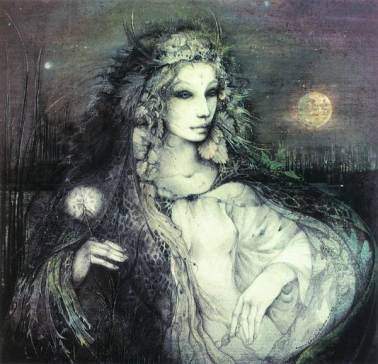 For the longest time I found myself unable to connect, or should I say, unwilling, to try to connect to the stories of the women in the Mabinogion. For those who don’t know what the Mabinogion is, it is a collection of the earliest prose stories of the literature of Britain. The stories were compiled in Middle Welsh in the 12th–13th centuries from earlier oral traditions. The two main source manuscripts were created c. 1350–1410, as well as a few earlier fragments. These stories offer drama, philosophy, romance, tragedy, fantasy and humour, and were created by various narrators over time. Scholars from the 18th century to the 1970s predominantly viewed the tales as fragmentary pre-Christian Celtic mythology. Today, we can appreciate the tales for the beautiful and sophisticated work that it is, stemming from an earlier oral Celtic tradition and recorded by Christian monks over time.
In this recording of earlier tales from a different and conquering religion, of course there were misunderstandings and certain flavours that did not sit well with the monks, and so modifications no doubt were made. Whether these were intentional or not we will probably never know, however, we can peel back the layers with what we know of the Celts and their predecessors, to make the tales come alive again to the Pagan soul.
I will admit now, that I am certainly no expert on the Mabinogion or Welsh mythology. Rather, this little presentation is to share my experience with coming to terms with what I had previously seen as an anti-feminist doctrine or propaganda. I also admit that I originally took the tales at face value, and only after having spent many years delving into the history and mythology of the Celtic peoples have I come to a better understanding, and been able to see more clearly just what the tales have been trying to tell us all along. My work with the Sisterhood of Avalon has helped me greatly in uncovering the real strengths of the women in these tales, and the messages that they are trying to convey through the mists of time.
I shall start with Rhiannon. She’s a well-loved goddess, sometimes seen as a Faery Queen. When I first came across this goddess, I could relate to her as a goddess of the land, symbolised by the white horse. I’ve always loved horses, and so discovering another horse goddess was a real treat. But then I learned more of her tale, and that’s when things started to get sticky for me.
Rhiannon had a child with her husband, the king, Pwyll. The child was stolen one night, and her handmaidens, being afraid that they would be blamed for their incompetence (and probably rightly so) killed a puppy and smeared its blood over the bedsheets where Rhiannon slept and where her child had slept. Upon discovering this horrible scene in the morning, Rhiannon was accused of killing her child, and was condemned to punishment. Her punishment? Being a horse goddess, she was condemned for seven long years to carry visitors to the court upon her back after relating the story of what she had done to deserve this punishment, while she sat on a horse block (this is a block used to mount up and get in the saddle, which takes the stress and strain of a human’s weight pulling down on one side of the animal during mounting). Rhiannon obliged, and for seven years she performed these tasks.
Not exactly the most inspiring feminist story ever told, is it? Why didn’t Rhiannon challenge the women who falsely accused her? Why didn’t she stand up for herself and deny the charge in the first place? Why did she accept the punishment so easily? When I first heard this myth, I was disheartened. I wanted strong goddesses to work with, like Morrigan. What on earth was this horse goddess doing, and what does that teach women today? And so, I left Rhiannon far behind, and have only come back to her recently, and learned of other women in the tales contained within the Mabinogion in the last few years.
Let’s begin with looking at Rhiannon as a goddess of sovereignty. Through her marriage to Pwyll, she connects the Otherworld to this world, and consecrating and blessing the choice of king, as was the way in Celtic lands. As representative of the land itself, she offers up many things without discrimination. She is compassion and nourishment. In the association with the horse, she is strength and working in relationship with a partner (think of a horse and rider working together). She is a Great Divine Queen, and indeed, I later found out that her name shares roots with that of Morrigan and Rigantona, who also are Great Divine Queens.
So what does this teach us? Well, it teaches us of patience, compassion and hope. Seeing Rhiannon weather her trials and tribulations with grace, never faltering in her duty can inspire others to do the same. She is a goddess of endurance, a reflection of the strength and endurance seen in her symbol, the horse. She is grace under pressure. She is true to herself, even in the midst of chaos and unjust treatment. She knows what can be changed, and what cannot. She picks her battles wisely.
She also teaches us of inner sovereignty as well as outer sovereignty. Her dignity never leaves her, even as she carries the few people who do choose to accept her offer of being carried into the court. She knows that the truth will win out in the end. She knows this because she is the land itself. The land knows things that we humans do not. The land knows the bigger picture. She knows that there will be challenges, hard challenges but still she does what she needs to do. She knows the right order of things, the way that the land needs to be in order for everything to prosper, even if the humans of the court do not know this. She teaches us not to give in to victimhood or self-pity. She knows that all things will pass, and this is simply one circumstance out of many that lie ahead.
When I found these deeper layers to her being, I was able to resonate more strongly with her story. So many women can relate to being betrayed by other women. So many women are made to live their lives according to what others think they should be. But Rhiannon stands strong in that, while not succumbing to the lowest common denominator. Rhiannon’s son is eventually restored to her, now a little boy of seven years, and Rhiannon returns to her place as Queen. Her son’s name became Pryderi ap Pwyll, which means “Care, son of Wisdom”. If we are strong enough, and if we do not lose our compassion, but still care for things and have compassion while undergoing the trials of experience which lead to wisdom, then we will follow in the footsteps of this goddess of sovereignty. Forgiveness is necessary in order to move forwards. The past cannot be changed, but we can be healed of the wounds of the past in order to provide for a better future. In doing so, we become sovereign of ourselves, making choices based upon the current moment, and not out of fear or hurt of the past, or worry about the future. Rhiannon teaches us that we have choices, and that the choices that we make can either destroy a kingdom, whether it be an external literal kingdom or our own inner kingdom, or we can hold it together until a better circumstance presents itself. Through her own strength of will, her own dignity and grace, she is able to overcome it all. Well, she is a goddess, after all!
While we may not be so graceful and dignified under pressure, it is certainly something to think about and perhaps strive for in our daily interactions. It made me see this Celtic Welsh goddess in a completely different light. The tale has helped in my own journey to find inner peace and sovereignty of my own self. She reminds me to be as compassionate as I can, as well as showing me how strong I can be against the trials and tribulations of the world, injuries and injustices and more.
Another goddess whose story I originally balked at what that of Blodeuwedd. She was a woman created out of flowers in order to be married to Lleu. This story in itself connects with another goddess from the tales, Arianrhod. She laid three tynghedau, the Welsh equivalent of the Irish geis, upon her son: that he should have no name save one which she herself provides; that he should not bear any arms except those that she provides; and that he should never marry a woman from the race of Men. These “rules” may seem harsh and unpleasant, a kind of “wicked stepmother” scene apart from the fact that she is indeed his real mother. But again, when we peel back the layers of the story, we understand more. In ancient times, it was the mother who often bestowed a name, arms and chose a wife for her son. I’m guessing the monks who recorded these tales didn’t quite “get” that idea, and so made her out to be a wicked woman denying her son of many things. And so, Lleu gets his uncle to “make” him a wife, and he creates one out of flowers and she is named Blodeuwedd, or Flower Face.
Arianrhod’s tale continues, but now I’m going to focus on Blodeuwedd. A woman created for a man – hmm, where have we heard this story before? This might very well be a take on the Christian tale, and the original meaning of it lost to history. However, we can look deeper at many parts of this tale, to see the strengths found in the feminine.
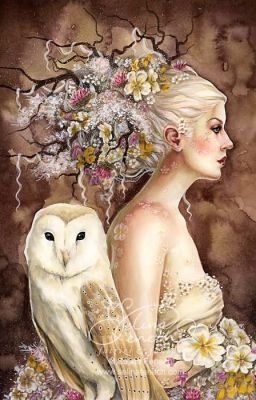 Blodeuwedd was the model wife, for a while. But eventually, while the husband was away, she fell in love with Gronw, a neighbouring lord. They lay together for three nights, and then Blodeweudd decided to plot against her husband, in order to kill him and live instead with Gronw. She schemed until she found out how she could kill her husband, who was not easy to kill, ie. he cannot be killed indoors or out, on horseback or on foot and only by a spear that took a year to make and was only worked on during Sunday mass (a forbidden, holy time, which is quite interesting and an open “nod”, if you will, to the story’s Pagan origins). Blodeuwedd discovers how to do this by asking her husband, who seems rather stupid really in giving her all these answers to these riddles, and then Gronw sets to work on the spear.
So when the spear is ready, she makes a bath for Lleu on the banks of a river and builds a house of thatch with only a roof and no walls. She brings either a buck or goat, depending on which translation of this tale you read, and then ask him to show her how he needs to stand with the animal in order to be killed, which he does. Really. Gronw then rises from his hiding place and throws the spear at Lleu, which injures him. As he lies dying, his uncle Gwydion comes and turns him into an eagle in order to save his life. Blodeuwedd and Gronw return to rule over the court, while Gwydion then goes in search of the eagle that flew away, eventually finding him and restoring him back to his original form. After a year has passed, Lleu returns to court, and demands that he should enact the same deed that was done to him, upon Gronw. Gronw has no choice but to accept to keep his honour, but he requests that a stone be placed between him and Lleu. Lleu agrees, and throws the spear, which goes right through the stone leaving a great hole, and kills Gronw. (The stone can still be seen today, with a great big hole through it). Blodeuwedd runs away, but Gwydion tracks her down and turns her into an owl, as “punishment”.
When I first read this tale, I thought “My, what a horrible woman”. But when I looked deeper, and applied what I knew of Celtic mythology and lore, a new picture began to emerge. There are a couple of tales where two kings fight, usually over a woman, such as one of the tales of Gwynn ap Nudd, or the more recent Oak and Holly King. The woman represents the land, and decides who has sovereignty over which part of the year. Lleu means “light” and Gronw is associated with darkness. So, we can see the cycles of the year represented in the “battle” between the light half of the year, and the dark half of the year, with the goddess of the land choosing her mate at the appropriate time.
In lying with Gronw for three nights, this is actually a form of marriage in ancient Celtic law. There were many forms of marriage, this being just one of them. So it is easy to see how the goddess of the land, the one who was literally “made” from the land out of flowers, chooses who will be king. She is dutiful to Lleu during the appropriate time, and then weds Gronw again when the time comes to move into the dark half of the year. In this regard, Blodeuwedd is another goddess of sovereignty.
She herself transforms as well, from that which turns to the light, ie. flowers, to that which turns to the dark: an owl. Married to Lleu, as a flower she turns to the light. Married to Gronw, she is a creature able to see clearly in the darkness, and fly free. The monks who wrote this tale down saw the transformation into an owl as a punishment, and recorded it as such, but really what would you rather be? A flower or an owl? Something rooted to the land, or something that can fly, see in the dark, is an exceptional hunter and which is utterly gorgeous?
Perhaps Gwydion did not change her at all. Perhaps Blodeuwedd changed of her own accord, so that she could fly free and exist in the dark half of year with the appropriate king and husband. Perhaps she will return again the spring as the flower, making the cycle complete. Perhaps that is the truer, older tale.
Blodeuwedd shows us that in us there is both light and shadow, and that we must acknowledge both these aspects of ourselves. For if we do not, if we abandon one for the other, we become imbalanced. We need winter just as we need summer.
With Rhiannon and Blodeuwedd, we can find tales of the stories of women, their struggles and their pain, their choices and the cycles of life, death and rebirth. We can still find them in the old tales, even through the thin veneer of a conquering religion at the time. We have to be able to open up our perceptions, however, to look deeper, as well as do the research into the time and place when these stories occurred. We need context. Without knowledge of ancient Celtic lore, these stories, taken at “face value” in the Christian context can seem utterly demeaning towards women. But when viewed on a deeper level, with what we now know of Celtic lore, as well as the cycle of the seasons and looking with a Pagan eye, we are better equipped to fully understand just what the stories were trying to say.
My work with the Sisterhood of Avalon helped me to better understand these women’s stories. The SOA uses the tales of Rhiannon, Blodeuwedd, Ceridwen, Arianrhod and Branwen to move through cycles of healing and transformation. The creator of the SOA, Jhenah Telyndru, is a wonderful woman and scholar in Celtic studies, bringing good research and lore to a deeper understanding of the myths and tales. You can find out more about the SOA at sisterhoodofavalon.org.
Their stories are our stories. Even today.

 Bullying in any shape or form, whether in person or online, is a very difficult thing to deal with. I’ve had my fair share of it, with trolling on my social media sites and the occasional personal attack/character defamation (mostly from people whom I’ve never even met). This has again happened to me very recently, and thankfully it’s only the second personal attack that I’m aware of using myself as the subject. It’s a slog to get through it all, and can make you despair at the human race entirely, but I’ve come up with some ways to deal with bullying, which may help you if you ever find yourself in such a situation. If you are in physical danger, please contact the authorities at once. Here are 10 ways you can work through this situation, should you find yourself being bullied in any shape or form.
 Blessings of Lammas/Lughnasadh/Gwyl Awst to you. May your harvest be abundant and rewarding, and may we learn from our experience to carry knowledge forward into wisdom.
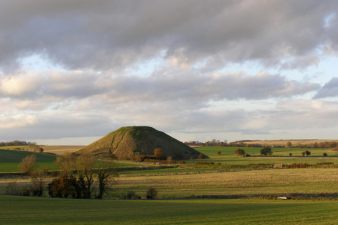 Sitting on top of the barrow, I could feel the energy of the land around me, as well as the energy of the ancestors and the barrow itself beneath me. The land’s energy was golden like the sun, flowing and bright. It was a stark contrast to the energy of the barrow, which was dark, cool and quiet. In the landscape, looking out over at Silbury Hill, I could feel the richness of this time of year, and see the ancient priests of the land atop the platform of that great hill, directing the ritual observances for honouring the harvest and the land, beginning at The Sanctuary and flowing all throughout that wonderful temple radiating outwards from Avebury’s henge and circle. Everything was in motion, everything was in full swing.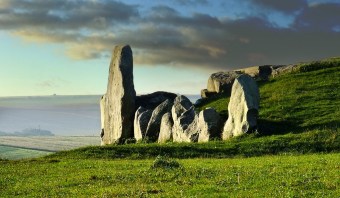
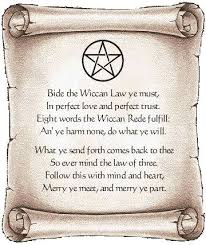 Lately I’ve been thinking about this concept, as I am doing a lot of reading and researching at the moment, and keep coming across this concept is a lot of Wicca/Witchcraft books. While I know that there are many traditions in Witchcraft that do not follow this concept, some do, as well as most (if not all) Wiccans, and it’s got the brain going, considering this concept more deeply and not just taking it for granted.
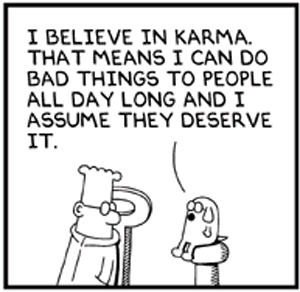 I feel that this is a very odd Western misinterpretation of karma, for starters. As well, I know of plenty of instances and people who do good things, who go through the ringer, and plenty of people who do bad things, and don’t seem to suffer any consequences. (Trump, anyone?) Karma is not a system of reward and punishment. As well, the Hermetic principle of like attracting like can work in this instance, but not in the way that most people would believe. It’s not that simplistic. Note that I use the word simplistic, rather than simple, because there is a huge difference, at least in my opinion. Let me explain.
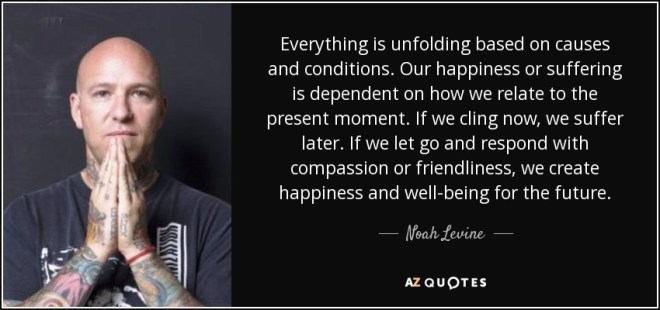 So, looking more deeply at The Threefold Law, if we do something bad, like cursing someone, then it could be said that on a certain level it comes back to us threefold, but not in the sense that seems to be very popular, ie. do good and good things happen, and vice versa. But if our actions are not honourable, and if we do things to harm other people, we are in turn harming ourselves, our environment, our gods: everything. Harming others causing suffering, both externally and also within in a threefold pattern: we harm our physical, mental and spiritual wellbeing. We’ve lost that connection to everything else, that sense of integrity and integration.
 What to wear in ritual? Whether you’re a Druid, a Witch, a Wiccan, a Heathen or from any other path this question often comes up. The simplest answer is: wear what you like. However, let’s go into more detail, for the sake of this blog post!
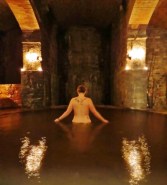 The last time I was as the White Spring in Glastonbury, it was open to the public and three women went in the main pool (not the bathing pool, I might add) and performed a ritual there in front of everyone with two of the three ladies completely starkers. While that may have been appropriate for a private ritual, when the public are also walking around it is, in my view, highly inappropriate to do so. Imagine a nun from France visiting, or a young schoolgirl who is asked by her teacher “What did you do this weekend?” and she replies “Daddy and I went to the White Spring and watched naked ladies in the water”. I have performed private ritual at the White Spring in the nude with friends, and it was absolutely lovely to immerse ourselves in the sacred and very, VERY cold water (we had to use the main pool, as the bathing pool wasn’t in existence then).
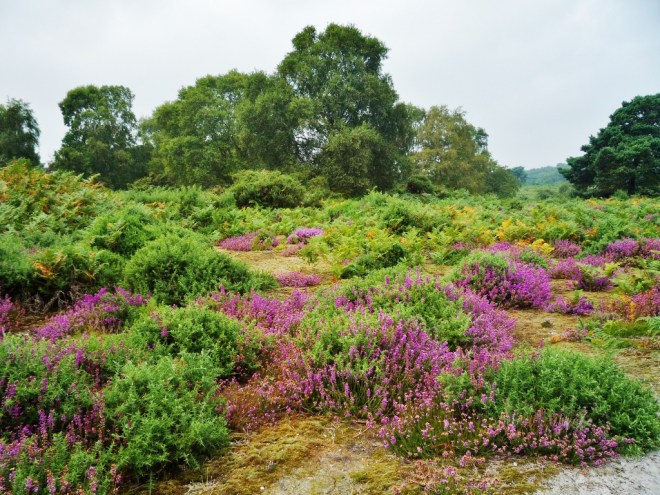
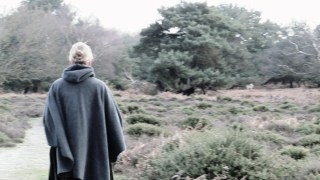 When I am trudging out onto the heath for ritual, I wear good boots as I live in adder country. I usually also wear trousers such as jeans that have a heavy material which the gorse cannot penetrate, or at least knee-high boots that can ward off most of the pricks and thorns. I like the dress in natural colours, mostly greens lately as I find this personally pleasing. Green is also a colour associated with the faeries and the Otherworld, and in my current work is very appropriate.
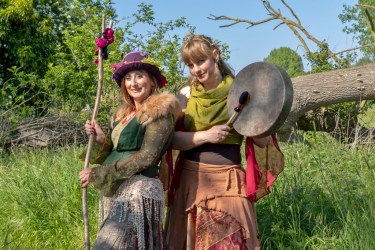 The most important thing is that you like what you are wearing. Even if it is a simple piece of ritual jewellery that you can hide underneath your shirt, if that pleases you then wear it wherever and whenever you do ritual. Being comfortable is also a big factor, as being hot and uncomfortable, sweaty or cold is not really all that conducive to productive ritual. Let what you wear (or don’t wear) reflect your true self, in accordance with the law and propriety. And most of all, let it be fun and enchant you, and be a contributing part of the ritual if you so wish.
 Down the Forest Path