An Ounce of Prevention is Worth a Pound of the Cure

Over the years I’ve done a lot of work with personal sovereignty. This is work that is never-ending. Why? Well, we must be vigilant in so many areas or our lives and in our own sovereignty, in order to cultivate it and nurture it: it’s not a one shot deal. We don’t do the work once and that’s it. It’s a process. Like learning, expanding our horizons, becoming better people, becoming who we are meant and want to be; it’s all a process.

I’ve had to learn how to be discerning in my life: in who gets to be a part of it, whose energies I will allow in, and also what I consume. Life throws so many things at you that you can’t control. However, what you can control is your own actions and your own personal sovereignty. It’s all about choice. You can, for the most part, choose who gets to be a part of your life, and who doesn’t (as an adult, at least). Yes, you will have colleagues, bosses, other people in your life who aren’t chosen, but here I’m talking about the inner circle of your life. Who gets to affect you on a personal, energetic, physical and even psychic level? Who can you leave at the door, willingly, when you walk into your personal space?

Discernment is such an important concept in our lives. When we have the power to choose, we are taking part in our own discernment and our own sovereignty. And we do, in fact, have a lot of power to choose. It’s all about finding out which areas you can boost in your discernment. Income, environment and other factors will have an affect on your discernment, and so you have to make the choices that work for you. What works for me may not work for you, or even be available to you. So we have to work with what we’ve got, first and foremost.

In this article I’m going to talk about some of the things that we consume. I’ve spoken many times about what we consume on a physical level, from a Druid’s and Pagan’s perspective, and from a Zen perspective as well. But here I’ve going to talk about what we consume on an energetic level.

Protection magic is probably the biggest area of spellcrafting in Pagan circles. Why is that? Because we are exposed to all sorts of energies throughout the course of a single day that we need to take a closer look at, and think about how it is affecting our lives. For me, it’s important to work with prevention, and that way we won’t need so much of the cure. Taking a look at the energies that we allow into our lives before they begin to affect us is the first step in this process of discernment. We may do this on a physical level already, ie., we take off our shoes before we enter into the home, to keep the dirt, bacteria and other nasties out of our home. Think about it: your shoes have been in public toilets, walked through pavements covered in all sorts of nasties such as dog wee and poo, gum, spit, etc. Do we want to track all that back into our house? Hell no. So we take our shoes off at the door. One moment spent in an airplane, train or public toilet will have you wanting to remove your shoes before you take all that into the house with you. Guaranteed.

Doing the same with energy is extremely beneficial for you too. Did you have an argument with your boss, or did someone express road rage at you on the way home? Did someone say an unkind thing to you online, or in person? Have you watched the latest world tragedy on the news, or had your television pumping out violent scenes in your living room? These all have energy, which can build up in your home and in your soul. It’s already been proven that when we are exposed to violence, we become de-sensitised to it. What I want to do is to sensitise you again, so that you are aware of these energies that affect you on a daily basis. Words and images have power, names can hurt you just as much as sticks and stones. In a world where there is more media than ever being consumed, the sheer amount of information being thrown at you whether you wanted it or not is completely staggering. So what can we do about it?

This is where discernment comes in. We can choose what we allow into our personal space in so many ways. Do you watch the news first thing in the morning on the televison while having your breakfast? Do you feel down and a little depressed with the world afterwards? Maybe you should consume this form of media at a different time, and perhaps even in a different way. Reading the newspaper can be a big help for those of us who are sensitive to images of violence and grief which are the mainstay of all the major news networks on television today. I literally can’t watch 30 mins of news with crying, because the energy of people’s suffering on the screen is real, and I know that. When I see people wailing as they search through the rubble for their child, I know that it is real. It’s not an abstract or a movie, it is real life. That energy will affect me for the rest of the day. Some people are a lot less sensitive, and can watch it and get on with their day. But I, for one, would never, ever want to be de-sensitised to violence and grief, because that is the mainstay of my own personal compassion for others and my ability to empathise. I can’t turn it off, and I wouldn’t want to, for compassion and empathy I feel make me a better person. But what I can do is to select just how much I intake these energies, so that they don’t overwhelm me on a daily basis. There is not a lot that I can do for earthquake victims thousands of miles away, apart from donating to a charity to help them. But what I can do in my own environment is a lot more, and that is where I need to spend my energy.

Social media. Yikes. When I think of the past times and energy that I have spent with people whom I don’t know from a hole in the wall, I literally cringe. Don’t waste your time and energy arguing or even interacting with nasties on social media. It depletes you and just adds to the barrage of energy that is sapping you dry. Instead, be discerning about who and what you interact with on social media. And spend less time on there overall, because the real world matters a whole lot more. Doomscrolling is a disease. Get out and turn your face to the sun, the wind, the rain, the stars. Those are energies that are a whole lot better to consume than insults or even material from people you don’t know and over which you have very little control in how it’s being presented to you. Choose your friends, your contacts,  your groups wisely. Be selective about the ads that you see. Don’t let the algorithms dictate what you will see, but instead create your own. You are not 100% at the mercy of social media providers. You are a consumer, and so you will have a say in things, even if it’s a lot smaller than you would wish. And if this is a really big issue for you, then leave it altogether. More and more people are doing this, and it’s not entirely a bad thing. Choose your social media intake wisely. Be discerning, and be sovereign.

I could probably write a whole book just on this subject, and so I will keep this article in check and just remind myself, and others, to look deeply at what it is that you are consuming and bringing into your personal space. If we are discerning about the energies that we allow in, we will need a lot less protection magic and work in the long run. It’s the first step in any energy work, and the basis of all personal sovereignty.

Blessings to you and yours.
Is Nature Indifferent to Us?

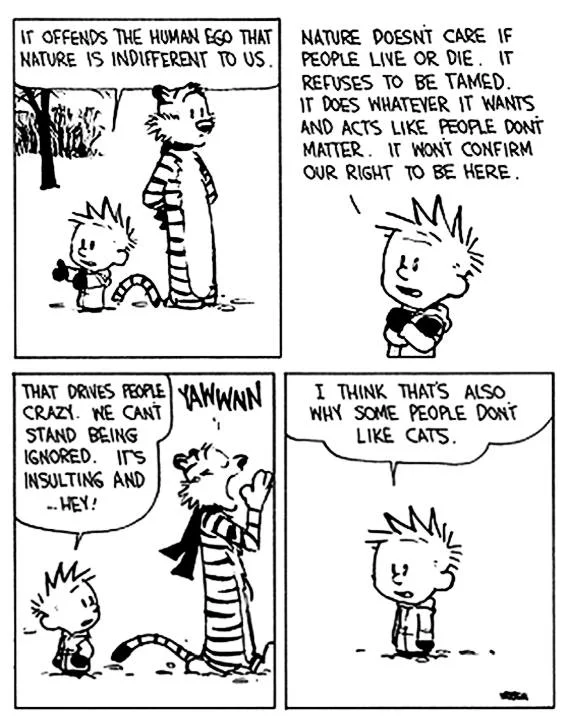
I love this Calvin and Hobbes cartoon, by Bill Watterson. It speaks to me on so many different levels, not least of all as a Mother of Cats. But it’s mostly the first part that I’ll be pondering over in this blog post today.

Is nature indifferent to us? Well, perhaps on the whole, yes. Nature could be indifferent to everything. The entirety of nature is such a vast concept, to me it’s like pondering deity, for in my own religious and spiritual view, nature is deity.

However, in my own personal practice, I feel that the gods are not indifferent to us, so where does that leave me with regards to the above? I’m just not sure. Could it be a paradox, that the deities care and don’t care at the same time? That would make them truly similar to cats…

It’s hard to come to terms with the darker aspects of nature, the pain and suffering that exists. Just yesterday there as a fox in the garden, and it looked like s/he had been hit by a car. One of their back legs wasn’t working, and there was definitely trauma to the back leg and hip. The fox had worried all the fur off of the back leg, hip and tail. It was taking respite from the wind in our garden, sheltered as it is by hedges. It also had a nice long drink from our pond.

After a while I went out to see just how badly it was injured. It couldn’t hear me above the wind, and I didn’t want to startle it so I called softly out to it. It turned its head and then quickly stood up. I gave it a quiet wave and it ran on its three legs back through the hole in the hedge and was gone.

I put some food out for it later that day, and will be doing so each night. I fear that the chances that this fox will survive are pretty slim, but at least it won’t die on an empty stomach.

I meditated that night on the suffering that goes on all around us, every second of every day. That poor fox was in lot of pain, but there was nothing I could do about it. Even had I called the Suffolk Wildlife Trust, chances are that by the time they got here the fox would be long gone anyway. I wondered at how such a thing could happen, could be “allowed” to happen to a beautiful creature as this fox. Tears flowed as I struggled with the suffering of so many lives right now.

People are in the hospital, wars are going on, wild animals are being hit by cars, the oceans and rivers are full of raw sewage and plastic – I could go on and on. It sure seems like the majority of humans today are indifferent to nature, so why shouldn’t nature be indifferent to us?

But nature hasn’t been indifferent to me. I have had wonderful experiences of true connection. I understand how we are all part of this one, great whole. I just wish that others could understand this, in order to save ourselves from our own self-destruction, and the widespread destruction of nature all around us.

But nature is also indifferent. The wind blows whether we like it or not. We have no say in earthquakes, sunshine or rain. Perhaps this is not indifference, but our own inability to see the bigger picture, the whole. 

I am not offended by the seeming indifference nature has for us. Rather, I see it as an opportunity to show nature how much I really care. I aim to live in this world as best I can, with as much sympathy, empathy and compassion as I am able to give. I seek to be a contributing, functioning member of my own local ecosystem, and thereby a part of the wider world too.

Maybe nature really is like a cat. Sometimes it appears indifferent, and other times we can feel the genuine affection that it has for us, if only we are sensitive enough to feel it and open enough to accept it.

Surrendering

Since the release of his book, Surrender, I’ve been thinking about this concept that Bono talks about in so many different ways. In one tale, presented live on the “The Late Show” (see video below) it really struck a chord within me (pun totally intended).

He talked about how he had (and still has) to approach his wife of 40 years within such terms. He spoke of approaching her like this: “Only if you arrive at her fort defenceless, do you have half a chance in challenging her own, almost unbroachable defences”.

I thought that this was utterly beautiful. It could be applied to so much in life, not just your loved one. For me, it’s about being authentic, about being truly and utterly you, to whomever it is you are trying to connect with. It could be your life partner, your parents, your children, your gods, your ancestors, your community.

When approaching the gods, there is no point in putting up a mask, surrounding yourself with defences. They are gods. They see through all that crap. If you choose to open up your soul to a god, then there is no need for games, for duplicity or falsehoods of any kind. There is only you, and the deity.

It’s much the same with your life partner, family, ancestors, even those of your community. Those who think that they are fooling you with guises and masks are only fooling themselves. People are more perceptive than many think. We know when something or someone is “off”, it’s just that often we choose to ignore that instinct.

Authenticity is about surrender. It’s about being utterly human, being utterly you. It’s acknowledging the good and the bad and everything in between. It’s about working towards being the best person you can be, without masks, without disguises.

This doesn’t mean you have to let go of all boundaries. But if you truly want to connect on a soul-deep level, it is about being totally, utterly you. Letting down your defences also allows those to come to your aid. Keep them up, and they keep everything and everyone out.

The concept of surrender, and of defences, is one that I am going to chew over for quite some time this winter. In the stillness and silence of a winter’s day, in the overarching darkness of a long winter’s night, I am taking this to heart and really experiencing what it is to live in this manner. It will will, I think, open up new ways of living and being that before were only imagined.

This winter, I am surrendering.

Beauty Companies’ Dirty Little Secret

Since 2017, when plastic microbeads came under the spotlight, there was much commotion to get this “ingredient” banned from cosmetic and skincare products. Great, you might think, because they succeeded. But did you know that there are tons of other microplastics out there that are still perfectly legal, and have been since the 1960’s?

Some of the main culprits are:

Dimethicone

Polyethelene

Acrylates Copolymer

Carbomer

These legal microplastics show up in shampoos, facial cleansers, moisturisers and lots of other products. Often they are used as thickening agents. Seems like good old corn starch isn’t really good enough anymore. There are other microplastics out there – look out for anything that has acrylic or acrylate in the word, or a polymer of any kind.

Some beauty brands, like Avon, have been against animal testing for over 30 years. Great, you might say. But I recently found out that around 80% of the products I looked at have microplastics. Many of these products used to have their ingredients listed on the website, so you knew what you were buying before you actually made the purchase. However, I have noticed that since the increased use of microplastics in their products, they have stopped listing ingredients for many of their skincare and beauty products on the website, and all of those with unlisted ingredients contained microplastics. It seems Avon is cottoning on to the fact that we are becoming more aware of what is and isn’t acceptable.

Even companies like The Body Shop are still using microplastics. There is Acrylate Crosspolymer is their Microdermabrasion Vit C facial scrub, for instance. It was also in their Satsuma Body Scrub, which is now no longer available.

There are some good websites that go into detail about the legal microplastics still available for companies to use in their products. There is also a petition to get the EU to ban ALL microplastics. As the companies refuse to take responsibility for their actions, it’s up to the consumer to be informed on every purchase. Which is, I know, a right pain the arse. But if we care enough about what kind of world we are leaving to our descendants, and to all life, then we must take the extra few seconds to read that ingredients list, read up on the latest information, and stay aware.

Some articles to help you get started on microplastics are:

Get to Know Your Microplastics

Get to Know Your Microplastics Part II

For a wonderful company in the UK that is totally plastic-free, has 100% recylable packaging, offers refills through the post and also student and NHS Key Workers discounts, see UpCircle for their great skincare products. This is a personal recommendation, not a paid promotion 🙂

The Most Important Page of Any Book

The Most Important Page of Any Book

There are now lots of Pagan books out there, on a huge variety of subjects. Some are new, some are old, some are out of print but still available through second-hand shops and websites. I’ve recently been perusing some older and out of print books on Wicca and Witchcraft, as well as Paganism in general and it’s really hit home just how much one page of a book can make all the difference. In fact, it’s the most important page of any book. And what is that page?

The page at the beginning of a book that has the publishing details on it.

What? Yeup – that’s the bit that I find the most helpful from the start. Why? Because it gives you context. You can find out just when the book was written, so you will see © 2001 Witchy McWitch. These few words give you an idea into the time in which the words were penned, a snapshot in time as to what facts and truths were available, and what were not, and how they were presented. Under that you will see the publishing dates, such as “First published in 2012 by So & So Publishing”. There will be the initial publishing print date, as well as other information to let you know how many printings of this book there has been.  If you are buying the book brand new, this reprint information gives you an idea of how popular the book is, as well as the possible opportunities for correction during subsequent print runs by either the author (if they’re still alive) or the publisher (if at all possible).

So why is this important? Well, information changes, history changes as new facts come to light. Knowing just when a book was written will allow for some leniency with regards to what was known at the time, versus what we now know after decades of research. I can forgive a book that is 20+ years old for not having a good history of witchcraft, for example. With even older books I can be more forgiving. The use of terms such as “shaman” and “shamanic”, as another example, can be forgiven because that was the term being used at the time. If the book hasn’t undergone a reprint recently, or has been out of print for a while, then this information just can’t be changed. And this is, at least to this author, a source of anxiety. I don’t know about other authors, but often when you put stuff out there, it’s out there for good and people can forget the context in which it was written.

People change. Facts change. Views of history change. What is politically and socially correct, changes. But old books can’t change. Not unless a new publishing company picks it up, the author is still alive to consult about making the changes, and everyone is happy to go along with it. But so often I will see criticism and horrendous reviews of old books regarding the information contained within. If you look at the book within context, you will know that it is out of date regarding historical accuracy, and then you might be a little more lenient. But instead people slam the old authors, those who many of us from Gen X and previous grew up with. We know that some of the information is wrong, or outdated, if we have the privilege of being able to keep up to date with the latest books and information (and in today’s growing economic crisis here in the UK, and around the world, we know that people have less and less money to spend). Think about it for a minute. If you haven’t been able to buy a new book on an aspect of Paganism in the last decade or so for whatever reason (no money, no time to read it because you’re working two jobs and trying to raise kids, etc.) you won’t have the most up to date information. But people will still criticise you and the books that you have for it, when it is beyond anyone’s control.

(There is a caveat here – some books do just contain information that was made-up at the time, and the author knew it. Or it was just poorly researched when information was quite readily available at the time. I’m thinking of a certain book written in 1990 that states the ancient Irish peoples carved pumpkins. Yeah. We knew better even at that time.)

Books are a luxury. For sure. Not everyone has the ability to do the in-depth research, to keep up to date with the latest information and the world of academia. For some people it just bores the crap out of them. Some people are doers, not readers. We have to take a look at the bigger picture, and stop cancelling authors whose books are out of print, as well as over-criticising people for not keeping up to date with the latest academia. It’s just not possible for some people to do. It’s utterly beyond their control.

I am so lucky that I am able to search around to find these old books, to add to my collection. I am so fortunate that I am able to buy new books with the latest academic research. I understand my white, middle-aged woman privilege here. Which is why I’m not ranting at others online or in person about the material they present, the authors they like, the books that they’ve read or not read (apart from my small caveat above). Because there’s a whole world of circumstances that I cannot possibly understand.

People are throwing out, or at least recycling old books because some of the information in them is out of date, contains bad history or what not. But as I’m re-reading these old books, every time I pick one up I look at the publishing details, to remind myself of the context. I can then be more forgiving. It doesn’t mean that all the material is worthless – it means that we have learned a lot more since this book was written. Now, if it was a brand new book written in the last few years, I might have a different attitude, but again there are variables: is the book self-published? If so, then there aren’t any external editors to say to the author “Look, this claim that you make has been shown to be false, here’s some research for you to look up” or some such. Circumstances matter.

Acknowledging circumstances help us to live more compassionately.

One last thing to think about is that authors, if they have the good fortune to have kept going throughout the decades, will contradict themselves sometimes. This is a good thing, because it is showing growth (sometimes in the wrong direction, it may seem, but it shows that they are still seeking). I released my first Pagan book in 2012, written in 2011. I am most definitely not the same person I was 10+ years ago. I have said things in my older books that I cannot say today, because my life has changed. I mention in one of my old books that I’m vegan, but I haven’t been vegan for a long time now, for various reasons. But someone reading that book will still think I am, or may even criticise me later on when they read a subsequent book and find my position has changed. The history that my older books contain may not stand up to the test of time. But the message, the exercises, the feeling and the passion hopefully will, as long as people understand the context in which it was written.

Words are funny things. They’re like stones, and if you put too much stock in them, hold too many too close to your heart, they will weigh you down. We have to let some of them go, in order to fly. We have to change and adapt with the times, realise that there are circumstances beyond our control, or that we aren’t even aware of while holding a compassionate regard for the past, and an understanding of just how far we have all come.

You’re Not A Real Witch/Druid/Heathen/Whatever

At some point in your pagan spiritual path, you may come across some person or a group of people who tell you that you’re not a real [insert path here] and may even give you “helpful” reasons as to why they have come to this conclusion. And I’m here to tell you that it’s all bollocks.

First off, anyone who has the gall to tell someone else that they’re spiritual path is wrong because it differs from theirs, most likely has some superiority/inferiority/ego issues. It usually takes someone with pretty low self-esteem to try and knock down other people, and with the anonymity that the internet provides, this can be done in large quantities. What we all must remember is that when someone says something like “you’re not a real [insert path here] because you don’t do [insert whatever here]” it is saying a lot more about them, and not a lot about you. It displays their hang-ups, their biases, their issues, not yours.

Some people will confuse their dislike for something and state it as something that is “wrong”. However, simply because someone doesn’t like it doesn’t mean that it is wrong. I *heart* unicorns. Always have, always will. Does this make me less of a witch/druid/heathen/whatever? I don’t wear black, I don’t have a witchy aesthetic per se, I’m not particularly drawn to “dark” magic and I don’t even “look” witchy. I honour different gods from different traditions and follow many different paths. I am a Witch, a Druid, a Heathen, a Zen Buddhist. I don’t limit myself to one “pure” tradition of anything, because I don’t believe that exists. Does this make me any less in the eyes of the pagan public? To some, yes. And that is their problem, not mine.

My path is extremely rich and rewarding. For me. If it inspires others to follow/develop theirs, then I’m so very pleased and filled with gratitude. We need to support each other more, not tear each other down. There’s enough of that nonsense already in the world. Let’s not add to it.

Nature teaches us that diversity is key to a healthy, functioning ecosystem. What fills my cup is constant learning and taking that learning into real experience, which will lead me down many interesting paths. I can be more than one thing at one time, or at all times. I am a sister, a daughter, an aunt, a wife, Mother of Cats, author, singer, dancer, YouTuber, blogger, podcaster, Northern Expsoure fan and more. I am not one thing, nor could I ever be. Plurality is a good thing. It keeps things interesting.

If someone’s path diverges from yours, take time to understand more. Even if you don’t agree with it, it’s not your place to decide what is valid or authentic, and what is not. When we do so, we are seeking to belittle someone, and that is just not cool. Again, it says more about us than it ever will about them.

No one can please everyone, and nor should anyone even try. For when we do so, that’s when we are being inauthentic. That’s when we lose sight of who we are, and who we aspire to be. Our dreams are our own, and we shouldn’t let others tell us whether or not we should seek them out. True sovereignty lies in knowing who you are, what you love, what brings you joy, what makes you the person you are. It is knowing your strengths and weaknesses, your light and your shadow. While others may provide you with inspiration on your path, never, ever let anyone dictate who you should be or what you should do.

Don’t let people “should” all over your life.

You are a real whatever-it-is-that-you-want-to-be. That’s your life, your living it, your path. No one else can walk it for you. Let your own story shine.

Edit: I’ve since recorded a follow-up piece to this blog post, and this has now been posted on my Bandcamp page here: joannavanderhoeven.bandcamp.com/track/dismissive-paganism

The Goddess has a plan… or does She?

I’ve come across the phrase “the Goddess has got a plan” or something similar within the Pagan community, especially when people are trying to sort out why good things happen to bad people, and bad things happen to good people. For me personally, there are a few reasons why this just doesn’t sit right in my own Pagan worldview.

To begin with, I simply don’t believe in predestination. Many people have a simplistic view of “fate”, which seems to preclude the concept of free will. Many things are “fated to happen”, or meeting that person was “just fate”. Sometimes the notion of free will is forgotten in these instances, other times willingly overlooked in order to explain or justify the reason something has happened. Many Pagans, and all Wiccans, believe that we have free will, such as in the Wiccan rede (maxim or “counsel”) “an it harm none, do as ye will” which translates to “do not harm others while you live up to your full potential”. You will is your potential, your spiritual goal, your highest self.

But everyone is on this same ride. We are all going through life together, and someone else’s will may come into your life to challenge, support, annoy, or validate your own experience and your own will. Some would argue that a higher power has a plan for everyone, and that they are in some sort of control over the final destination, which means that there is some sort of control over the everyday experiences that lead to this final destination. This precludes free will, in my opinion.

Some have turned away from deity because of what has happened to them in their lives. They can’t believe that a deity would allow such things to happen to them and/or to the world in general. This is still a belief in pre-destination, and a deity that controls everything like some master puppeteer.

For me, deity is most certainly not this in any shape or form. Deity is the energy of life, of death and of renewal. That is its agenda. This energy may be seen in many different ways, relative to culture, to personal preference, to environment and so on. Different people attribute more associations to this basic agenda, myself included, into a more specified spiritual practice. But overall, the plan is life, death and renewal (or regeneration).

Our relationship with deity is very personal, and can be very specific. But does my Goddess have a plan for entire world? I know that she most certainly has a wish for the world, but it’s not up to her. It’s up to us.

Our free will, our own capability of taking full responsibility for our lives and the lives of others is part of that overall plan of life, death and renewal. It’s the growing up of the human race, the evolution that hopefully will take place sooner rather than later. In a Druidic sense, it is coming to realise that we are part of an environment, and that we need to be a contributing and beneficial part of that ecosystem in order for the whole to thrive (us included). In a Wiccan sense, it would be to do the least amount of harm and to become the best person that you can be in a similar context. In Hedgewitchcraft, it would be to understand and work deeply with the cycles of nature in your own home environment, crafting your life in complete attunement to the world around you, both the seen and the unseen. In all of the above, we are opening ourselves to deity in order to better understand ourselves, and how to live well on this planet.

That, in my opinion, could be the only plan the deities could have for us. Bad things will happen to good people, not because it’s part of deity’s plan, but because there are bad people out there who harm others knowingly or unknowingly. Human ego, greed and fear get in the way of so much that could be accomplished.

Sometimes it’s really hard not to despair when the world seems like such a mess. But we have to put faith in ourselves, in our own actions and be the example we want to see reflected back to us in the world. Working with the wonderful energy of the gods is one way, though not all Pagans are religious. Working with the energy of the land where you live is at the core of all practice, to better understand our place and how we can make it better not just for ourselves, but for all in order to have a sustainable future that follows life, death and renewal, even when not viewed from a religious standpoint.

Your own Will is that which will see you through the most difficult of times. If you align your will to the flow of nature, you will come to understand the true inter-connectedness of all things. And these all have free will, just as you do. It’s learning to meet each other, soul to soul, and work with that energy which in Druidry is often called “awen”. In our relationships with the world we come to better understand the world and really participate in this great, vast cycle within cycles. We will see the good, the bad and the ugly on the way, but we have to realise that not all of that is part of any deity’s plan. It just is, and we can learn to work with it, to condemn when we need to, to be the light we want to see in the world, and to really think long and hard about our own ethics and morality.

That’s my plan, anyway.

Pirating and E-Book “Re-sellers”

How can you tell whether an e-book download is legit? Well, the simple answer is unless an author or publishing company offers you a free e-book direct from their website, then you most likely dealing with illegal material. Most people know that the many “free” pdf download sites are really just sites that are trying to install malware and other nasties on your device/system, but there has emerged a new, more legitimate-sounding con: the e-book “re-seller”.

It’s recently come to many Pagan authors’ attention that there are quite a few sites “re-selling” digital formats of their books. Please note that you cannot “re-sell” a digital format of a book. Every book that is sold is protected under copyright, and may only be used and read by the person who purchased the item.  E-book “re-sellers” sites offer illegal pdf downloads of the works. Some of the digital “re-sellers” have websites that look very authentic, and are even using large well-known second-hand platforms that make you think that what they are doing is legal. But please, make no mistake, a “second-hand” e-book is an illegal version.

Publishers sell licensed versions for Kobo, Nook, Kindle, Googleplay and more, ensuring that with each purchase, the author is getting paid for that sale. These are protected versions of the book to be put onto your chosen device. An e-book “re-seller” selling a pdf is not the same (it is not protected in the same way as the above versions are). What’s worse, once a single pdf is out there on the internet, hundreds of sites can then use it for their own personal gains (with nothing going towards the author).

Pirating of e-books is something that is rapidly starting to undermine the publishing industry. What most people don’t realise is that when they illegally download a book, they are putting another nail in the coffin of authors everywhere who are trying to write more books. Most authors these days can’t even afford to have writing as their sole career: it’s very, very hard to make a living as an author. For instance, did you know that the standard percentage that an author gets per book sold is 10% net? That’s net, not gross. So, after the publishers, the sellers and everyone else has had their share, the author gets 10% of what’s leftover. Sometimes that’s just pennies. The percentage is sometimes higher for an e-book, but it is still very much lower than what authors used to take home ten or twenty years ago. With the illegal downloading of books, this throws the industry into a tailspin and it is the author who suffers the most.

Many, many people are feeling the strain of earning less and working more, authors included. Many, many people can’t afford to buy all the books that they want. For some, illegal downloading seems to be the answer. What people might not realise is that the more they do this, the more likely it is that an author will not be able to sustain themselves and, therefore, will stop writing all those lovely books.

So what is one to do? If you are short on cash, you can always use a legitimate e-library, and if they don’t have the books you want, you can always ask them to order them for you. My husband has used the county library’s e-book department and read hundreds of books through them. Libraries pay for the license, and so you can read the material you want legally. As well, the author gets a crust of bread with her soup.

You can also work as a book reviewer in your spare time, and dedicate online places to book reviews such as a website and blog. Then, once you have a legitimate platform established, you can ask the publisher for a review copy, and then write your review (usually sending an email back to the publishers with the link to your review). I have a couple of publishers that I work with in this respect, who send me info on new book releases a couple of times a year. I email them back with the titles that interest me, and then I after I’ve received and read the book, I write up a review. I haven’t had to pay for the book monetarily, but I’ve devoted my time and energy into helping promote the work on various personal platforms. In this way, I am engaging in a legitimate exchange of services for goods. Plus I get real books to keep and put on my bookshelf 🙂

Help keep your favourite authors going through legitimate retailers, libraries and a fair exchange of services. x

Living Lagom 3

Living Lagom 3

It’s been a while since I’ve written about my adventures with lagom. I had almost given up last year (as you might have seen from my last post where I was lamenting the greed and selfishness that was expressing itself in the British public at the start of lockdown) however I have quietly carried on, making small changes in my own life and finding that balance point not only spiritually, but on a very physical level as well.

Perhaps the biggest change for me has happened with my wardrobe. Some might think that this is a very superficial change, but actually, for me clothing has always expressed who I am. Like my writing, like my art, what I wear is a part of me, and upon reflection, a very huge part as it is what I present to the public every day. It is an intrinsic part of every human’s experience: what will they adorn/clothe themselves with today? Clothing can reflect so many things, from your own personality to your religion, culture, your musical or sporting preference and (sigh) financial status. It is a part of you, who you are and what you choose to share with the world.

Grad year, high school

My own clothing style started in high school, where I enjoyed the basics. Jeans, t-shirt or a plain coloured collared shirt (usually black) and dark knitted jumpers/sweaters in the winter. Black boots. Very monochrome, I enjoyed the darker colours from navy blue to grey and black.

Me in Jesus Christ Superstar

In college I discovered the bohemian style, and colour flared out from every angle of my wardrobe. I loved going to hippie and head shops, where the fabric and patterns from Guatemala reflected the hope and positivity in my heart (as well as some of the less than legal experiences I was having at the time, but which I have happily left to those days). I was a wild child, a flower child, a free spirit roaming across the country to land 3,000 miles away on the west coast.

A day off from the barn in Vancouver, BC

Eventually, that group of friends and culture dissipated, and I found my clothing habits changing again, to simpler and practical items. I was, after all, now working at an equestrian centre, managing the stablehands, and so I needed clothing that kept me warm in the winter and cool in the summer. It was back to jeans and t-shirts, plain colours and easy to wash and wear clothing.

Me (in the hat) and my sister

When I moved to the UK, that fashion sense followed me for a while, with a bit of a sporty/edgy kick as cargo pants were the rage and the skater fashion style emerged into the wider general public. Then my life was turned upside down, and I found myself working at a new age shop in Wales, where I was living at the time. The happiness of my flower power days tempted me back, in the search for better times and reliving memories that helped me get through the day. This sort of fashion stayed with me for many years, until I realised that as long as I was searching for happiness in the past, I would never find it in the present. Those days were over, and I needed to reflect my newfound independence from my previous self, while still acknowledging and enjoying the memories, as well as incorporating the lessons that I had learned along the way.

And so, once again, it was back to basics. And this is where lagom fits in. My core clothing style is unfussy, plain basics that allows me to be comfortable. I don’t need the flashy clothing to tell people who I am: if they are interested, they will ask. I don’t have to shout it from the rooftops.

And so I’ve come full circle, back to when I first discovered a style that I liked over 35 year ago back in high school. Plain colours, (though not as much black as back then), jeans, simple jewellery and footwear. Casual yet put-together.

And by finding what my core style is, I’ve been able to express that better through lagom. It’s not about buying more items that fit with my style, but about how to best express that style in balance. Creating a capsule wardrobe of around twenty items and then adding to that dependent upon the season has really helped.

In order to create capsule wardrobe, you need to have the basics of your own personal style. These are things that you know you will always reach for, which for me is jeans and a t-shirt or a collared shirt, sometimes with leggings. Take these items out of your wardrobe and put them aside. These are the keepers, the basics that you can use all year round.

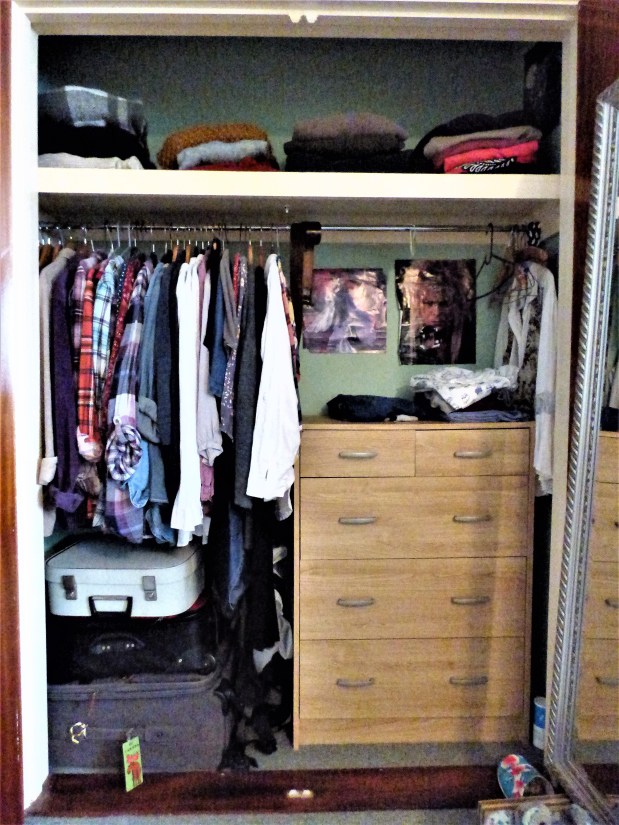
My current closet for autumn, and yes, there is a picture of David Bowie as the Goblin King in there. Keep the magic alive.

Items that you don’t love, that don’t fit, that you haven’t worn since the last season it suited, give it away to charity. Then, with a much roomier closet now that you have gotten rid of extraneous wardrobe that no longer suits you, put your core items back in. Then consider the season that you are in. Autumn is here in the UK, and so I’ve pulled out my jumpers and long-sleeved tees. These seasonal items I keep in storage in a blanket box in the spare room, so that my closet isn’t overwhelmed with clothing I don’t wear because it is not in season. The shorts and summer shirts go into storage, and a few autumnal pieces come out. I do the same with winter and spring too: put away the items you love and know you will wear again next season, and get out what is appropriate. By doing so, you won’t have to shop for new clothes, but instead you are shopping your own wardrobe!

This is good for you, your bank balance and for the environment. Too often we can look at a closet or wardrobe that is full of clothing that is out of season, and the items that are relevant can get lost in the jumble. When I bring out my heavier winter clothing out of storage, it’s like falling in love all over again. Those cozy jumpers in the greys and darker colours just remind me of winter. In the spring, I get out my lighter shirts and bring colour back. In the summer, it’s all about practical wear, what I can wear while trekking about on the heathland and the coast, in practical gear that still reflects my own sense of style. And going into autumn – well, it’s my favourite season, so the basics are added to with those beautiful fall colours.

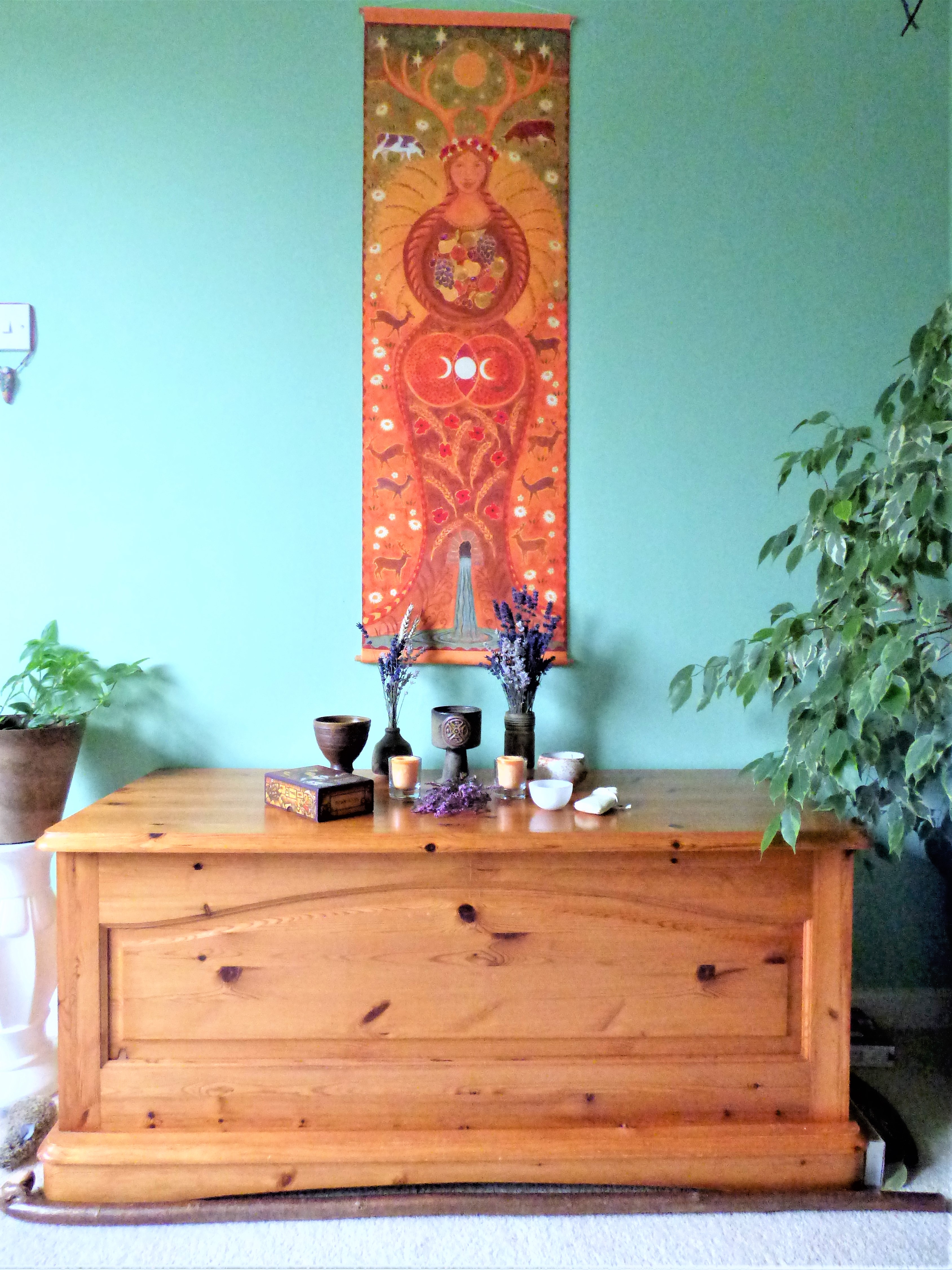
The blanket box where I keep my out of season clothing

This is a lagom way of dealing with your own wardrobe. You don’t have to go all Marie Kondo and minimalist to the extreme. What you are doing is finding the balance, where you can rotate your wardrobe and not spend a lot of money each season buying new clothing. As well, when you have a wardrobe that works together, you will find that when you are shopping for a new item, whether that is brand new or in a second-hand shop, you will take the time to really consider whether it works with the items you have. It’s all about using what you have, and not having too little, or too much.

And therein lies the lagom. You are not depriving yourself of clothing and creating a minimalist wardrobe of less than twenty items. You are finding your own style, rotating it according to the season, and falling in love once again with items that you haven’t seen for a year when you bring them out of storage. It’s a perfect system for me, where the anticipation of seeing the next season’s much-loved items coming out of storage brings me joy.

Storing your items is simple – like I said, I have a blanket box where I can keep the out of season items (coats included). If you have a spare room with a closet, you can keep items there. But don’t let it get away from you, remember the lagom rule: not too much, not too little, but just right. Don’t have a nice, uncluttered closet in your bedroom, and then an overflowing one in the guest room or in storage boxes under the stairs. Be specific, be discerning, and remember that each item of clothing that you re-wear, you are saving the planet just a little and also keeping your hard-earned cash in your own pocket.

If you would like to start looking at how to de-clutter, become more environmentally conscious and create a capsule wardrobe, there is a very good YouTuber in Denmark who creates wonderful videos to help you find your own style and system. Though the clothing brands she recommends every now and then are ethical brands, they are also priced sky-high, and so if you do need new items you can look for less expensive, good quality clothing brands such as H&M, who have their own brand of clothing made from recycled fibres and natural materials. Their Tencel fabric items are so soft and lovely, and I can highly recommend their denim shirts. As well, there are many H&M stores where you can drop off your old clothing, which they will recycle and give you vouchers off for your next purchase with them. If you would like some cash for your old clothes, this may be a hassle-free way to do it. And, of course, there are always charity shops!

Lagom is a way of life, of finding out where that balance point is for YOU. And that point changes with each person. Like milk in a cup of coffee, we each have our preference. But ask most Swedes, and they will usually say “lagom is best”.

Witches and Brooms – Sex Magic/Sexual Fantasy Or Something Far Greater?

Witches and Brooms – Sex Magic/Sexual Fantasy Or Something Far Greater?

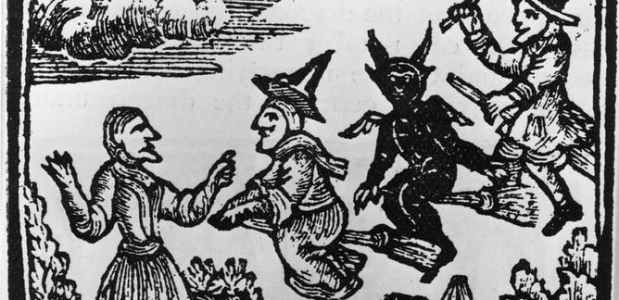
Over the years I’ve heard quite a few people equate the riding of the broom by a witch to a sexual experience. Often these folks state that the witch used a hallucinogenic ointment which was rubbed onto the broom, and then inserted in a sexual manner which made her think she was “flying”. I can tell you, there are a lot easier ways to get high.

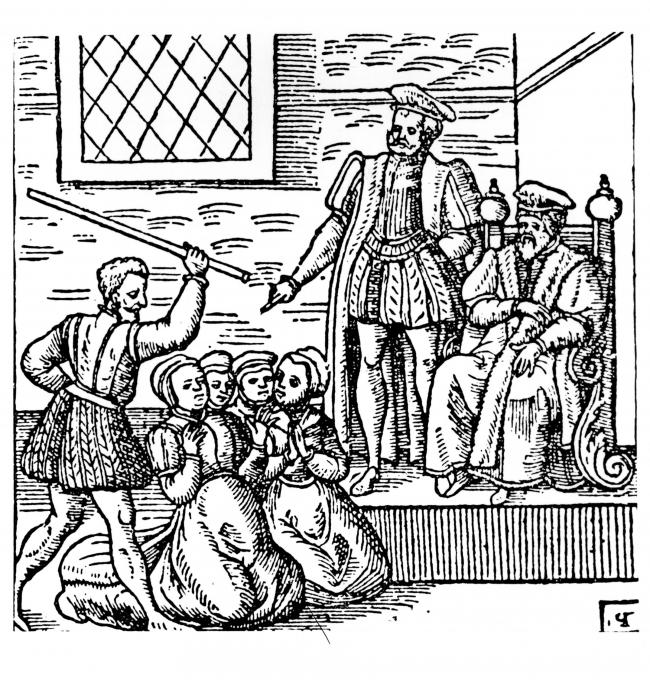
This theory comes from a few confessions extracted during the dreadful times of the witch hunts across Europe. What is often forgotten or purposefully left out is the fact that these so-called confessions were extracted under torture. Europe and Scotland had absolutely awful methods of torturing so-called witches to extract information from them, usually with questions led by the examiner to produce a consistent result among the captives. In England, torture was illegal, however, they still kept their victims awake and used sleep deprivation to get what they wanted, as well as having the person kept in one position for hours at a time without being able to move. That’s torture too.

If we are to believe that what was said under torture is factually correct, then we must also believe what else was said alongside this confession. We must believe that these people had sexual congress with goats, or the Devil himself. We must believe that these people suckled their familiars (animal helpers) with their own blood. We must believe a host of other outrageous stories that were created to instil fear and hatred, dividing a populace and creating a space where the old, the weak, the poor and the independent thinkers were targeted against the power of the Church and patriarchy.

It is my firm belief that the sexual imagery of the witch “riding” her broom is the result of the sexually repressed minds of the witch hunters themselves. It is only one of many sexual fantasies created by these men who were paid to bring people in for prosecution. This was their job, and they made money from it. You would have to be quite a horrible type of person to want to do this sort of job in the first place. Just saying.

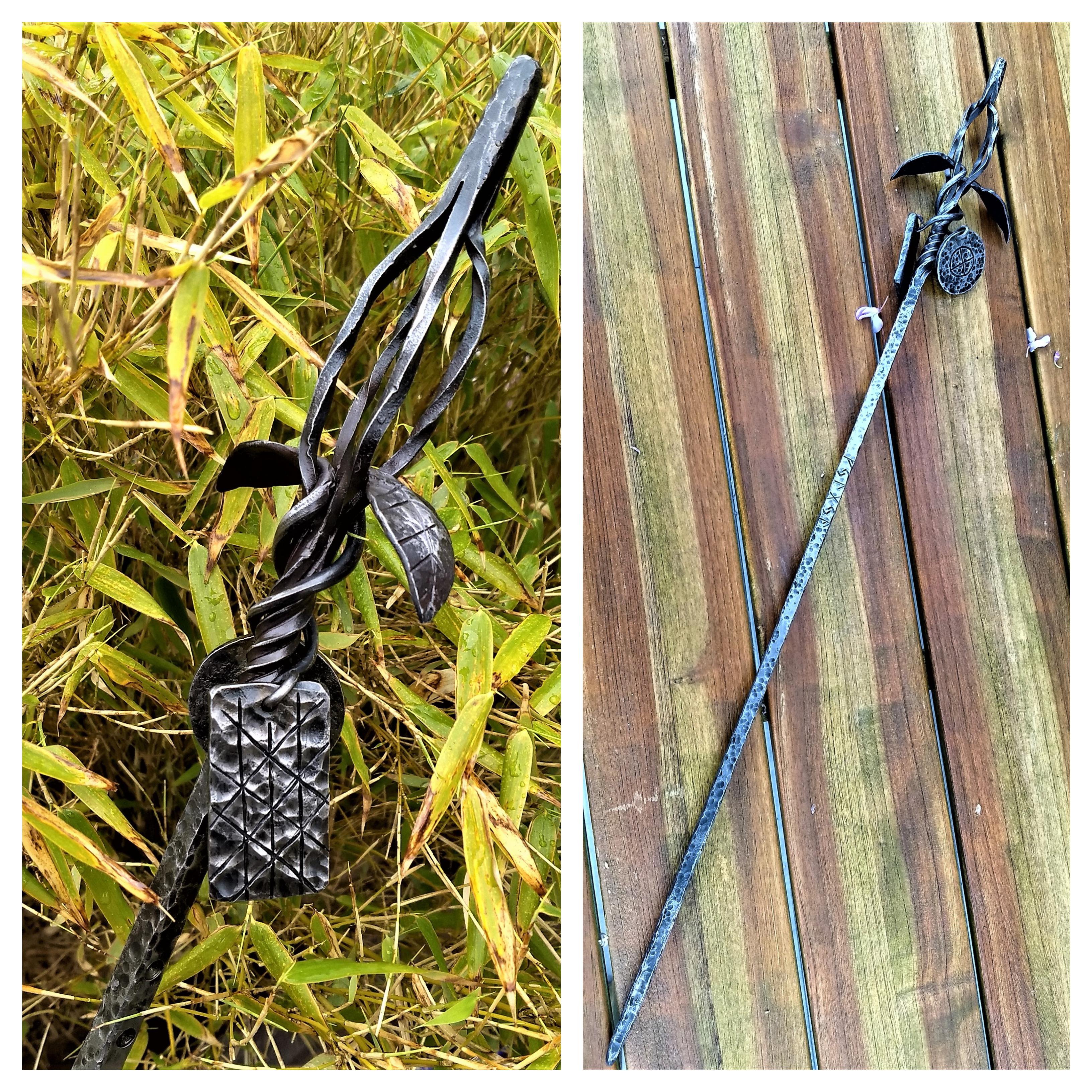
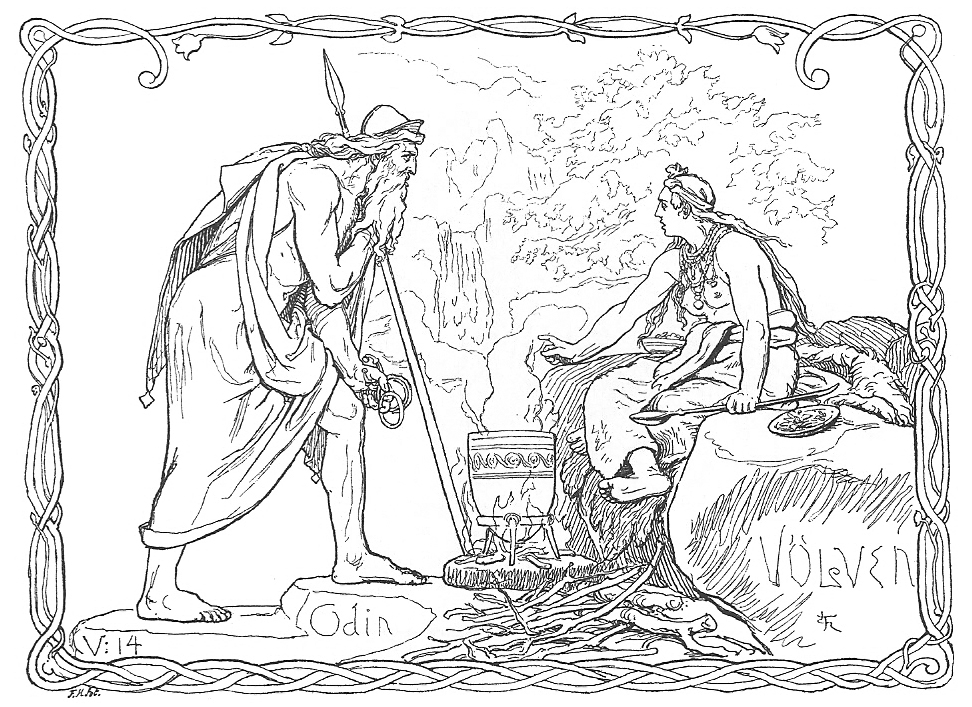
In fact, the witch riding her broom comes from a long heritage of witches working with staffs, stangs, wands and distaffs. We can trace this work in Europe back to the völva (plural völur), a type of Norse shamanistic practitioner of magic and divination. Völva actually means “staff carrier”. Usually a woman, she always had a staff, sometimes wood, sometimes an ornamental iron distaff. We know this from the many burials found across Scandinavia which have these women buried with the tools of their trade.

I’ve even heard some folks say that the practice of the völva was seen as shameful in Viking society. They use the sexual fantasy imagery and overlay it against the profession of the völva, claiming that this is what she did with her staff, like a witch riding her broom covered in the flying ointment. First, let’s look at the “shameful” aspect.

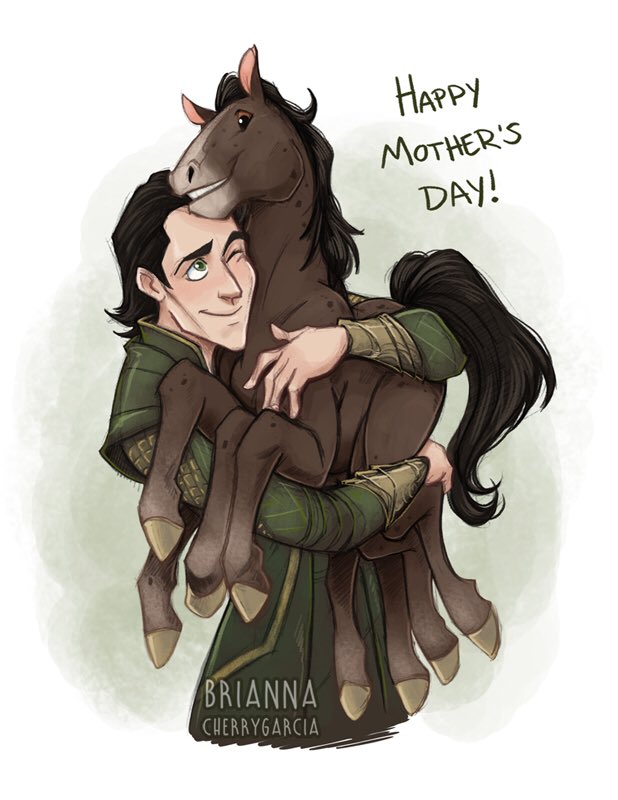
For women, it was not considered shameful to practice magic, except from a Christian point of view. For men to practice the magic of the völva, known as seidr, it was seen in Viking times as “ergi”, often translated as shameful. For a man to do women’s work was seen as unmanly, though we do have to remember that the sources from which we get this information were written after the Viking period by the patriarchal Christian monks. We also see women warriors, buried with their weapons, and so the question of men’s work and women’s work is even more circumspect. We see in the myths of the gods and goddesses a couple of the gods doing womanly things: Odin learns the art of seidr from the goddess Freya (he’s not seen as unmanly), Thor dresses up as a woman to get into a giant’s hall (still not unmanly) and Loki turns himself into a mare to have sex with another horse (still not called out as unmanly and actually producing Odin’s steed, Sleipnir, in the process).

(Artwork from: https://www.deviantart.com/briannacherrygarcia/gallery)

Add on top of that the fact that all the burials found of the women who are considered to be völur are high status burials, and the question of shame seems absurd. The Osberg ship burial, perhaps one of the most famous Viking ship burials, had the body of a völva laid to rest with with a host of beautiful treasures (what was left of them, for the burial had been broken into a long time before, with many of the goods stolen). No person who was considered shameful would be given such a send off.

The question of drugs does come into play when looking at the ancestors of the more modern-day version of the broom riding witch. Many of the burials were found to have pouches of hallucinogenic herbs on the body, such as henbane or cannabis seeds. These seeds, when thrown onto hot coals would produce a smoke that, when inhaled, would most definitely get you “high”, but not in the way that the sexual fantasy of the witch riding a broomstick would by the witch hunters. The clue is in the staff itself, and what it symbolises.

The word seidr is thought to derive from spinning or weaving. The völur were those who could see the way that fate was woven or spun through their contact with the spirit world. Their distaffs were their link to that ability. For those graves wherein a wooden staff was found, the link lies more with the World Tree that one can use to travel to the nine worlds in Norse cosmology. Through the staff there is a sympathetic link created with the World Tree, with Yggdrasil, and it can be used to “ride” between the worlds.

And this is where the descendant of the völur appears today, in the form of hedge riding, an aspect of Hedgewitchcraft. Riding the staff/stang/broom/whatever you have to hand that resembles the world tree helps you to travel between the worlds in order to find the information that you require in your Craft. Most Hedgewitches today do not use hallucinogens, being able to perform the working through trance states that are induced by other means.

So, in conclusion, the equating of broom riding and sex seems more like a far-fetched fantasy than the actual reality when we dig a little deeper into the history and the ancestry of witchcraft. That it is continuing to be spread today only helps to demean and undermine the power of women in working magic, turning something extremely symbolic and important into a sexually repressed fantasy created by the patriarchy. When a witch is riding her broom, or using her staff, stang or wand in ritual, the lineage is far greater than most people can ever assume, and is far more powerful than any witch hunter could ever dream of.

For a great video on the staff of the völva, see Freya’s video below: