
Well, I decided to get the drone out, regardless of the weather and the wind. I went into the forest, where there was some shelter, and thought I’d put into images what I wrote in my last blog post. So, enjoy!
wicca
The Deer’s Secret
The fallow deer stags have shed their antlers on the heath and in the forest in the last few weeks. As I found one atop a small rise next to ancient Celtic tumuli (burial mounds), dropped on the grassy tuft of a half sunken oak stump, I was gifted with this beautiful reminder that we all need to let go of certain things in our life.
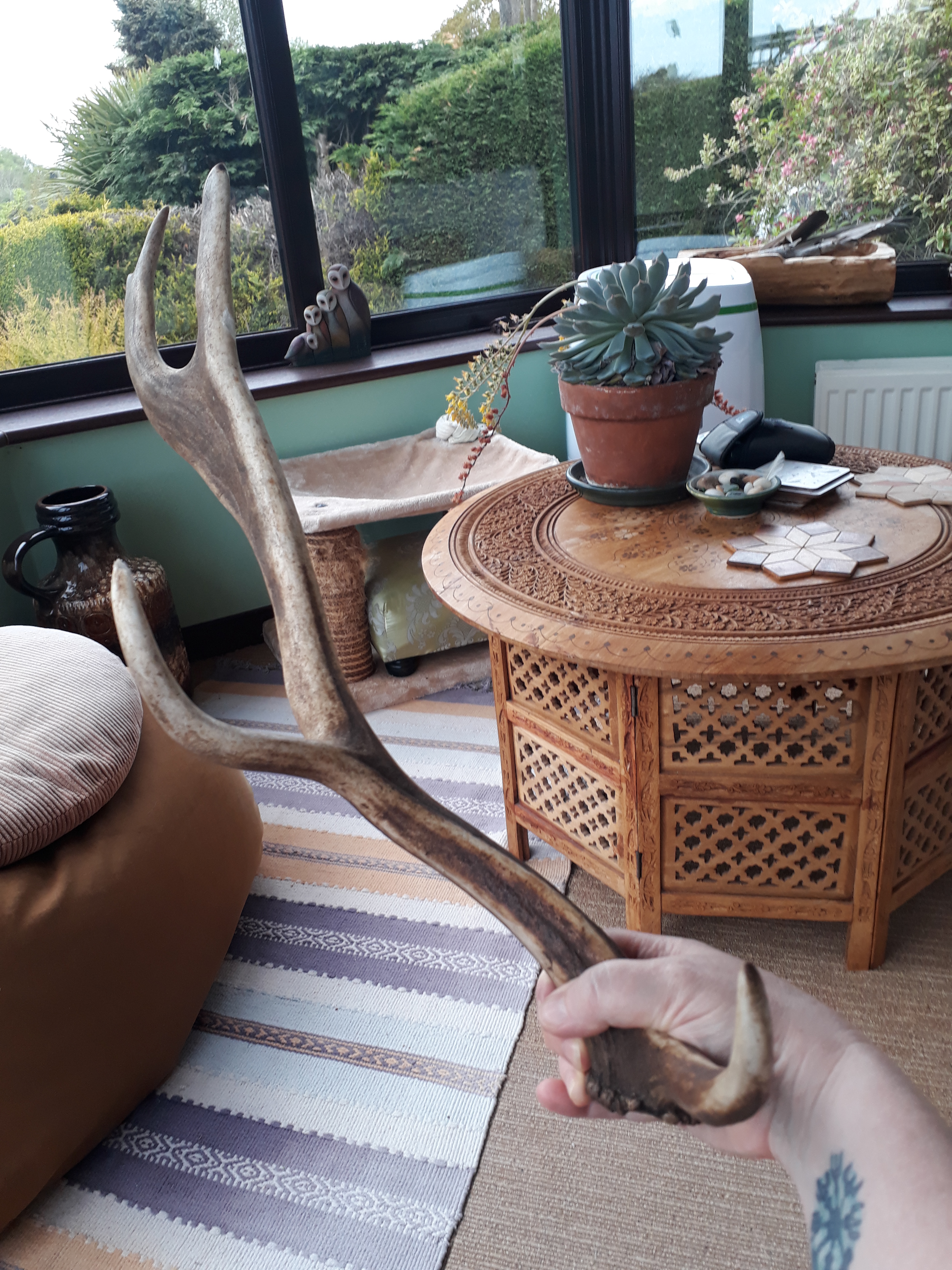
It can be hard to let go. Whether it is past experiences, trauma, emotions or loved ones, eventually we will have to let go at some point. If we don’t, we will hinder ourselves as we travel through life on our own personal journeys. Just as a deer must shed his antlers in order to grow new ones, so must we shed that which no longer serves us in our lives. If the deer doesn’t shed his antlers properly, fully and completely, complications arise when the new ones begin to form. When the time is right, the stag knows when to let go. Sometimes it is with a simple, gentle shake; other times the antlers need to be knocked off purposefully on low trees branches or stumps. Either way, the setting is created for new growth.
The stag’s antlers grow throughout the summer, enabling him to display them proudly come the autumn rut. When growing, the antlers are covered in a beautiful, soft velvet to protect them and allow for room to grow into the shapes destined for that year. When the antlers are full grown the velvet begins to fall off, and the deer helps this process by rubbing it on trees to shed the last of the strips and allow the antlers to fully dry out and harden in the early autumn sunshine. The older the deer, the more points on the antler appear. There are some majestic old King Stags on the heath, whose great strong necks hold up a crown that is almost impossible to imagine. These antlers will help fight off any challengers to the does that have chosen to be with a certain stag, and are both an aggressive and defensive means, one tool of many for the continuation of the herd. When the antlers are no longer needed they are shed, demonstrating the cycle of life, death and rebirth, and the need to let go of that which no longer serves.
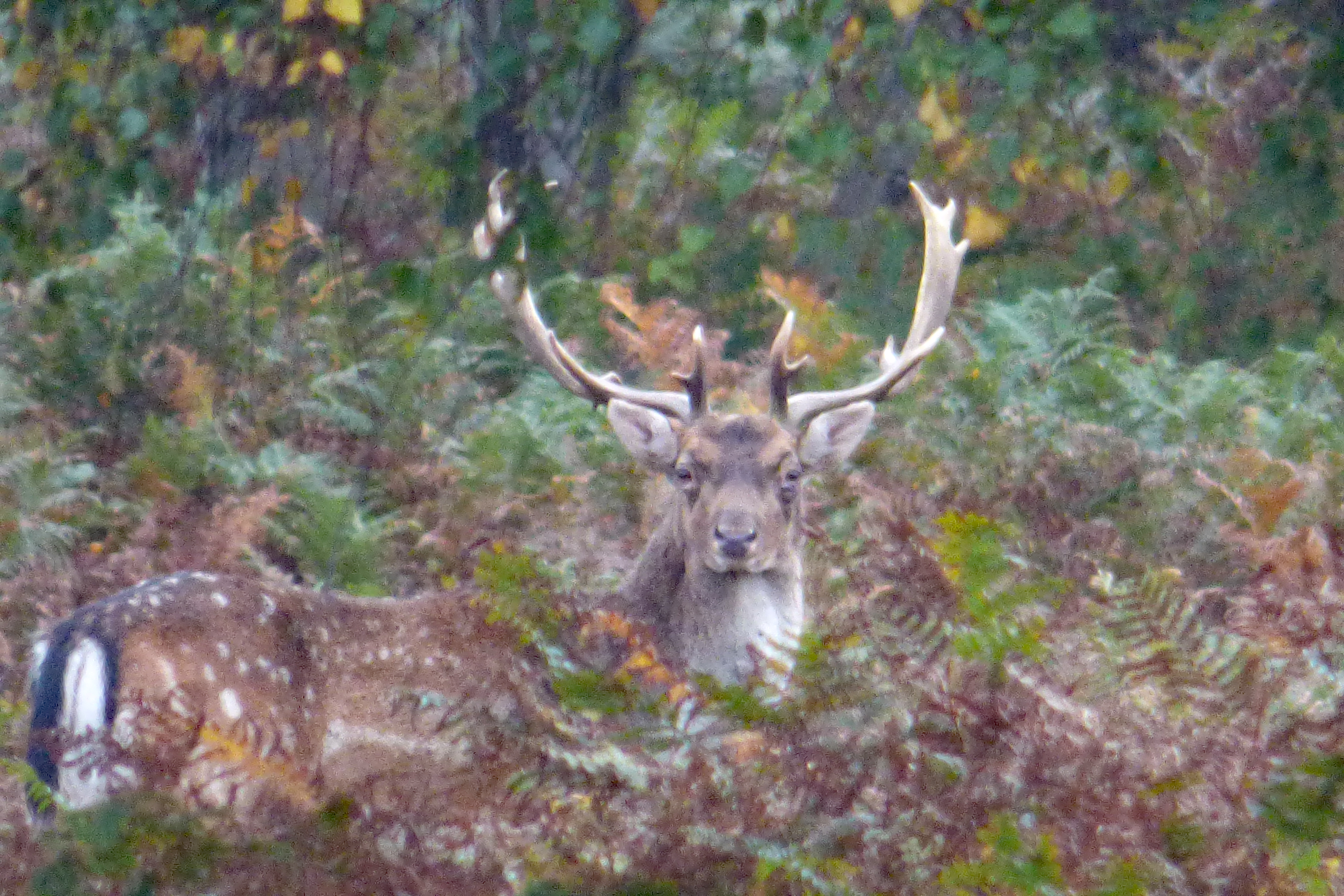
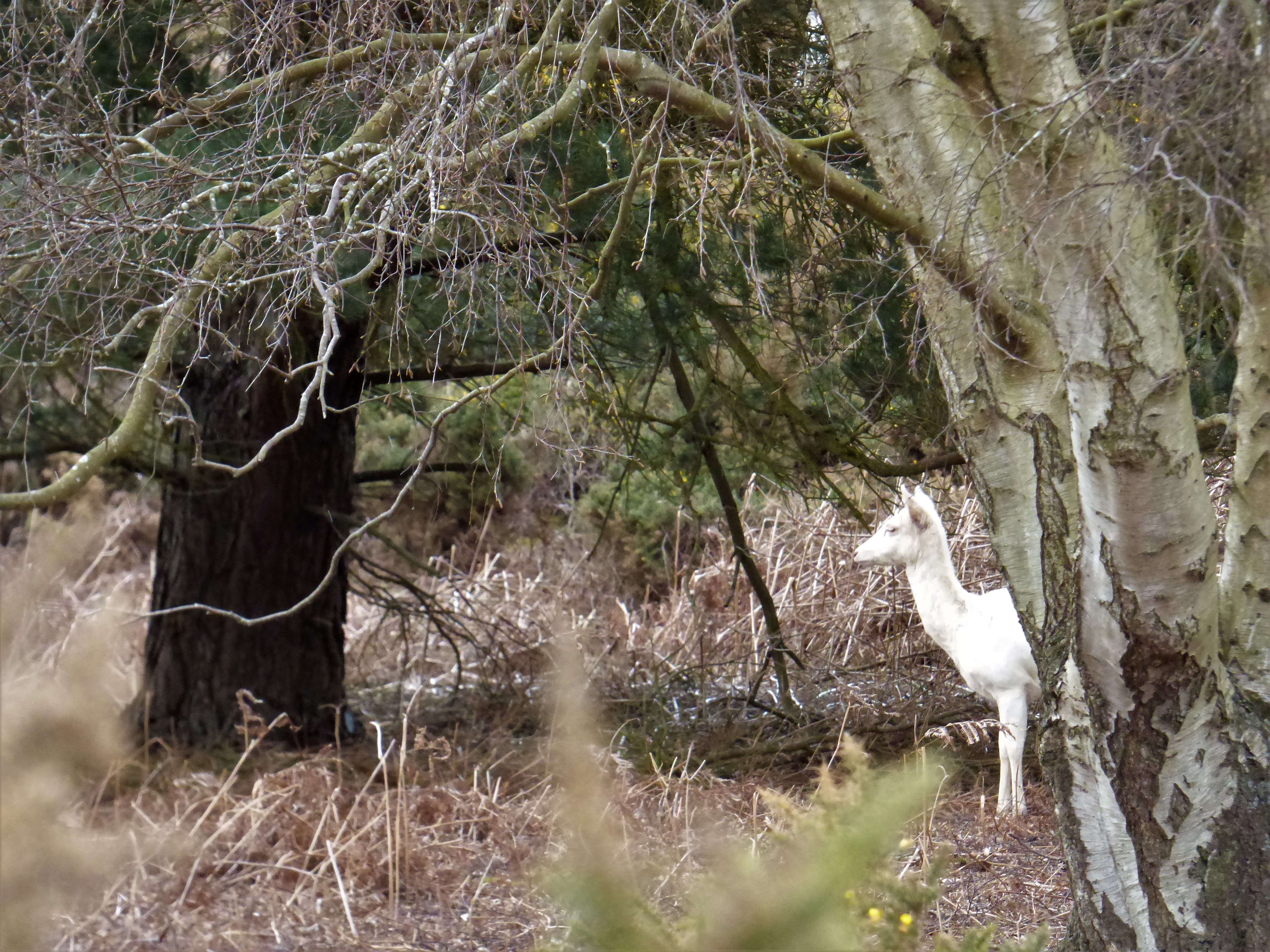
Though many in the Pagan community use the festival of Samhain to reflect on what no longer serves them in their lives, for me here living with the local deer community it is the month of May where I find this inspiration. Closely observing the deer, hauling buckets of water out onto the heath for them in the last two years as we have had so little rainfall, leaving offerings of seeds and song, I have established a relationship with them that is so beautiful and inspiring. They know me now, and I have watched as young prickets have matured into stags, and lead does hand over the power to a younger female as their reign over the herd comes to a natural close. I have spent an amazing three years with a white doe, always catching her watching me as I roam the heathland and knowing that she carries messages from the Otherworld in her spiritual capacity. Though she is now gone from us, her spirit lives on in the dappled light of the beech wood and the gentle breeze that blows the heather bells, ringing the faery bells in both this world and the Otherworld.
If we are unable to let go, we cannot move forward with health, vitality and authenticity. We will hinder our progress, sabotage our current situation and be mere shadows of who we could be. The deer remind us that letting go is not a one-time affair, but a process that happens again and again as we work our way through the spirals of life. Every year they must shed their antlers, this cyclic dance of the Antlered God reminding us of the process, and how to move through it.
Some of what holds us back are shadow aspects that no longer serve us in the present moment. While they may have been necessary coping mechanisms in their time, in this present moment they only stop us from being our true, authentic selves. We may have been hurt in the past, but that hurt lies in the past, and carrying it always into the present moment is a burdensome thing to bear. Instead, letting go again and again is the way to move forward, to develop the skills necessary to cope with what life is doing at this very moment in time. We must learn to shed that which no longer serves, and grow into our antlers of sovereignty. And when the time comes, we shed those antlers too.

The sword Excalibur that was given to King Arthur needed to be returned to the Lady of Lake upon Arthur’s death. We return that which no longer serves to the earth, to the waters of the subconscious, to the Otherworld and the Goddess in order for it to be transformed and wrought anew when the time is come. This cyclic myth may have been created through observation of the natural world, and the cycles of the flora and fauna that inspire Pagan mythology. We wield our swords of sovereignty, and then return the power to the land when the time is right, ready to forge anew what it is that we need in the next cycle, like a stag shedding his antlers and then growing anew.
As I look out over my laptop and out into the verdant green of the garden, the beech, ash and birch trees swaying in the light breeze, I am filled with the beauty and mystery of this earthly life and its cycles. We have come out of a long, difficult winter and now the summer is in full swing. The world has turned soft and lush, the bare branches of the trees now heavy and singing in full voice of the songs of summer. The blackbirds join in the song all day long, and the house martins beep beep overhead as they dive and glide to feed their young. That all important Mystery that lies at the heart of Pagan traditions is so abundant all around me, and I am so grateful for this journey. I know what it is that needs letting go, and I do it each and every day, until I find that I am no longer carrying it but have instead stored it away neatly on the shelves of life experience. I walk forward free, able to grow and be in my full, sovereign self.
Thanks to the Deer’s Secret.
Is Nature Indifferent to Us?
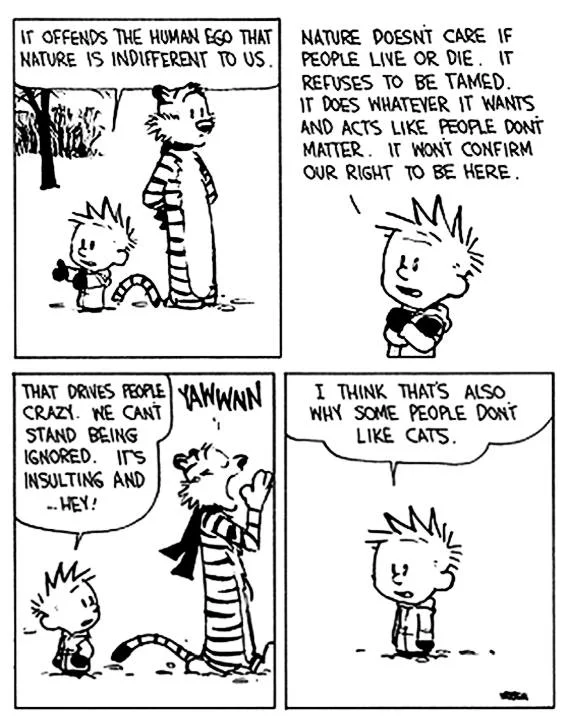
I love this Calvin and Hobbes cartoon, by Bill Watterson. It speaks to me on so many different levels, not least of all as a Mother of Cats. But it’s mostly the first part that I’ll be pondering over in this blog post today.
Is nature indifferent to us? Well, perhaps on the whole, yes. Nature could be indifferent to everything. The entirety of nature is such a vast concept, to me it’s like pondering deity, for in my own religious and spiritual view, nature is deity.
However, in my own personal practice, I feel that the gods are not indifferent to us, so where does that leave me with regards to the above? I’m just not sure. Could it be a paradox, that the deities care and don’t care at the same time? That would make them truly similar to cats…
It’s hard to come to terms with the darker aspects of nature, the pain and suffering that exists. Just yesterday there as a fox in the garden, and it looked like s/he had been hit by a car. One of their back legs wasn’t working, and there was definitely trauma to the back leg and hip. The fox had worried all the fur off of the back leg, hip and tail. It was taking respite from the wind in our garden, sheltered as it is by hedges. It also had a nice long drink from our pond.
After a while I went out to see just how badly it was injured. It couldn’t hear me above the wind, and I didn’t want to startle it so I called softly out to it. It turned its head and then quickly stood up. I gave it a quiet wave and it ran on its three legs back through the hole in the hedge and was gone.
I put some food out for it later that day, and will be doing so each night. I fear that the chances that this fox will survive are pretty slim, but at least it won’t die on an empty stomach.
I meditated that night on the suffering that goes on all around us, every second of every day. That poor fox was in lot of pain, but there was nothing I could do about it. Even had I called the Suffolk Wildlife Trust, chances are that by the time they got here the fox would be long gone anyway. I wondered at how such a thing could happen, could be “allowed” to happen to a beautiful creature as this fox. Tears flowed as I struggled with the suffering of so many lives right now.
People are in the hospital, wars are going on, wild animals are being hit by cars, the oceans and rivers are full of raw sewage and plastic – I could go on and on. It sure seems like the majority of humans today are indifferent to nature, so why shouldn’t nature be indifferent to us?
But nature hasn’t been indifferent to me. I have had wonderful experiences of true connection. I understand how we are all part of this one, great whole. I just wish that others could understand this, in order to save ourselves from our own self-destruction, and the widespread destruction of nature all around us.
But nature is also indifferent. The wind blows whether we like it or not. We have no say in earthquakes, sunshine or rain. Perhaps this is not indifference, but our own inability to see the bigger picture, the whole.
I am not offended by the seeming indifference nature has for us. Rather, I see it as an opportunity to show nature how much I really care. I aim to live in this world as best I can, with as much sympathy, empathy and compassion as I am able to give. I seek to be a contributing, functioning member of my own local ecosystem, and thereby a part of the wider world too.
Maybe nature really is like a cat. Sometimes it appears indifferent, and other times we can feel the genuine affection that it has for us, if only we are sensitive enough to feel it and open enough to accept it.
New Video: Spiritual Downtime
It’s okay to take a break 🙂
I have a new course: An Introduction to Freya
I am offering a new course! An Introduction to Freya: Goddess of Life, Sovereignty and Magic.
For more information, please visit my website at joannavanderhoeven.com.
If you are interested, please email me at vanderhoevenjoanna@gmail.com.

The Audiobook is Here!
The new audiobook (the first version didn’t meet the criteria) of The Path of the Hedge Witch is now available on Audible! I am so very pleased with the narration by Coleen Marlo. And the cover even has a cat on it. Purrrfect!

New Interview!
Last week I was interviewed by Pagan for my new book, the Path of the Hedgewitch. The podcast is now available, so please go on and have a listen, and check out all the other great stuff on there too!
New Year, New Video!
New Video: The Longest Night
Enjoy! Happy holidays to you all, and all the best for the new year. xoxo
The Runes: Rād
In this blog series , we will go through the runes as they are recorded in the Anglo-Saxon or Old English Rune Poem.
The fifth rune, Rād or Raidho as it is commonly known, means “riding” and is mainly concerned with travel and roads, pathways and suchlike, but has lots of other lovely aspects to it such as partnership, co-operation, and sometimes even good luck. In the Old English Rune poem, Rād is defined thus:
“Riding is for every man in the hall
Easy, and strenuous for him who sits upon
A powerful horse along the long paths.”

As someone who has worked with horses for many years, I can see the truth is this kenning quite clearly from a literal viewpoint. When we have a powerful horse beneath us, we need to learn how to work in co-operation with its own power, instead of trying to overpower it ourselves. Horses work best with us if we use a “power-with” model, instead of a “power-over” model, especially when working with dominant or lead mares. If you are fighting against the horse’s own power (and it’s way bigger and stronger than you) and are on a long road, then you will be exhausted by the end of it. Instead, learn to work with the horse’s energy, a blending with your own and form a true relationship, one of reciprocity, of give and take. You’ll get where you need to go in life a lot easier that way.
This rune also makes you consider your “seat”, or how you sit in the saddle. You have to work with the horse, and your seat is just as important as the reins. How you sit will greatly influence the horse, as it can feel the slightest movements in your weight, legs, hips, even the turning of your head. Many people think that riding is all about the reins, but first and foremost, it’s about your seat. If you weight is too far forward or too far backward, for instance, it will impair what you and the horse are trying to achieve. So Rād/Raidho is a good reminder to be mindful of how you are in the world, in order to move through it better.
Pollington suggests that this rune may have been used as a good luck charm for travel.[1] If you are planning a journey, or wish to go on one, using this rune could be very beneficial. The shape of the rune even suggests travel, as the rough outline looks like the head and neck of a horse. As stated above, it could also mean power, and even wealth, for horses have always been expensive to keep. Don’t forget that not all travels occur in this world – this rune could symbolise travelling between the worlds too.
Even the deities used horses – Odin has his eight-legged Sleipnir, and the wains of the Sun and Moon are drawn by horses. There is a beautiful Bronze Age solar chariot in Trundholm, Denmark, with a very lifelike representation of a horse (strangely, on wheels) which may symbolise the turning of the year.
Rād is to work with a powerful ally. Use it in your travels, both in this world and the Otherworld. Be mindful of your seat, and work in co-operation. Rād is not only the means of travel, but the road itself.
Sources:
Albertsson, A. Wyrdworking: the Path of a Saxon Sorcerer, Llewellyn (2011)
Gundarsson, K. Teutonic Magic: A Guide to Germanic Divination, Lore and Magic, Thoth Publications (2007)
Pollington, S. Rudiments of Runelore, Anglo-Saxon Books (2011)
Rance, S. The English Runes: Secrets of Magic, Spells and Divination, Dragon House (2017)
Waggoner, B. A Pocket Guide to Runes, The Troth (2019)
[1] Pollington, S. Rudiments of Runelore, Anglo-Saxon Books (2011)
 Down the Forest Path