Reblog: A Full Moon of Samhain Ritual

Here’s what happened on the full moon of Samhain this year 🙂  To read the original blog post, visit my channel at SageWoman for Witches and Pagans, at PaganSquare.

The candles were lit, the incense smoking, and the bells of the church ringing in the still night air. Friday night is the practice night for the village bell-ringers, and so our ritual was accentuated by their skilful tones. The moon was riding high in a hazy sky, and haloed with an ever-widening ring that spoke of the Otherworld.

We raised our boundary, which was to the whole of the property, and called to the realms of Land, Sea and Sky. We honoured the ancestors at the full moon of Samhain, as well as the spirits of place. We invited the Fair Folk who were in tune with our intention, as they have been a part of our rituals since we began. We sang to the four quarters, and then invoked the gods. We invited all who were harmony with us this Samhain night. This was our first time in invoking the god into our full moon ritual, but it felt right. How right, we were just about to discover.

We honoured the tides of Samhain, the winter months of darkness. We then performed our magical working at the fire, and gathering our clooties: ribbons of intention that we tie to the branches of the apple tree at the bottom of the garden every month. Walking back to the terrace where the bird bath, now a sacred basin of water reflecting the moonlight, served as our vessel as we drew down the moon into the water. The church bells rang in time to our working, and stopped just as we finished. The air was utterly still.

Suddenly, a loud bark sounded from the other side of the hedge, down the track a little ways. A fallow deer stag, wandering the moonlit night. We stopped and turned to the noise, and he barked again, this time a little closer. We looked to each other and smiled, feeling blessed by his presence. Then an enormous bark, just the other side of the cedar boundary, which made us all jump. He was right up against the hedge, near the little hole that the muntjac, fallow deer and badgers made.

And he was trying to come through.

We could hear him brushing against the hedge, wanted to come through the doorway, but his antlers preventing him from doing so. The firelight made the area where the entrance lay shadowed from our sight. Our breath quickening, we looked at each other. The God was here, and he was making himself known. He paced along the back boundary, trying to come through first one hole in one corner, and then the other. He then returned to the middle of the hedge, where the boundary between the civilised and the wild lay, that doorway to the Otherworld that lay in the hedge, and pawed the ground, sniffing the night air, sniffing the scent of the three women gathered around the sacred pool. Gathered around the sacred pool, with hearts beating loudly in their breast.

“A blessing to you, God of Samhain, Lord of the Wildwood. May your journey into darkness be blessed, and we are honoured by your presence,” I whispered softly into the night, tears falling down my cheek.

We heard him still sniffing, and we felt his eyes upon us. The world stood still, and we hardly dared to breathe. Would he change his shape and come through? What would we do if that happened? A hush descended, and we no longer heard him just the other side of the hedge. With hands slightly shaking, we dipped our clooties into the water and walked down to the apple tree, right where he had been sniffing just the other side. As we walked, we sang to let him know we were approaching. “Deep into the earth I go, deep into the earth I go. Hold my hand, brother; hold my hand. Hold my hand, sister; hold my hand”. We bravely tied our ribbons to the branches, knowing that the God stood only a few feet away from us. Stepping back, we finished the chant, and bowed to the apple tree and hedge, bathed in the soft moonlight. Silence reigned. We knew he was no longer there, and we didn’t hear him leave. He simply disappeared through the veil between the worlds.

We made our offering, and gazed into the mirror at the fairy portal shrine I made under the beech tree. We saw things: bonfires on the hills of Tlachtga, owl-faced warriors, deep caverns beneath the earth, the land of the sidhe, and the Mari Lwyd. We circled the fire clockwise three times for blessings, and then ended our rite, breathless and filled with wonder.

May the Lord of the Wildwood bless you all this season, may you find nourishment in the darkness of winter.

© Joanna van der Hoeven 2017
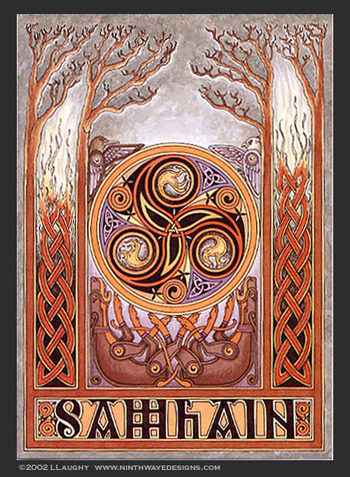
Samhain: Ancient and Modern

Here’s a taster of a blog that I put up yesterday for SageWoman’s channel at PaganSquare. To read the full post, click HERE.

samhain 1Calan Gaeaf (Welsh) or Samhain (Irish) begins at sunset of 31st October and runs to to sunset 1st November according to most Western Pagan traditions. If working by the moon, it is the first full moon when the sun is in Scorpio. If working by the natural landscape, it is when the first frosts bite. Samhain was termed the Celtic New Year, as it marked the ending of one cycle and the beginning of another. The Celts reckoned their days from sunset to sunset, and so the start of the year would begin in the dark time at the beginning of winter. Samhain marked the first day of Winter.
Calan Gaeaf, however, is a time that is not a time, and therefore some Pagans honour this tide and season from 31st October right through to the Winter Solstice. It is a time after many things have died, and there is a stillness to the air, an Otherworldly feel in the silence. It’s a dark time here in the UK, with long nights on our northerly latitude, and usually a very wet time as well. It’s not hard to see how these months could be seen outside of time, outside of the cycles of life, death and rebirth.

Calan Gaeaf, Samhain, Hallowe’en, All Soul’s Night – for many pagans this is the ending of one year and the beginning of another. It is often seen as the third and final harvest – with the last of the apples harvested, the cattle were prepared for winter and the grain stored properly. It is also a time when it is said that the veil between the worlds is thin, and the realms of the living and the dead are laid bare to each other. We are approaching the darkest time of the year, and the killing frosts and snows await just around the corner. It is a time of letting go, of releasing into the dark half of the year, and getting rid of the dross in our lives so that we do not have to carry them with us through the long winter nights. We consciously make the effort to live better, meaningful lives and let go of all that holds us back – our fears and worries, our anger and hatred. We nurture the beneficial and the good that we have in our lives, ensuring that they are well kept for our plans to come at the winter solstice. So the cycle continues.  READ MORE…

Respect and Conduct at Public Sacred Sites

When visiting a sacred site, we can get carried away. We can often forget that at public sacred sites there are others there who are on their own quest, pilgrimage, whatever. We want to rush in, to do the work, to perform ritual, to connect, to sing, chant and celebrate. But we have to think more carefully about shared space.

I recently went to the White Spring with my Druid College Year 3 apprentices. I adore the White Spring; it’s such a lovely site. However, after about 15 minutes various people and groups piled in to temple, and the words “Pagan Circus” comes to mind…

At one point, we had some Druids chanting the awen softly one corner. Lovely. But then another woman began singing in another corner. In a third corner, a man was standing and singing at the top of his lungs (which in that space is really, really loud). Trying to get away from all this noise, I made my way the quietest part of the Mirror Pool in the middle of the temple. I gazed into the water, slowly collecting my thoughts and meditating upon the sacred water, when suddenly three women, two naked and one clothed, clambered into the Mirror Pool, stood in the middle of it and held hands, performing some sort of ritual between themselves. Needless to say, my meditation was, by then, a hopeless cause.

We have so little opportunity to be who we are, especially at such sacred sites as the White Spring. But we also have to bear in mind that this is a public space. There are other Pagans there who are attempting to commune with the energies, the gods and goddesses, the spirits of place, and who don’t need others crashing in on their precious few minutes in that area. These sites are not a Pagan free-for-all. We must respect others and the place. You would never see a group of monks from an abbey in the south of France rock up to Ely Cathedral and suddenly perform Mass, or chant their evensong while the resident monks and visitors alike are doing their thing. We have to bear this in mind, that other people’s experiences are just as important and valid as our own.

And it’s not just Pagans visiting these spaces. The White Spring is open to everyone, from groups of nuns visiting from Spain to families from Yorkshire on a weekend getaway. There are very practical things we need to bear in mind at such places. For one, it’s still illegal to be naked in a public space. For another, not everyone wants to see naked people, for various reasons. Imagine the Catholic nun trying to connect with St Brigid, and then having a group of naked priestesses splashing her habit as they clamber in and out of the sacred pool (there is, indeed, a separate plunge pool for people to dip in, should they wish!). Imagine a primary school teacher asking the young girl what she did on the weekend, and her reply was “Daddy and I went to visit a spring, and watched naked ladies.”

Many of these sacred sites have special out of hours timings for those who wish to hold private ritual. Both Chalice Well and the White Spring offer this, and it should be borne in mind by those who wish to hold ritual at these sites. That way, you won’t be intruding on anyone’s time spent at these sites, or offend anyone who’s beliefs are not your own. It requires advance planning and commitment, but it’s not that hard. I’ve done it myself, and had private time at the White Spring to plunge my naked self in the icy waters with a couple of friends, or visited the Red Spring after closing hours.

Let’s bear in mind other people’s experiences, which are just as valid as our own. Let’s not turn our sacred sites into spaces of competing rituals and rites all happening at the same time. Let’s honour the sacredness of the site, and remember that it’s not just there for us. The energy of these spaces is not only for our own spiritual nourishment. We take, take, take all the time. Receive healing, inspiration and more at these sites, by all means. But remember to give back, by respecting the site, and other people visiting it.

Make it an enjoyable and memorable experience for all.

A very early teaser…

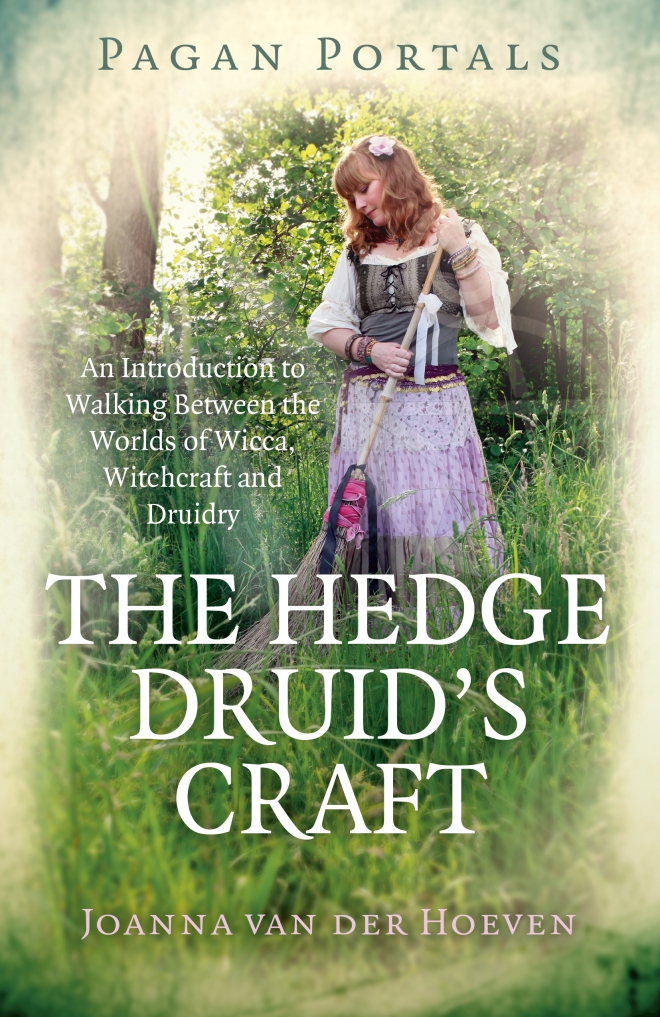
So, here’s a little teaser about the work that I did a couple of months ago, when the gods decided to sit me down quite literally and make this book happen. This book will not be available until 29 June 2018 through Moon Books, but I just thought I’d leave this here…  🙂

Cover high res

Endorsement by Mabh Savage, author of A Modern Celt and Celtic Witchcraft:

“This book is an absolute must for anyone seeking to deepen their magical nature or set out upon a path to connect with the world around them. Jo is incredibly inclusive and covers aspects of witchcraft, Wicca and druidism interspersed with an alamanac-style folklore juxtaposed against modern science and a common-sense realism about the modern world we find ourselves in. As a witch on an eclectic path, and a trainee Bard, many of Jo’s words and experiences really resonated with me. Like Jo, I have always been a witch, but appreciate this can mean different things to different people, and I also have found that some Druidic paths can at first appear dry and academic, but with this volume you can sink your toes into the earth and reach high into the sky to touch the stars; to feel what being a Hedge-Druid can really mean; how it can change your world. Jo works with herbs, plants and animals, examining all types of creature, from what we might consider the lowest, such as insects and invertebrates, to the magnificent mammals such as stags and horses. She reminds us that each has a vital place in the world, and in its eco-system, and even shows us how we might go about finding our own animal ally. As well as the earthly beings we can connect to, Jo teaches us how to connect to the celestial beings; the sun, moon and stars, and the aspects of our earth that they control, such as the tides and the seasons. Jo speaks to us of the inherent goodness in some people; how we can look past the horrors that some humans have brought upon the world and see the hard work of those (including many druids and those on similar paths) who are trying to fix the damage and repair the connection between humans and nature. Jo reminds us that we can fill each day with ‘the magical and the mystical’, and gives us the tools and knowledge to create our own deeper understanding of this truly wondrous world we live in.”

The birds have gone…

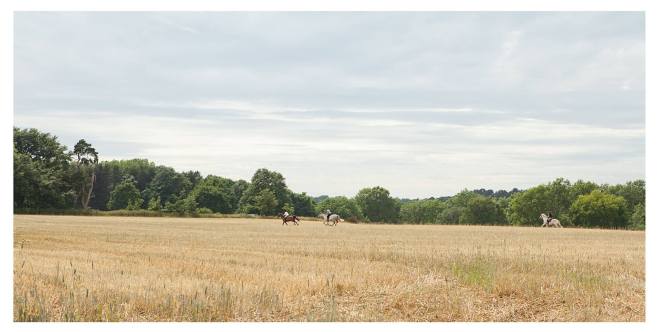
It is a melancholy time of year. Most of the fields are now lying still, shorn and with the stubbly remains jutting defiantly into the last of the summer sunshine. The house martins departed over the weekend; I had spent much of last week watching the elders teach the young ones how to glide and ride the air currents in preparation for their long trek to their winter homes. The sky is so silent and still without them, and there is a small space in my heart that is sad to have said goodbye to them. Good luck on your journey, little ones. May you be as safe as can be, and I hope to see you again next summer, when you herald in the start of the season of warmth and sunlight once again, alongside the calls of the cuckoo.

The full moon makes sleep difficult; dreams are seemingly random and exhausting, and will only have meaning when the actual events happen. My skills in divination and the sight are through dreams more than anything, but right now I’m so tired that I’ll be lucky to remember anything upon waking. It’s only in the actual doing or being somewhere that I’ll remember that I dreamt it, like on Saturday when I signed a new contract, and remembered writing an email with a query regarding it. In the dream, I had no idea who I was writing to or why; now it all makes perfect sense.

It is a time when we are seeing the fruits of our labour. But it is also a time when we cannot yet rest or lay down our tools, for there is still much to be done. There are many other harvests that await. I have had a good crop of raspberries this summer, and another one on the way. The first apple harvest was abundant, and the second looks to be even better from my three little trees. I have just released my seventh book, with another written and in production, and a whole new one to work on. Druid College’s next Year 1 session begins in October, but we have our first session of our Year 3 apprentices beforehand to journey with on pilgrimage to Glastonbury in September. There is still much to be done.

The leaves are beginning to change, and a soft sadness tinged with relief lies within my breast. It feels like I’ve cried a long time, and am releasing that juddery sigh that often follows a good sob. New things await, but the old ones are being put to bed first. Everything in its own time. Nature does not hurry, and yet everything gets done.

So this evening I will be honouring the full moon and the Lammastide, with ritual in the company of a couple of lovely ladies. As the combine harvesters grumble relentlessly in the background, we shall sing to the moon, and share in the bounty that we have received with the spirits of place, the ancestors and the gods. Bread that I will bake this afternoon will be our offering, as well as words and vows of the work to come.

The times of sadness and stillness are required, just as the times of light and laughter. For we cannot have one without the other. They are not opposites, but simply on different places in the spectrum of human emotion. We ride the currents in keeping with the tides and seasons, and work towards integration and harmony.

May we be the awen.

6

If you’ve enjoyed reading this blog post, or any others on this site, please consider contributing towards the future of Down the Forest Path with a £10 donation for a year’s support of the work. You can donate by clicking HERE.

Blessings of the First Harvest

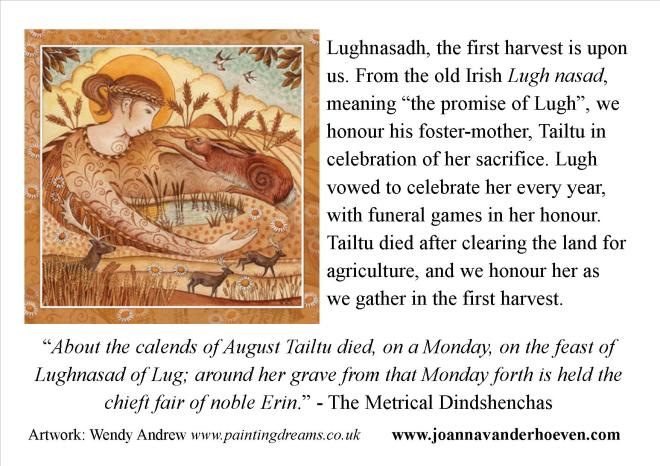
As Lugh pledged to honour his foster-mother, Tailtu with games in her honour every year, what pledge will you make to the land? Let this vow strengthen your resolve through the cycles of the seasons. Lammas/Lughnasadh blessings to you all. x

Lughnasadh

Reblog: Lughnasadh and the State of Grace

Here is a reblog of my post on SageWoman’s channel at Pagan Square. Blessings of the first harvest to you all! (To see the full original post, click HERE.)

_MG_9378 Lughnasadh is upon us, and the farmers are anxiously looking to the skies for a few clear hours when they can harvest their crops of wheat in my area. It has been a hot, dry summer, and of course, just when the harvest is due to come in we get changeable weather with rain showers every day; not ideal when you need to gather in a crop like wheat totally dry, or else it will rot. So just like our ancestors, we look up and hope and pray for some dry weather, and for the farmers, that they’ve rented the combine harvesters on the best day for it, and not when it’s going to dump it down halfway through their work.

Things are unpredictable in life. It’s just something that we have to accept. With a little grace, we can face the problems and triumphs, the highs and the lows with equanimity. Grace is a word that is little used today, but one which I think is important, and one that I’ve been trying to live each and every day.

It’s not easy, to live with grace. Acceptance does not come easily when things don’t go your way, or when people don’t behave the way you think they should, or the weather turns unexpectedly, or you suddenly find out that you need a root canal, but hey, that’s a good thing, at least they can save the tooth and not have to extract it. (Yes, I’m undergoing quite a bit of dentistry this past month, having cracked a tooth at Gatwick airport on my way to a three-week visit to my family in Canada last month. Not ideal.)

So how do we deal with life’s upsets with grace? By being open to change, to what comes, and not to dwell too much on how we think things should be. Because however much we think we know what’s best, or that we have total control over a situation, the simple fact is that we just don’t; we are viewing life through a single lens of perception, and we have absolutely no control over external influences in our lives. Living as we do alongside myriad other beings, we have some control (I would hope) over ourselves and our reactions and intentions, but very little when it comes to others. And this is a good thing.

Grace is all about working with the concept of freedom and acceptance.

People are free to do what they will, so long as they are not breaking laws or harming others. Live and let live. We as individuals fall into that category, and when we can allow others to be themselves, whether they’re rude and obnoxious, lovely and charming, or everything in between then we are living with grace. We focus on our own self, but without becoming self-obsessed. We are awake and aware to all aspects of ourselves, from the light and the shadow, from the conscious and what lies hidden beneath layers and layers of past experience and trauma.

Grace is often equated with beauty and elegance of form, and when we decide to allow life to happen as it happens, we find that we actually do move through it with less struggle, with less flailing. That doesn’t mean that we will suffer any less, but that we deal with the suffering and the struggle in a manner that is calm, peaceful and accepting. This isn’t easy to do in the slightest. It takes a lot of practice, and is not something that happens overnight. Grace is also synonymous with favour, and we may just find that when we are more accepting of what life throws our way, our luck may change, or at least our perception of it, and we are able to move through the currents with more ease. We are going with the flow of the tide, not against it.

So this harvest season, I am going to remind myself (often) of that single word: grace. When I am flailing, when I am struggling, when I am angry or upset, when I am in the dentist’s chair again next week, I am going to stop, take a moment, see the beauty, feel the pain, and accept. And then I am going to work if I can to change it, and if I can’t then so be it. Just as the wheat in the field awaits a dry, sunny day for harvesting, so too can I work with patience and the tides and times of life, for nature is not in any hurry, and yet all things get done.

Honouring the Storm

Right now, video is coming easier to me than words…

Blessings of the Summer Solstice!

Here’s a little video from my morning at the beach 🙂


Book reviews: *A Legacy of Druids* and *Fairycraft*

A-Legacy-of-Druids-coverA Legacy of Druids by Ellen Evert Hopman is a capsule held in time, with interviews by Druids from all over the world that were taken twenty years ago. It is interesting to hear their stories, especially from those people I know now, and whose perceptions have changed with the passage of time.

It’s not a book on how to be a Druid, but rather a conversation with an entire room full of them. You get to “work the room” so to speak in this volume, finding so many different personalities, histories and visions for the future. The foreward by Philip Carr-Gomm was perhaps the most interesting for me, and which coincided with my perception of Druidry as it is today. That this should be so is obvious; as a nature-based tradition, Druidry is always evolving, and here was have the proof that this is so.

Dynamics, schisms, traits, perspectives of different Druid traditions, with a lot of American vs British is reflected in the interviewees’ words. That these perceptions and their individual predictions for the future have changed over the last twenty years is, I think, a very good thing. With the popularity of the internet, dialogue has opened across vast oceans, with views being shared, references, academia, experiential gnosis and more. The divide between the two has lessened greatly, to the benefit of all.

Of course, I did not agree or resonate with the words of every Druid (or Druid friendly person) interviewed. Like being at a party, there are some people you want to hang out with and others that you don’t. But all of it is informative, in its raw, unedited state. You get real flavour of who that person was at that time, and what Druidry meant to them at that particular point in time.

A very interesting, and original work. I would love to see a modern version of this done, with as many of the same people in the original work, as well as new voices!

fairycraftI thoroughly enjoyed Morgan Daimler’s Fairycraft. This book is the follow-up to her Pagan Portals Fairy Witchcraft, and goes into deeper depth for this particular practice.

This book is extremely well-researched, and contains as well as a plethora of information, the author’s own experiences in the tradition. This down to earth practicality is what sets this book apart from others on the subject. It is divided into many sections, each with their own sub-section detailing the matter fully and capably. Not only do you learn fairy lore and customs, but this book also provides you with rituals and rites, prayers and holiday suggestions suited to one who wishes to honour or develop a deepening relationship with the fey, the sidhe, the gods and the ancestors.

Daimler’s writing is sincere and succinct, not overly flowery and not trying to impress, but rather expressing honestly what she has learned through her many years of experience in the tradition. I especially enjoyed the final portion of the book, entitled “Living Witchcraft”, for it gave me a deeper insight into the tradition and its practicalities, and also the author herself. I’ve enjoyed all of Daimler’s works, and look forward to reading more.